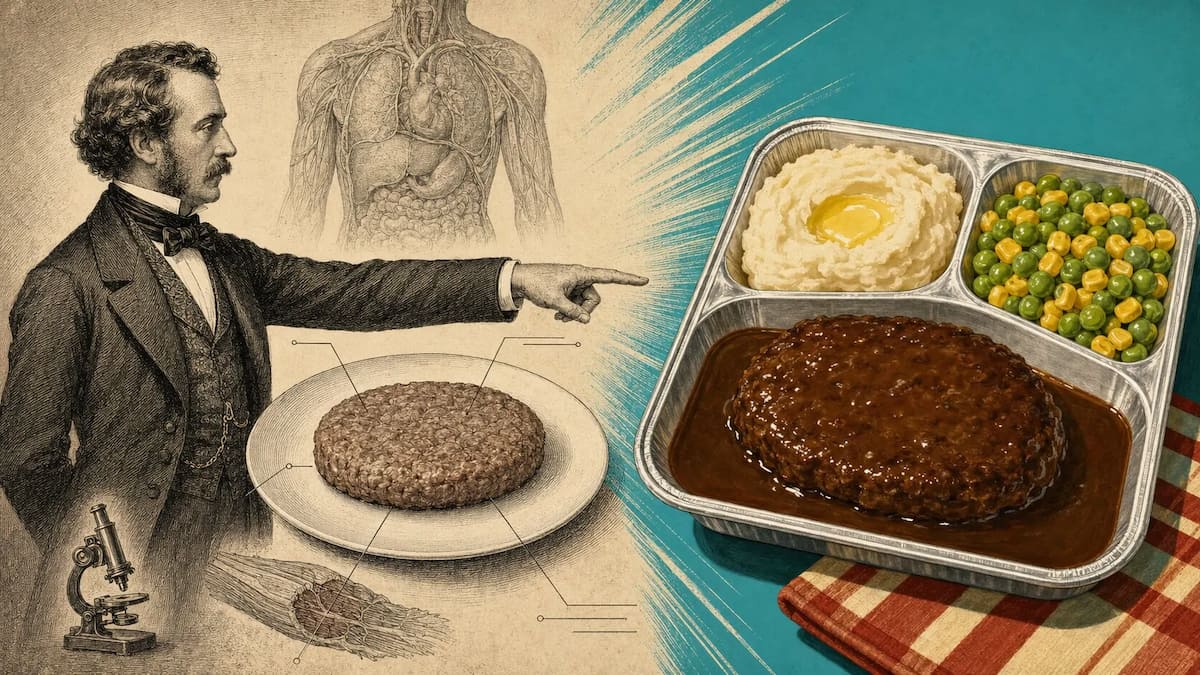
THERE MAY BE NO MEAL more completely at odds with the man whose name it carries than the Salisbury steak.
Consider its most familiar incarnation: an oblong patty of ground beef, soft enough to cut with the side of a fork, sitting in a shallow brown lake of gravy. Alongside it is a scoop of mashed potato, perhaps some peas and carrots or a yellow drift of corn. For many Americans, it arrived in a compartmentalised aluminium tray, one of those early frozen dinners in which the gravy had territorial ambitions and the vegetables tasted faintly of the freezer. It was cheap, filling, reassuring and eminently reheatable: less a steak than the comforting suggestion of one.
Dr James Henry Salisbury would have been appalled.
The potatoes, peas, corn and breadcrumbs were not harmless accompaniments in his view. They were the enemy. Salisbury believed starchy foods and vegetables fermented inside the body, producing poisons that caused an astonishing range of illnesses, from heart disease and tuberculosis to tumours and mental distress. Human teeth, he argued, were evidence that we had been designed to eat meat. In the dietary republic he imagined, beef was both food and medicine, while a serving of mash bordered on self-sabotage.
Yet this is how food history likes to behave. A severe 19th-century health cure, devised amid the digestive catastrophe of the American Civil War, eventually became a gravy-drenched monument to convenience culture. A doctor declared war on carbohydrates; posterity put his name on a TV dinner full of them.
The Doctor And The Beans
Salisbury was born in Scott, New York, in 1823, and trained as a physician after working as an assistant chemist for the New York Geological Survey. He was interested in the connections between food, the digestive system and disease at a time when germ theory was still taking shape. That curiosity might sound admirably modern. His methods were not.
In 1854, Salisbury decided to find out what would happen if he lived on baked beans alone. The answer arrived quickly. After three days, he described himself as “very flatulent and constipated”, with dizzy spells, ringing ears and prickling limbs. Mental work became impossible.
For most people, this would have constituted both a result and a warning. Salisbury treated it as the beginning of a research programme.
Two years later, he invited six “well and hearty men” to live in his home and subsist on baked beans and coffee. In another experiment, four men ate nothing but oatmeal porridge for 30 days. The trials produced dizziness, weakness, unsteady legs and an extraordinary quantity of gas. The men took long walks, apparently in an effort to distract themselves from the incessant rumbling of their own bodies.
It is difficult to read these accounts without picturing a solemn Victorian household scored by a symphony of flatulence: Salisbury taking notes while his boarders paced the grounds, each man trapped inside the consequences of breakfast.
The experiment was extreme enough to prove almost anything its author wished it to prove. A monotonous diet of one food had made the volunteers ill; Salisbury concluded that starchy and plant-based foods themselves were the problem. When he finally fed the oatmeal group a 10-ounce beefsteak dressed with butter, salt and pepper, their heads cleared and their stomachs settled. Beef had staged a dramatic entrance and, in Salisbury’s mind, won the argument.
From there, the conviction hardened. Lean meat was easy to digest, restorative and natural. Plants were suspect. The medical faith behind the Salisbury steak was born not in a kitchen but in a series of dietary ordeals.
Medicine In The Shape Of A Patty
The American Civil War gave Salisbury’s theory a much larger and grimmer testing ground.
Serving as a Union physician, he encountered armies being destroyed from within. Diarrhoea and dysentery killed far more soldiers than enemy fire. Camps crowded men together under dreadful sanitary conditions, while military rations did little to improve matters. One of the staples was hardtack, a dense square of flour and water baked for durability rather than pleasure. Its celebrated resemblance to a roof shingle was not entirely metaphorical.
To Salisbury, the culprit was obvious. This “amylaceous, army biscuit diet”, he believed, fermented in the stomach into “alcohol and acid yeasts”, poisoning an already vulnerable gut. His answer was radical elimination: coffee and beef.
Not just any beef, either. Salisbury’s “muscle pulp of beef” came with instructions of the sort that reveal a man for whom dinner was a clinical procedure.
The animal should be well-fattened and between four and six years old. Every trace of bone, tendon, fascia, connective tissue and what he called “glue tissue” had to be cut away. The remaining lean muscle was minced or chopped to break down the fibres, then shaped into cakes between half an inch and an inch thick.
There was, however, to be no brutal compacting. The meat should be pressed only firmly enough to hold together. Too much pressure, Salisbury warned, made it taste “livery”. Modern cooks will recognise the practical wisdom hiding inside the peculiar medical doctrine: overworked minced beef does indeed become dense, dry and chewy.
The cakes were broiled slowly over a smokeless, flameless fire. Despite the regimen’s austerity, Salisbury was not wholly indifferent to morale. Butter, salt and pepper were permitted, as were Worcestershire sauce, Halford sauce, mustard, horseradish and lemon juice. The prescription may have been strict, but it did not have to taste like punishment.
This early Salisbury steak was therefore neither a hamburger nor the gravy-softened patty we know now. It was carefully stripped lean beef, minimally handled and simply broiled: medicine that happened to be shaped like supper.
The Victorian Wellness Gospel
Long after the war, Salisbury turned his theory into a movement. In 1888, he published The Relation of Alimentation and Disease, the grand statement of his belief that most human misery began in the digestive tract and much of it could be expelled with meat and hot water.
The Salisbury Diet called for two to four pounds of lean beef a day, accompanied by three to five pints of hot water, for periods of four to 12 weeks. It was an early entry in a genre we now know very well: the totalising wellness regime that offers one villain, one cure and a convert’s radiant certainty.
The diet found its most energetic evangelist in Elma Stuart, an Englishwoman who said it had cured her after a decade of physical immobility. Stuart spread Salisbury’s gospel through What Must I Do to Get Well?, a book popular enough to pass through 32 editions. Under her influence, a battlefield ration became a transatlantic fad.
It is tempting to call the Salisbury Diet proto-carnivore, because its promises and prohibitions sound startlingly contemporary. But its deeper familiarity lies in its structure. Here was a doctor offering relief from complex illness through purification: remove the supposedly toxic foods, submit to the protocol, flush the body clean. Here, too, was the compelling testimonial, the grateful disciple whose recovery seemed to settle every remaining question.
The patty carried all of this with it. It was not merely meat. It was a theory of the human body, compressed into a cake and placed under the broiler.
How Hamburg Became Salisbury
The name, however, had another journey to make.
Minced-beef patties were already familiar as Hamburg steak, their title linking them to the German city. The term “Salisbury steak” was in American use by 1897, but the First World War gave it patriotic force. As anti-German sentiment swept through English-speaking countries, German names were scrubbed from menus and public speech. Hamburg steak became Salisbury steak; hamburgers were, for a time, rechristened “Liberty sandwiches”.
The US Army adopted the new vocabulary. A dish that had first been proposed as a remedy for sick soldiers was now being renamed for other soldiers, not because its composition had changed, but because language itself had entered the war.
The new name outlasted the fever that helped popularise it. “Liberty sandwich” faded, as these bursts of compulsory patriotism often do. Salisbury steak remained. It sounded respectable, vaguely scientific, perhaps even grander than the inexpensive minced beef beneath it.
By then, the dish had begun slipping free of its inventor. Names are excellent vessels for memory, but they are equally good at surviving after the memory has drained away.
A Steak Built For The Freezer
By the middle of the 20th century, few diners were approaching Salisbury steak as a treatment for intestinal fermentation. Its new virtues were economic and logistical. Ground beef was inexpensive, adaptable and easy to portion. A 1945 Cookbook of the U.S. Navy included a recipe designed to feed 100 people: Salisbury steak had completed its transition from individual prescription to institutional food.
Then came the frozen dinner.
Postwar convenience culture required dishes that could be produced in enormous quantities, frozen, transported, reheated and still emerge with some claim to pleasure. Salisbury steak was almost suspiciously well suited to the task. Like meatloaf and sloppy Joes, it was hearty and forgiving. Unlike an intact steak, a ground-beef patty did not depend on a fleeting degree of doneness. Most importantly, there was gravy.
Gravy is flavour, of course, but in a frozen meal it is also engineering. It protects the meat from drying out, disguises the indignities of reheating and gives the whole tray a sense of abundance. Even the aluminium compartments played their part, restraining the brown tide from breaching the potatoes, mixed vegetables, tater tots or hot apple dessert before the diner was ready.
And so Salisbury steak reached the form in which millions would remember it: not medical meat but edible domestic technology. It allowed dinner to wait in the freezer until somebody had the time—or merely the energy—to heat it. Its brownness was not glamorous. Its softness did not require a knife. Its appeal lay in dependable surrender.
The official definition had drifted just as far from Salisbury’s immaculate “muscle pulp”. Modern US regulations require a packaged Salisbury steak to contain at least 65 per cent meat, but permit pork, substantial fat and carbohydrate extenders such as breadcrumbs or oat flakes. The pure beef cure could now contain the very grain matter its creator had blamed for poisoning the gut.
Then came the sides: potatoes, peas, corn. Every tray was an argument against Dr Salisbury, served under his own name.
The Revenge Of The Mashed Potato
There is an easy version of this story in which we laugh at an eccentric Victorian doctor and his gaseous experiments, then congratulate ourselves for knowing better. But Salisbury steak’s endurance suggests something more interesting than simple folly.
Salisbury wanted food to behave like medicine: controlled, purified and obedient to a theory. The culture that inherited his steak made it do something messier and more useful. It became cheap food for a crowd, then quick food for a household, then nostalgic food for people who remembered the tray, the gravy and the minor childhood thrill of eating dinner in front of the television.
Its history is a succession of American preoccupations pressed into one oblong patty: Civil War disease, Victorian dietary zeal, wartime nationalism, military catering, industrial food and postwar convenience. At every stage, the dish was valued for a different reason. It was a cure, a cause, a patriotic renaming, a mass ration and finally a comfort.
What survived was not Salisbury’s science. It was his form. Minced beef, handled lightly, shaped into a thick cake and cooked until savoury: that part made culinary sense even after the doctrine around it collapsed. Add onions and gravy, let the patty soften in the sauce, and the stern prescription becomes something generous.
Perhaps that is why the final irony feels so satisfying. The doctor tried to save people from starch. The dish that bore his name found immortality beside a mound of mashed potato.