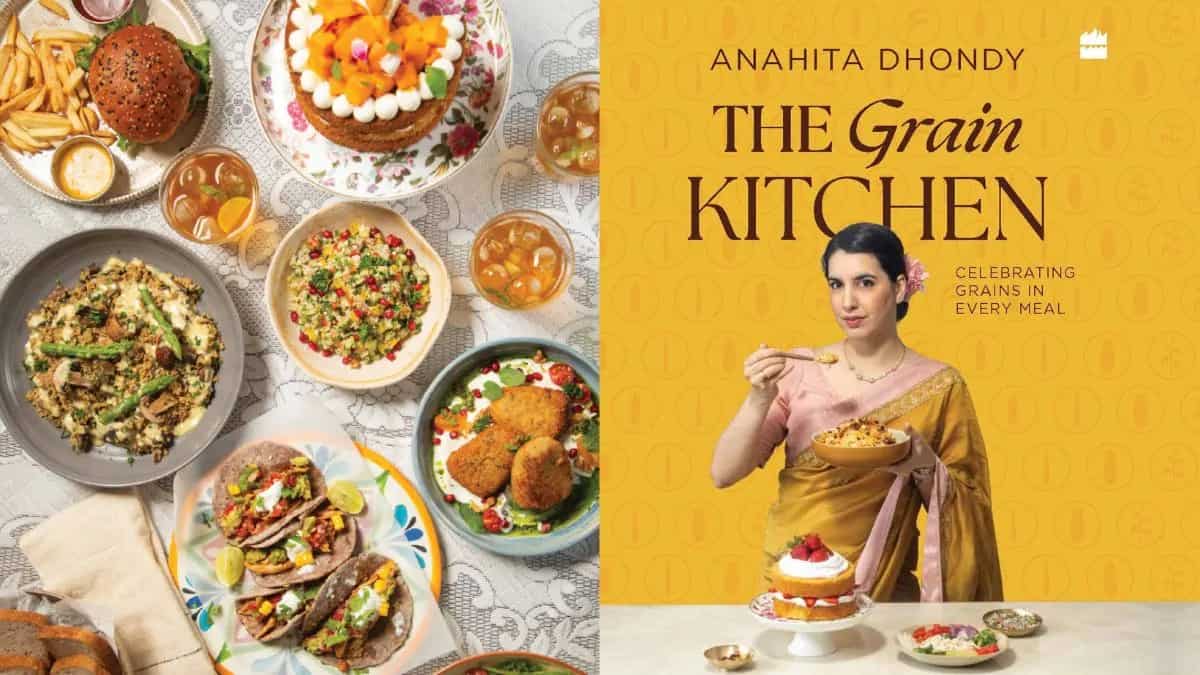
Quinoa had its year. Avocado had its decade. Both landed as revelations and hardened into cliché, the kind of ingredient you now subtly roll your eyes at on a brunch menu. Chef Anahita Dhondy has watched that cycle with a fair bit of suspicion, and her new book The Grain Kitchen is quietly built to sidestep it. "Millets, I don't think, have ever been a trend," she says. "It's been something that's continuously, slowly grown and grown back into getting popular. It's still not as popular, but I feel like it deserves a lot more attention - same with oats, corn, wheat and rice. These are all beautiful grains, and we consume unlimited amounts of them in our diet."
Grown back, not blown up. That small distinction is the spine of the whole book. A slow argument, years in the making. The Grain Kitchen was signed in 2022 and took four years to reach the shelf, and it wasn't originally meant to be this book at all. "When I met the HarperCollins team," she says, "they said, okay, you know what, we might not be ready for an only-millet book. But a grain book would do really well, because people are interested in adding different varieties and learning different ways of using these grains. And that's how The Grain Kitchen was born." Now it's come to fruition, she's plainly joyful to be here adding, "It's taken us four years to get here. But it's here, it's beautiful, and I absolutely love it."
It isn't a millet book exactly. It's a celebration of different grains, different techniques, different ways into a pantry most of us barely open. But millets are unmistakably the beating heart of it. "The millet chapter is one of the biggest chapters in the book," she says, "and it's got some very cool, interesting recipes that you can include in your everyday cooking." Chef Anahita has been cooking her way through these grains since around 2014-15, long before they were common knowledge, first on her restaurant menus, then on social media, long before she had a book deal for any of it.
A spotlight did eventually find them. In March 2021, on a proposal from India backed by 72 countries, the UN General Assembly declared 2023 the International Year of Millets. A year of government luncheons, export drives and rebranding, with the grain repackaged as a nutritional hero. It was the sort of attention advocates had spent years asking for. And it's precisely the sort of attention Anahita is wary of. Spotlights move on. Trends, by definition, end. Her bet is on something the hype cycle can't deliver: a permanent place in the Indian kitchen, built on flavour and utility rather than a UN calendar year.
Why Millet Is The Grain That Fell Off India’s Plate
Her wariness makes more sense when you look at what actually happened to millets in India. These were staples for thousands of years; hardy, drought-tolerant crops that once made up a third of the country's food basket. Then they were quietly edged out. As per studies, India's per-capita millet consumption fell from 32.9 kg to 4.2 kg per year between 1962 and 2010 (Kane-Potaka & Kumar (2019), reproduced in Frontiers in Sustainable Food Systems (2021) proving beyond a doubt that we we leaving behind something that was once a staple.
That's the real problem the book is trying to solve. "They're not on our plates," Anahita says, "not on our tables as much as they should be", not because they stopped being good for us, the farmer, the soil or the climate, but because convenience won. A book that simply celebrated millets would be preaching. Hers is trying to reverse an actual habit.
This is why The Grain Kitchen is pitched at the home cook rather than the shelf. Having had ample restaurateur experience herself with SodaBottleOpenerWala, Anahita is refreshingly honest that home cooking and restaurant cooking are different games entirely. "Running kitchens and cooking at home are two completely different games," she says. "Running kitchens has got a different thrill to it - the rush, the large volume, all the steps that make a dish come alive. It's very exciting. Cooking at home depends on which route you take. If you're the organised, planned home cook, it's much easier to function. If you're someone like me, who cooks on a whim thinking 'this is what I'm feeling, this is what I have in my fridge' it's like a mystery basket every day." The one thing she thinks home cooks should steal from chefs is prep: "We do a lot of it, and it helps us put things together much faster." So the book leans into it hard with a whole section on condiments, pickles and what she calls flavour bombs, plus recipes engineered to come together fast..
Where Fusion Becomes Natural
Accessibility also means giving nervous cooks permission to play. The book borrows freely from all over the world, and Anahita approaches it from a relaxed perspective. "Some experiments go down south," she admits, "and some can be absolutely delicious, those both deserve recognition, both only one has a place on your plate." The Japanese jhal muri, for instance, is a direct nod to someone who inspired her in the past. "It's inspired by Chef Adwait's version at Inja in Delhi" she explains, "which does Indian-Japanese fusion beautifully. Some things work well because the ingredients are similar, the textures are similar, and you can play around with it, wasabi and green chutney, for example, go really well together." The berry pulao, meanwhile, needs no such justification (but as a chef known for her Parsi fare, that's justification enough). "It's a classic, no questions asked, could be a chicken pulao, a keema pulao. Rice is a beautiful carrier of flavours, and we've known that forever, for generations."
But she draws a line at messing with the most important meal of the day. " I do feel like it's good to experiment, like if you're trying a new green because you might not know what works for you. But I'm not the biggest fan of overnight oats," she admits. "I like my oats completely cooked. That's very traditional. But I know a lot of people who love overnight oats, it's completely personal." As a chef, she says, "I lean more towards traditional flavours." The experimentation, then, isn't the point it's the on-ramp. Try something new alongside something familiar, she suggests, because you won't know what sticks until you do.
Not every ingredient in the book came easily. Corn, of all things, gave her the most trouble, not because she doesn't love it, but because she loves it too specifically. "A few recipes with corn challenged me the most," she says. "I love corn, but I love to eat it just the way it is. It reminds me of the monsoons, walking to the thelawala with my granddad, watching him cook it on live coals and put nice masala and nimbu on top of it." Turning that memory into a chapter meant working against her own instincts: "I really had to work my way and create some interesting recipes with corn, using it as a grain, not just eating it the way it is." The chapter that resulted includes makki ki paan and a corn burfi, but the one she singles out is makki ki dhokli: "You get the right flavour of corn with the flavour of dhokla, and you can pair it with a delicious curry."
Millet - The Grain Of The People
Underneath all of it runs a politics she wears lightly. "I've never thought of it as a constraint," she says of the sustainability label attached to her name. "I've always thought of it as an extra superpower, maybe, it gives me more room to be experimental, more freedom to create. I've never thought of food only from a sustainability angle. I've always thought of it from a nutrition and a delicious angle, because that's what chefs do. Even if you want to introduce something new to someone, you want to make sure it looks good, it tastes good. They'll always remember it for what it tastes like." The sustainability, she says, was always baked in, back when scarcity meant nothing got wasted, and the word itself hadn't been invented yet.
The book's dedication points somewhere she thinks the credit is overdue. "To the farmers of India, who never get enough credit, thank you for everything you do to get these beautiful grains onto our plate." It's the one place her advocacy turns blunt. "Try working a day on a farm," she says, "and you'll know how hard it is." Visibility in a recipe book won't transform a smallholder's economics, and she knows it, but she's clear about whose labour puts the grain on the plate.
Chef Anahita is candid that she isn't writing for this year's readers. "I do look at these books as long-term investments," she says. "I know that ten years later, people are going to be more invested in the grain, and will want to know more about it and what recipes they can make with it." She's been an advocate, in her words, "since the day I tried the grain", and intends to go on including it "gently, beautifully and deliciously," long after the International Year of Millets has faded into the run of themed UN calendars and the government campaigns have moved on to the next crop.
That's not a moment. That's the opposite of one. And it's a far more interesting thing to be chasing.