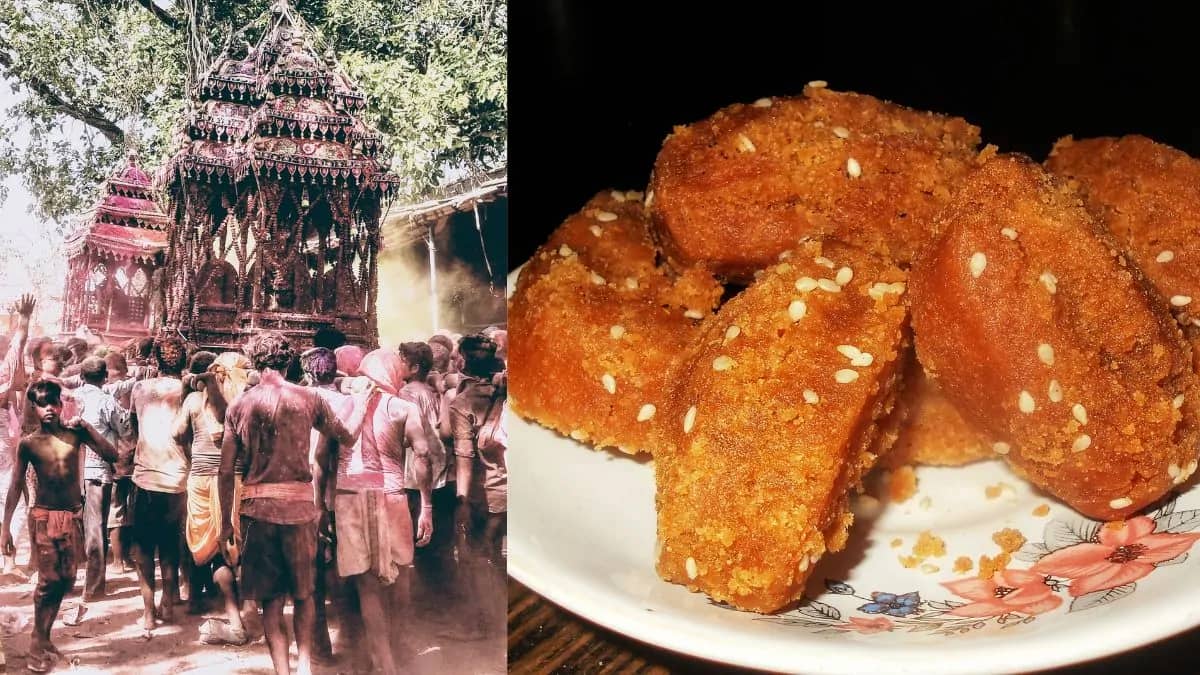
It goes without saying that Holi is one of the biggest Indian festivals. Now in the movies and pop culture, you see people smeared in gulal, chasing each other with buckets full of water. The fun, frolic and dancing are indeed a big part of the festival, but since the festival is so big across the subcontinent, several regions have given it their own spin. Bengal also has a few peculiar traditions associated with the festival. Dol Jatra, Dol Purnima or Deul is huge in Bengal, especially among the devotees of Krishna. An idol of Krishna and Radha are adorned in colourful clothes and smeared in gulaal or ‘abeer’. Further, the idol is taken out in a procession, the palanquin in which the idol is kept is also decked up with flowers, leaves, and all things colourful, and the motion of the swinging is called ‘dol’. The procession is accompanied by music, dance, the sound of conch shells and chanting.
Image Credit: Wikimedia Commons
Drinks made of curd and butter are distributed, people colour each other with abir and play around swings in open courtyards. The festival of Holi also coincides with the birthday of Chaitanya Mahaprabhu (1485–1533), the spiritual leader who led the Vaishnava movement in Bengal, and devoted his life to the worship of Radha and Krishna. The festival of Dol starts three days before the actual Dol Yatra, with Kirtan and bonfire, around which the idol of Krishna is carried several times. Like Holi, Bengali Dol Yatra is incomplete without festive delicacies. And when it is festival time, it is feast time in every household. Here are some must try festive Bengali dishes for Dol Jatra.
Image Credit: Wikimedia Commons
Bengali Dishes For Dol Jatra
Patishapta
Patishapta is a traditional Bengali dessert. Every variant of patishapta offers unique flavours and textures. Usually made to celebrate Makar Sankranti, it’s also a part of Dol celebrations since it's a winter-spring delicacy. From sweet to savoury fillings, it usually has kheer or coconut stuffing and is rolled like a crepe.
Image Credit: Wikimedia Commons
Pithe Puli
For ages, these pithe’s have been a fine example of craftsmanship and also much attention to these traditions. The innovative mix of fresh ingredients as well as leftover ingredients, is a fine culinary example. The tradition of making pithe and puli is seen in both sides of Bengal (Bangal from East and the Ghotis from the West). Puli pithe is the only pithe which is extremely popular in Bangladesh. They make puli pithe as dessert. Also, in various places like Noakhali, Mymensingh, and Barisal district, puli pithe is a popular dessert. So, the Bangladeshi diners of Ichamotee can easily connect with it. They taste nothing less than home. Most homes are now losing the art of making them and are turning to restaurants to pack some of their favourites.
Payesh
Payesh is the one recipe in Bengal that is always prepared with gobindobhog rice. Gobindobhog rice payesh, which is also known as kheer or payasam in other Indian languages, is the secret weapon that may transform this dish from good to outstanding. The dish is worth longing for because of the aroma of the rice and the added starch content. When it's cold outside, date palm jaggery replaces the payesh's sugar to provide the much-needed warmth throughout the chilly months of December through February and a few days of March.
Image Credit: Wikimedia Commons
Chhanar Jilapi
Chhannar jilapi also belongs to this illustrious league. Now, what is it, you ask? It is thick and decadent jalebi that is made with a chenna (cheese curd) mixture instead of a regular gram flour mixture. A close cousin of the sweetmeat would be the paneer jalebi of North India. But the differences lie in consistency, chenna jilapi is much crispier and darker in colour, almost brownish, while paneer jalebi are of deep orange in colour.
Malpua
It is relished in parts of Bengal, Bihar, Orissa, Nepal and Bangladesh during various festive occasions. Pua, or the Indian sweet pancake, is coated with sugar syrup and served with rabri or thickened, sweetened milk. It has an endless variety of recipes influenced by India's different cultural and geographical diversity. In the Jagannath temple, Puri, malpua is presented as the first offering (Sakala Dhupa) to Lord Jagannath every morning. Popularly known as 'Amalu', this sweet dish is also an integral part of the Chappan Bhog, offered to Lord Jagannath. It is also enjoyed during the winters in Bengal.
Khichudi
Bhog er khichuri or khichdi is a one-pot meal made with rice and soaked dal. But there’s something about the Bengali khichdi that makes something as simple as khichdi festive enough to be served to thousands of people lining up for the bhog. In the Bengali version, the lentils are roasted before they are cooked with rice, which gives the khichdi a unique smoky touch. A bunch of spices that you commonly find in East-Indian preparations, like bay leaf, green cardamom, dried red chillies and how can we forget the Bengali favourite mustard oil in which the tadka is prepared.
Image Credit: Wikimedia Commons
Labra
The renowned Bengali dish labra is prepared and served as prasad. It is a thick and hearty vegetable hodgepodge that the Bengali people of all ages enjoy. People have adored this dish for ages because of their abiding love for it. This side dish recipe is produced using a spice blend known as panch phoran, which is available in shops. Nigella seeds, black mustard seeds, fennel seeds, golden fenugreek, and cumin seeds may be blended to make homemade panch phoran. It is usually served with bhoger khichuri, but steamed rice or roti can be eaten with it as well. This Bengali recipe does not include onions or garlic, so it is suitable for those who dislike those ingredients.
Chirer Pulao
Chirer pulao is basically the Bengali version of poha. It is a dish that is widely eaten in West Bengal and by Bengalis who live in other parts of the country as well. Slightly sweeter than the regular puha that you eat, chirer pulao literally means pulao made out of flattened rice or chiwda. It is a very quick dish to make an extremely filling and healthy to eat early in the morning. It is often packed as tiffin for kids as well as office goers.
Image Credit: Wikimedia Commons
Gaja/Goja
A sweet made in Bihar and Orissa of deep-fried sweetened dough flavoured with cardamom (elaichi). Also popular in Bengal as mishti, it is made of ghee and flour deep frid and then soaked in sugar syrup. Goja is a cousin of khaja, as both are made of almost the same ingredients. The sugar syrup can even be stored and kept for further use. In a saucepan, take the water and the sugar and bring to a boil. The recipe is a wonder for sweet tooths.