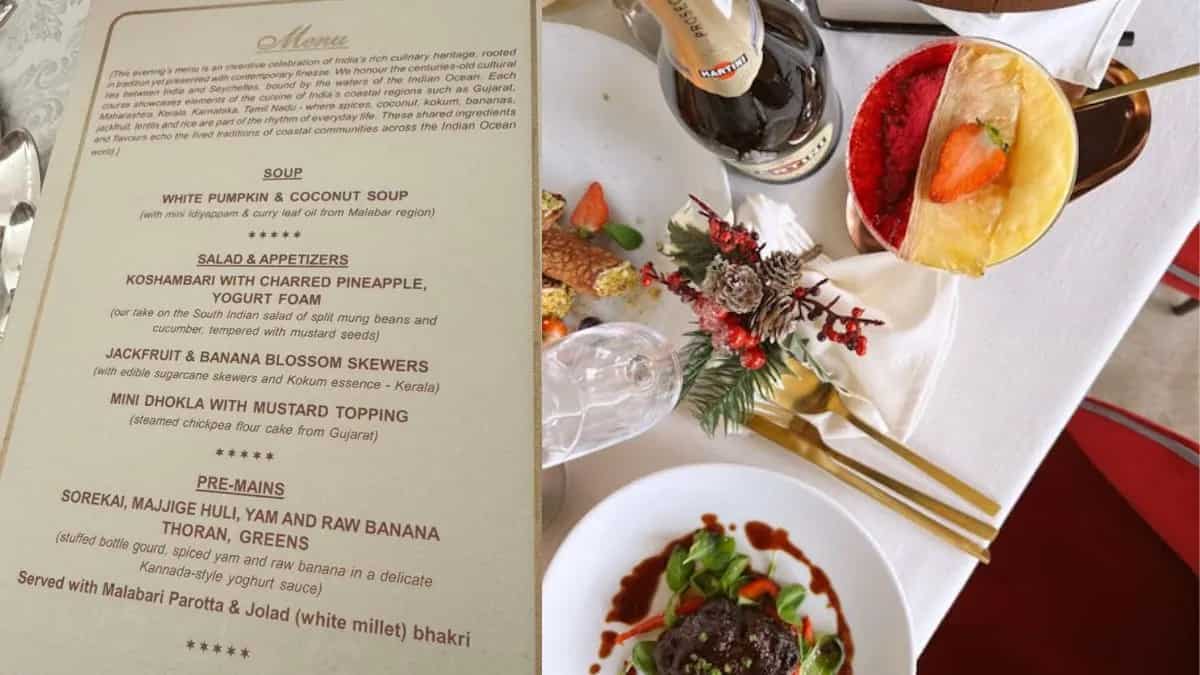
The aroma of a controversy often travels faster than the scent of freshly tempered mustard seeds. In the high-stakes world of New Delhi diplomacy, a quiet storm has been brewing over the porcelain plates of Rashtrapati Bhavan. The spark was a viral post by veteran diplomatic editor Suhasini Haidar, who pointed out an open secret in the capital. She suggested that visiting dignitaries, after navigating through experimental courses like charred pineapple and yogurt foam, frequently return to their hotel suites to order a comforting plate of traditional Indian food from room service. This observation instantly divided the internet. On one side are the purists who believe that the sanctity of Indian food lies in its unpretentious, hearty origins. On the other are the modernists who argue that a presidential dinner is precisely the place for culinary theatre. The menu in question, served during a state visit, was not merely a meal but a manifesto of India’s evolving culinary identity.
Image credit: Suhasini Haider on X
A Maritime Tribute In Every Bite
To honour the visiting leader and to reflect the maritime ties that connect India and Seychelles, the dinner was curated as a celebration of India’s coastal culinary traditions. The menu brought together flavours and ingredients from the Malabar coast, Karnataka, Gujarat, Maharashtra, and Tamil Nadu, presented in a refined, contemporary format. This was not a random assortment of fusion dishes; it was a deliberate attempt to map the subcontinent’s oceanic heritage onto a fine-dining experience. The evening opened with a warm, fragrant bowl of White Pumpkin and Coconut Soup. This was no ordinary broth; it was accompanied by mini idiyappam and a drizzle of curry-leaf oil inspired by the Malabar region. By starting with something so delicate yet deeply rooted in the coastal south, the kitchen set a tone of sophisticated comfort. It offered a gentle introduction to the complex spices that would follow, grounding the guests in familiar aromas before the experimental flourishes began.
Image credit: Pexels
The Anatomy Of A Modern Salad
The item that drew the most fire online was the Kosambari with Charred Pineapple and Yogurt Foam. To the uninitiated, this sounds like a pretension too far. Kosambari is, after all, a humble and refreshing South Indian salad of split mung beans and cucumber. By adding charred fruit and an aerated yogurt foam, the kitchen was accused of being flouncy for the sake of it. However, when one looks at the logic of the dish, it reveals a deep understanding of flavour profiles. The char on the pineapple adds a smokiness that complements the earthy mung beans, while the foam provides the acidity and creaminess usually found in a side of curd, but with a lightness suited for a multi-course gala. It is a modern take that respects the soul of the original while acknowledging that a state dinner requires a certain level of elevated presentation. The flourish, in this case, has a functional purpose: it lightens a traditionally dense dish.
Image credit: Pexels
A Journey Through The Provinces
There is also the question of regional representation. The move away from the North Indian hegemony of naan and paneer is a welcome one. India is a continent of cuisines. Promoting coastal flavours, as was done for the Seychelles delegation, or Himalayan produce for the EU leaders, is a fantastic strategic move. It showcases the biodiversity of the country. The appetisers featured Jackfruit and Banana Blossom Skewers, served on edible sugarcane with a hint of kokum essence. This was a clear nod to the coastal traditions of Kerala and the Konkan belt, bringing often overlooked indigenous ingredients to the forefront of global recognition.
Even the humble Gujarati dhokla made an appearance, though reimagined as a mini, fluffy steamed cake with a mustard topping. This diversity continued into the pre-mains, where the table saw Sorekai and Majjige Huli from Karnataka alongside a Yam and Raw Banana Thoran. By serving these with Malabari parotta and Jolad or white millet bhakri, the menu celebrated India’s commitment to sustainable, indigenous grains and regional breads.
Image credit: Pexels
The Logic Of The Main Course
The main course was a masterclass in regional balance. It featured Batata nu Shaak from Gujarat, Udupi Brinjal Sukka from the south, and a Paneer Tellicherry that fused a familiar protein with the bold peppercorns of the Malabar coast. Perhaps the most comforting inclusion was the Mushroom and Dal Varan, a Maharashtrian staple of lentils tempered with ghee and served over Sona Masuri rice. While the internet might mock the small portions or the artistic smears on the plate, the flavour combinations were grounded in centuries of tradition. The inclusion of fiery condiments like Gongura pickle, Mango Chunda, and Beetroot Pachdi ensured that the heat and tang essential to the Indian palate were never compromised. The critics who suggest that these meals leave guests hungry might be overlooking the density of these ingredients. A meal featuring millet, lentils, and yam is anything but light on the stomach, regardless of how delicately it is plated.
Image credit: Pexels
The Sweetest Form Of Diplomacy
The debate reached its crescendo with the dessert course: a Shrikhand Creme Brûlée. Here, the Maharashtrian staple of strained yogurt, cardamom, and saffron was given a French-style caramelised crust. This is where the experimental approach truly shines. It takes a beloved local flavour and translates it into a format that a global dignitary can immediately recognise and appreciate. It was followed by Khubani and Akhrot Halwa, a rich preparation of sweetened apricots and walnuts that speaks to the royal kitchens of Hyderabad. To finish with Nilgiri tea or a South Indian filter coffee is to provide a sensory bookend to a meal that travelled from the Western Ghats to the Deccan Plateau. To keep the evening lively, even the table snacks were a nod to street-side favourites: Elaichi chocolates, Nipattu, Dahi Vada, and Pani Puri were placed for guests to enjoy at their leisure.
Image credit: Pexels
The Verdict
Despite the noise and the room service rumours, there is a strong case to be made for these creative endeavours. When we look past the shock of the new, the actual dishes are quite thoughtful and creative. Take the much debated kosambari with yogurt foam. Is it a bit over the top? Sure. But this is a presidential dinner, not a casual lunch at a canteen. A certain level of theatre and elevation is expected on the world stage. The flavours are authentic; only the texture has been reimagined for a formal setting. We must give credit to the chefs for taking risks. It is easy to serve the same rich gravies that have been served since the 1950s. It takes courage to put banana blossom on a skewered pedestal in front of a Head of State. While the open secret of room service orders suggests we might have veered too far into the abstract and conceptual, the intent is noble. We are asserting that Indian food is capable of nuance, elegance, and evolution.