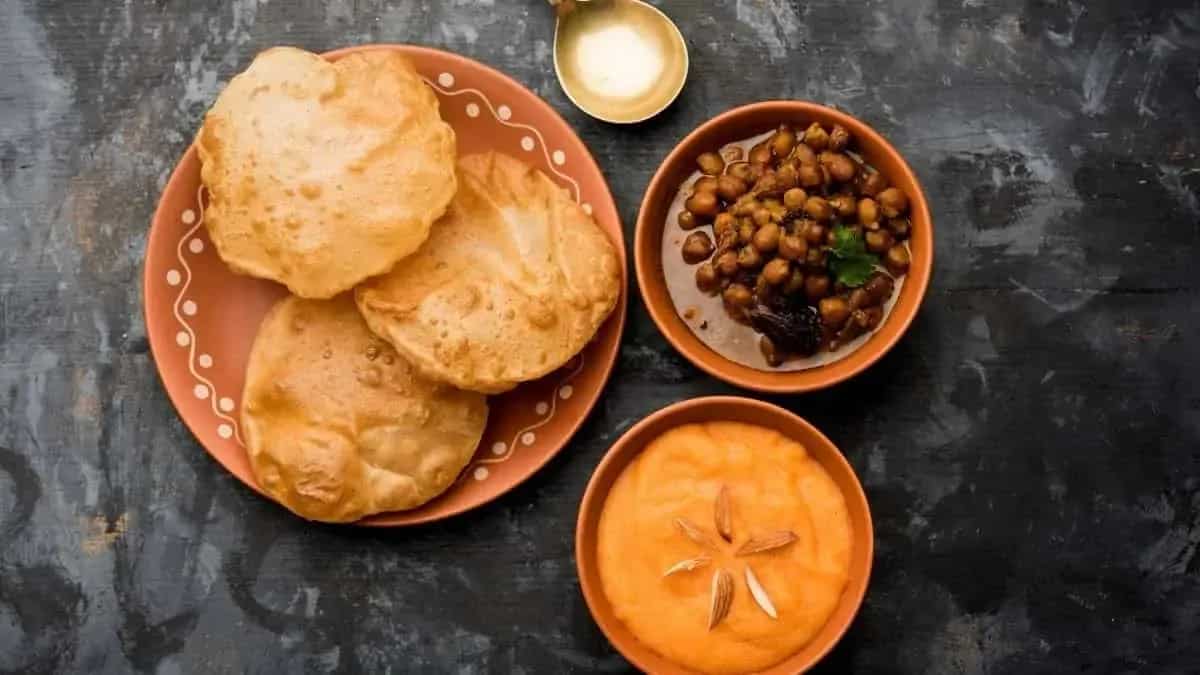
The Ashtami mornings have always been a little busier than usual. Preparing the classic puri, chane, and halwa bhog and welcoming the kanjaks for puja, the eighth day of Navratri has always been a celebration for girls. For a young girl, it is a day of coronation: sitting on a pedestal, having her feet washed in silver thalis, receiving shagun, and enjoying a generous serving of puris, spicy kale chane, suji ka halwa and often, a tangy kaddu ki sabzi. What’s not to love?
However, there comes a day when the invitation from the neighbourhood stops. The reason is usually unclear, or the whispers of reaching the biological threshold. The moment a girl starts to menstruate, the Goddess-child is suddenly deemed “impure” for the annual ritual that once celebrated her existence. While for some women it is a quiet heartbreak, others have started to come to terms with it by standing on the other end, preparing the bhog for the next generation.
Looking at the journey from being a kanjak to entering womanhood, here are some heartfelt stories of women of all ages and how their lives have changed, while the puri, chane, and halwa remained a constant for Ashtami.
Dr Aarti Kapur Singh
Media consultant & Food Historian, Chandigarh
“I remember my Ashtami mornings starting with my nani waking me up with 'Utth puttar, jaldi nahao..nayi dress nahi pehen-ni?'. And I’d known it was that day of the year when my little feet would be washed with reverence, tilak on my forehead, the nazar ka teeka on the back of my ear, and the men of the house touching my feet to seek blessings,” Aarti reminisces.
Image Credits: Freepik
At her nani’s home, the Ashtami bhog was always the holy trinity - poori, chane, halwa. Aarti narrated a picture of celebrating Ashtami, “In my nani’s kitchen, nothing was hurried. Each dish felt like it had been coaxed into existence, not cooked. I loved kaddu, so my nani would make her special khatta meetha kaddu for me!”
As a young girl, she remembers attending kanjak puja at various households, each having its own personality. “But yes, that silence arrived more abruptly than any explanation. One year you are देवी, the next you are simply not called. It wasn’t explained as much as it was understood in fragments,” she said. “To be placed on a pedestal, even briefly, teaches you what reverence feels like. But to be removed from it just as quietly teaches you something else - that value can be conditional.”
Image Credits: Freepik
While the contradiction has always lingered, Aarti found a way to hold the memories of food without judgment. “The first time I stood over the kadhai, stirring halwa, I realised how much patience devotion demands. The sooji resists at first, then slowly yields, absorbing ghee, water, sweetness - transforming. Rolling puris felt like learning a rhythm my nani had always known.” Aarti describes the first time she prepared the Ashtami bhog. “I measure nothing strictly on Ashtami - just a little extra ghee - which is always homemade, a slower roast, a pause between steps. And always, roasted and powdered almonds and a pinch of cardamom powder added at the very end, like a whisper. Because if there is one thing nani taught me, it is that flavour remembers intention.”
Krati Purwar
31-year-old Journalist, Noida
For Krati, Navratri was about food and money. “I used to carry a small purse, a highlight because only the elders carried them," Krati laughs. While the unusual combo of halwa and chawal ki kheer wrapped in a puri was a heavenly treat, the goal was the shagun. "After 3-4 houses, my stomach would be full, but papi pet ka sawal tha, so I used to eat some more so the aunties would give us money. How much can you even eat? But you can always stuff more money inside the purse,” she narrates, smiling.
Krati remembers her mother telling her, ‘You’re not a kanya anymore, you are a woman now. Badi ho gayi ho ab tum.’ “It’s not about restricting young girls from attending Ashtami or Navratri calls, but not allowing them near prasad or prohibiting them from touching the Goddess herself, the epitome of womanhood, is nothing but disrespect,” Krati calls out the hypocrisy. “You are telling me that I, a kid herself or even a 31-year-old woman, am “impure” or my “energy” isn’t “positive” enough to seek blessings of the Goddess, is unacceptable. I still abide by it because no point in arguing with people who are convinced that menstruation makes a girl impure. I am sure the Goddess would think otherwise, at least I like to believe that.”
Talking about her time preparing the Ashtami bhog, Krati says, “I haven’t prepared it by myself, but I have helped my mom prepare it many times. While I was over the moon when I made my first puri, the feeling kind of dialled down when I started to cook regularly. For someone like me, who enjoys cooking, when I cook something special at festivals, I get to relive that moment. I enjoy and still reminisce about the good old childhood days.”
Yashika Sharma
28-year-old Teacher, Ludhiana
“Between getting ready for school and still managing to sit in as many Kanjak Pujas as possible was quite a task. My earliest memories of Ashtami are sitting in the puja room at our home, where everyone would treat me like a Goddess, and the breakfast that was extra special,” Yashika dictates her early memories of Ashtami. “Having puri, chane, halwa before the school bus came to pick me up, and having the same thing packed in my tiffin had to be the best thing.”
Image Credits: Freepik
“While every year the trio of puri, chane, and halwa remained the same, I grew up. I remember crying that year on Ashtami because I wasn’t given the same princess treatment like always, just because I started to menstruate during Navratri,” Yashika looks back. “But after a couple of years, I made my peace with the puri-chane-halwa, my mother used to cook, waking up early in the morning. Until one day, when I moved cities for work, and the only thing that I missed during Ashtami wasn’t the kanjak puja, but my mom-cooked bhog.”
As for Yashika, puri chane halwa made at anyone else’s home never matched her mother’s taste. “I did try to make the Ashtami bhog once, but my arm started to ache from the continuous stirring, and I kept wondering how she did this every year so effortlessly. And in that moment, I felt that I transitioned from an innocent child to a woman,” she says with a sad face. “And soon enough, the festival was about both Maa Durga and going home to see my own mother.”
Shreya Sarpal
25-year-old Marketing Executive, New Delhi
“Waking up to the smell of halwa, puri, and chane, my fondest memory of my dadaji washing my feet, and going from house to house tasting different kinds of chane and halwa, is what Ashtami was all about,” Shreya narrates. “The whole day was like a food and gift tour. Some neighbours gave the kanjaks the crispiest ₹10 notes as they had just come from the bank, some added little touches of themed water bottles, tiffins, keychains, and little surprises. And I remember keeping a quiet track of the best halwa and the heartiest gifts as a prep for the next year.”
Image Credit: Unsplash
Unlike others, Shreya was never excluded from celebrating Ashtami at her home. “ I was fortunate to be called for Kanjak Puja in every house, every Ashtami, even after I started my periods. It was never made into a restriction for me, which, looking back, feels like a quiet but important kind of acceptance,” she says proudly.
“Even though I haven’t made the bhog myself, I had my own place in the process. I’ve been the ‘taste checker,’ the one my calls over with a spoon mid-cooking, asking, “Thodi aur cheeni”. And it has always made me feel that I’m a part of that final, important decision,” Shreya shares her memories of preparing the Ashtami bhog. “And then there’s the pooja thali, which I’ve always prepared with my dadi. Arranging the diya and placing the prasad just right.”
So, all these years, without actually stirring, being the silent observer, Shreya knows the halwa needs that slow roasting in desi ghee, the chane have to be simple, and no process can be rushed. “I may not be the one recreating the entire meal yet, but I carry the memory of how it should taste, and somehow, that feels just as important,” she concludes.
Jannat Chugh
22-year-old Student, Chandigarh
“I vividly remember getting dressed for school and still being called by multiple aunties to their homes, all at once. Attending the puja at different homes in a school uniform, quietly wishing it was a holiday, so I could fully enjoy it, the festival has been truly special for me,” Jannat narrates nostalgically. “The trio of spicy kale chane paired with pooris and halwa instantly brings back memories of childhood Ashtamis.”
“To be honest, I was quite an introvert, so I often hesitated and sometimes just wished I could go back home as soon as possible. But my elder sister was the complete opposite. I remember tagging along with her, and somewhere along the way, I started enjoying it too,” she talks about the childhood days. “I think I had already started going out less for Kanjak Puja once my sister stopped going. It made me wonder why she wasn’t going anymore, especially since she loved it so much. People would still call me, and I would ask her to come along, but she would simply say that she’s not being called anymore, and eventually I stopped going too without even understanding the reason behind it.”
Image Credit: Adobe Stock
Pointing out the regressive nature of the society, Jannat says, “On one hand, young girls are worshipped as symbols of divinity, but as we grow older, we start to face restrictions tied to the same belief system.” She also feels that they do impact the ideologies of being valued and celebrated, which are conditional and tied to different stages of life.
“Nevertheless, the goodness of halwa, pooris, and chane still makes me miss being at home on Ashtamis. I do feel homesick being away from home, even though the festival somewhere became a bittersweet realisation of growing up,” Jannat says, wishing to celebrate Ashtami with her family.