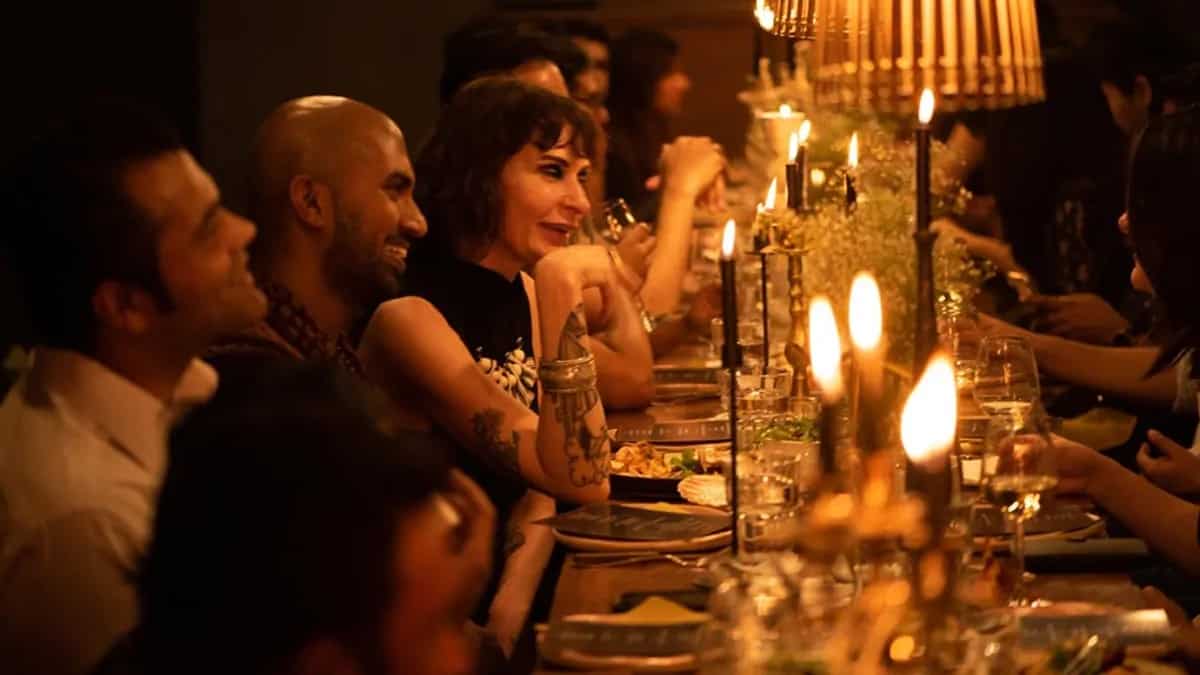
FOR YEARS, I’ve been running what could loosely be called supper clubs in Mumbai (although never officially calling them that, or for the matter charging for them). I was curious about how communities work in a city as chaotic as Bombay, where everyone seems to exist in their own ecosystem, their own work, their own lives and, increasingly, their own bubbles.
Coming from hospitality and food writing, my life has always been fairly social, but even then, I tend to move within my own circles. So, whenever I felt like cooking, I would occasionally open up my home to people I had met on Twitter — this was at least 15 years ago, when Twitter (now X) was still the place where strangers from the same city would exchange increasingly ridiculous opinions and, eventually, become friends.
The easiest way to turn those degrees of separation into something tangible was to put six or seven of them around my dining table. I would cook — being vegetarian made it an interesting constraint — and, over dinner, watch people who had never met before, find common ground.
EDITOR'S PICK | How India’s Craft Chocolate Makers Are Building a Category
Years later, almost as recently as three months ago, I found myself in Bengaluru, a city whose intense sense of community is perhaps matched only by its enthusiasm for house parties, and where supper clubs have become an integral and thriving part of the food culture. At NĀVU, a restaurant that began life as a supper club, I recognised something familiar: the intimacy of those dinners, only now translated into a permanent space. There are close knit tables, if not a community one, an open kitchen window and the chefs/founders move between cooking, plating, serving and clearing plates themselves.
FROM DINING TABLE TO BUSINESS MODEL
When Kanishka Sharma started NĀVU’s supper club in 2017, joined in later by her now business partner Pallavi Mithika Menon, the intention wasn’t necessarily to build a restaurant. In fact, the original idea was almost the opposite: it was a space where chefs could experiment, educate and explore, with diners often not even knowing what was going to land on their plates. What began as a supper club eventually moved through catering, pop-ups and a residency before becoming the permanent restaurant it is today. The people who came to those early dinners, they say, still form part of the restaurant’s extended community.
That trajectory is perhaps a useful way of understanding why supper clubs are enjoying a resurgence. They are not necessarily trying to compete with restaurants. They can be laboratories before restaurants, communities before customer databases and, increasingly, experiences in their own right.
For Aditya Ramakrishnan, of Má Là Kitchen, the supper club was a way of entering the food business without immediately taking the leap into a capital-intensive restaurant. With Sichuan food expert Dongli Zhang lending her culinary expertise, what began with two or three people around a dining table gave them the opportunity to test recipes, understand sourcing, learn service and, crucially, find out whether anyone actually wanted what they were cooking.
The answer was emphatically yes. The dinners grew from a handful of guests to 12 or 14 at a time, eventually feeding more than 3,000 people at home. Much of that growth came through word of mouth and Instagram stories, with diners travelling from cities including Mumbai, Delhi, Hyderabad and Chennai specifically for the experience. That is where the economics — and perhaps the real power — of the supper club become interesting.
A restaurant might seat a hundred people and hope that some of them post about their meal. A supper club may seat 10 or 15, but those diners are there precisely because they have sought out something they perceive as personal, unusual or difficult to access. The audience may be smaller in the room, but the experience can travel considerably further once the guests leave.
And unlike a conventional influencer campaign, the person sharing the dinner isn't necessarily being paid to tell anyone about it. House of Málà’s Saloni and Prachi Gupta describe the distinction rather neatly: a restaurant post essentially says, "I went somewhere good"; a supper-club post can say, "I discovered something". That subtle difference matters. Discovery is social currency. It gives people something to tell their friends, perhaps even photograph and, most importantly, a feeling of first movers advantage — a purely psychological instance.
*
This is also why the intimacy of the format matters. Reshma Mane of Every Aroma in Mumbai, which has been exploring home dining since well before the current supper-club moment, believes the experience has to begin with the “vibe”. Her food is rooted in the familiarity of ghar ka khaana, with regional cuisines and the flavours she carries with her through her own masalas; she recalls diners in Delhi, Chennai and Goa telling her that the food reminded them of flavours they missed from home. Guests aren't necessarily looking for another restaurant meal; they are looking for the warmth, ease and sense of being welcomed into someone's home. As Reshma puts it, the food, décor and service may all be part of the experience, but the host is its face — “Vibes should be the first box to be ticked off!” .
At The Find Atelier in Mumbai, a weekend supper-club in the suburbs, the experience is designed to slow people down and encourage connection. The founders have seen strangers exchange numbers over meals and then make plans to meet outside The Find — a small but telling sign that the social experience can outlive the dinner itself. Its discovery has largely happened organically too, through Instagram and word of mouth, with guests returning and eventually using the space for their own gatherings.
*
Meanwhile, Bengaluru's Vaazhai Table has a smart community-forming outlook. The supper club is a carefully constructed three-hour journey through South Indian food and memory. The 12-15 guests begin with ice-breakers and a guided art session designed to evoke childhood memories before moving to a 15-course banana-leaf feast; each evening is centred on the culinary heritage of a different region. The founders introduce each dish themselves, explaining not just what is on the plate but the history, culture and circumstances that shaped it. A dish such as "Chicken Chinthamani", for instance, becomes a way of talking about how scarcity of spices once led to a recipe built around little more than red chillies, curry leaves and pantry staples.
SLURRP REVIEWS | This Mumbai Supper Club Built A Gourmet Tasting Menu Around Chicken Curry (And Dares You To Ask Why)
That sense of discovery appears to travel well beyond the table. Vaazhai says guests have gone home to ask parents and grandparents about dishes they encountered, attempted to recreate recipes and recommended the experience to friends and family.
WHEN A MEAL TELLS THE STORY
For premium F&B brands, that presents an intriguing opportunity. A wine, spirits, ingredient, tableware or hospitality brand can enter a supper club as part of an experience that guests have chosen to seek out. Every Aroma sees potential particularly in premium ingredient and beverage collaborations that can genuinely enrich the meal, while House of Málà makes an important distinction: the brand should become part of the memory, not the headline.
Put through Jonah Berger's STEPPS framework from Contagious, the format almost seems de-signed for organic sharing: social currency, emotion, public visibility and stories are all built into the experience. But perhaps we don't need a marketing framework to understand why it works. We already know what happens when people discover something they love: they tell others about it.
The supper club simply gives them a particularly good story to tell. And perhaps that is why its resurgence feels less like a passing dining fad and is infact a burgeoning trend. In increasingly crowded cities, where restaurants can sometimes feel interchangeable and social media can make everything look the same, there is value in sitting around a table with people you didn't know an hour ago, eating food that has a story, served by someone who actually wants to talk to you about it.
Images (top to bottom): 1-2 from NĀVU; 3-4 from House of Málà; 5-6 from Every Aroma; 7-8 from Vaazhai; 9-10 from The Find Atelier.
*
Nikhil Merchant is a Mumbai-based F&B consultant, lifestyle and luxury writer, and goes by Nonchalant Gourmand, where he fuses culinary storytelling with cocktail craft. His work spans national and international publications, and he also consults on restaurant menus, beverage programs, and concept design at his company Elevenses Hospitality. He can be found on Instagram @nonchalantgourmand.
***
This feature is part of TRENDS WITH BENEFITS, Slurrp's monthly read on what moved the food and beverage industry, across menus, glasses, and the numbers behind them. Write to slurrp@htmedialabs.com if you'd like to receive the newsletter, with "Trends With Benefits" in the subject line.