Not lunch. Not the tiffin packed at home and traded away by second period.
The other food. The food that came out of pockets.
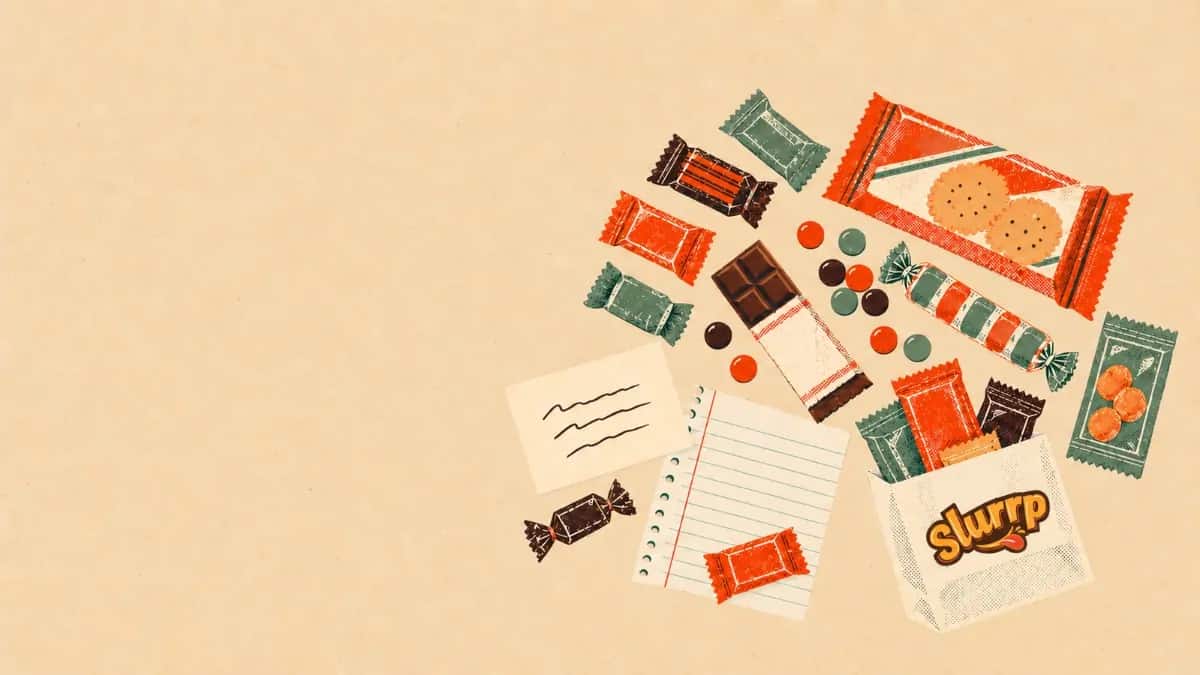
A mango candy passed under a desk, wrapper crackling, which was always the risk. A coffee toffee carried through two periods and unwrapped on the bus, because it was better if you waited. A bar of chocolate broken along its own lines and shared out by a system everybody in the row understood and nobody had ever explained.
None of it cost very much. All of it is still in there somewhere, bound to whoever was sitting next to you at the time.
That is what Slurrp took to four Delhi schools this Teachers’ Day: a small bag of sweets, and the question inside it. Not a hamper.
It started at home
The idea began with a colleague and his daughter.
What she had settled on for Teachers’ Day was this: small bags of familiar school-day sweets, a handwritten note folded into each one, all of it to be left in the staff room before the teachers came in.
And her name on none of them.
She wanted no credit whatsoever. No thank-you in return, no extra warmth in class, and — in the original phrasing — “God forbid, extra marks.” A thank-you stops being a thank-you the moment it can be cashed.
It is the kind of plan that raises a larger question on its own. Why only one staff room?
Also read: Teachers’ Day 2026: Low-Cost Food Ideas That Students Can Make And Sell For A School Fete
Four schools, four staff rooms
With the HT PACE team, Slurrp carried the idea to Ahlcon Public School and Ahlcon International School in Mayur Vihar, and to St. Lawrence School and Flora Dales Public School in Dilshad Garden.
The staff room was the right destination. It is the room in a school that belongs to the teachers rather than to the children — more often glimpsed through a doorway than sat in, and one of the few places in the building where the people who stand at the front of a class are not standing at the front of anything.
Inside each bag: Poppins, Gems, Melody, a roll of Rola Cola, Magic Pops, a box of Nutties, a ten-rupee Dairy Milk, a packet of Parle-G. Nothing you couldn’t once have bought at the shop outside your own school gate.
Each bag carried the same note: “A little taste of your childhood — for those who shape childhoods every day. Thank you, Teacher.”
Why the ordinary things stay
The foods that stay with us are almost never the best things we ate.
They are the ones that were simply there — at the same hour, in the same corridor, with the same three people, for years on end. Repetition does something that taste on its own cannot. Eat a mango candy on the walk home often enough and it stops being a sweet. It becomes the walk home.
School confectionery also ran an economy more complicated than most adult ones. Sweets were traded at rates everyone knew and nobody had set. Split down the middle with a thumbnail. Extorted, occasionally. Offered as apology. Hoarded in pencil boxes and hidden, with limited success, from the very people who have now been handed a bagful of them. Birthday toffees went round the class, one per desk, under supervision. Pocket money was pooled at the shop outside the gate.
One child’s favourite became another child’s first taste. A functioning system of inheritance, running on coins nobody bothered to count.
Years later, a wrapper can put a person back inside one very specific fortnight of their life. The object cost next to nothing. What it is holding does not.
No bag could reconstruct a whole staff room, and it was not trying to. Teachers of different ages did not grow up in the same tuck shop, and the sweet that anchors one of them may mean nothing at all to the person at the next desk. What a bag like this offers is a set of doors rather than a reconstruction: several ways back, and no way of knowing in advance which one opens.
Before they were teachers
Teachers’ Day language has a way of turning people into monuments. Mentor. Guide. Builder of the nation. Lamp, occasionally, lighting others while consuming itself. It is all sincerely meant and all of it slightly airless, and none of it survives contact with an actual staff room, because you cannot hand a bag of toffees to a nation-builder.
A gift made of childhood does something gentler. It remembers that the teacher supervising the lunch break once waited very impatiently for one. That the hand correcting the notebook once filled the margins of its own. That the person standing at the front of the room once sat at a desk of their own, had a favourite sweet, a best friend two rows back, a subject that frightened them, and a teacher they still think about.
A bag of sweets settles none of the real questions — how teachers are paid, supported or protected, and how schools are staffed. It was never asked to. It says one small thing instead, in a language that needs no translation. Before you were the person at the front of the room, you were the child at the desk. Somebody taught you, too.
The girl at the heart of the original plan wanted none of the bags to carry her name. Her teachers were never meant to know which student it was.
Which is something they taught her.