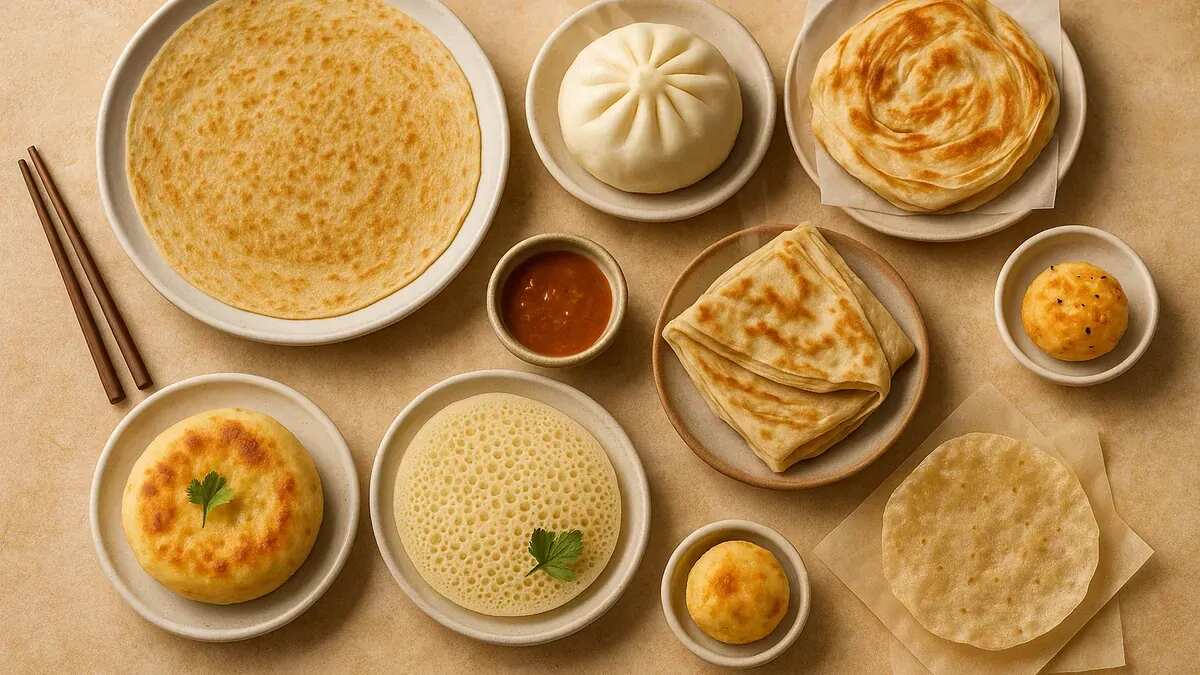
A hand tears something that looks like a spongy, tangy crepe. It doesn’t crack like a baguette; it sighs. It doesn’t sit beside the meal; it is the table—plate, pinch, and pantry staple in one. If you’ve ever wondered why so many cultures call a food “bread” when it doesn’t resemble a loaf, the answer is less in shape and more in what it does.
7 Global Staples That Don’t Look Like Bread
For this list, bread means three things:
- Staple role: a frequent foundation food, not a special-occasion sweet.
- Grain/seed base: made from a cereal grain or seed (sometimes with legumes), milled or ground.
- Cooked set: heat turns it—as dough or batter—into something you can tear, scoop, wrap, or fill.
Method changes the look. Steam keeps bread pale and plush instead of crusty; a griddle can turn batter into thin sheets; fermentation can sour and restructure starch so it eats like a staple even when it looks like a pancake.
1) Injera (Ethiopia/Eritrea)
What it looks like: A large, round, crepe-like sheet with bubbles—porous and springy. The surface is cratered; it bends without breaking.
Why it’s bread: Injera is a fermented grain batter cooked into a staple base. It’s foundation + vehicle: it grips bites, absorbs sauce, and makes cutlery optional.
How it’s eaten: Dishes are served on a shared platter lined with injera. You tear off pieces to scoop stews (wat) or wrap a mouthful.
Ingredient note (teff matters): Traditionally, it’s teff, a tiny grain with an earthy sweetness. Outside the region, batters are often blended with other flours, which can shift flavour, colour, and fermentation behaviour and soften teff’s structure. Blends can still be good—just don’t expect identical tang, aroma, or elasticity.
2) Bao (China)
What it looks like: A smooth, white bun, sometimes folded (gua bao), sometimes sealed and stuffed (baozi). It looks like bread with the crust removed.
Why it’s bread: Bao is a yeasted wheat dough—roll logic—cooked by steaming instead of baking. It’s a handheld staple that carries fillings and catches juices.
How it’s eaten: As a snack-with-meal or quick bite: opened and filled (gua bao) or bitten into with a centre (baozi). Sweet and savoury versions exist; the core idea is soft bread as wrapper.
Texture cue (why steaming changes it): Moist heat means no dry crust forms, so the crumb stays tender and pillowy.
3) Arepa (Venezuela/Colombia)
What it looks like: A thick round disk with browned patches, often split like a bun.
Why it’s bread: Arepas are a staple corn dough cooked until set and sliceable. In daily life they’re bread because they’re a neutral carrier for fillings and sauces.
How it’s eaten: Split and fill; top; or serve alongside mains. Think sturdy pocket.
Ingredient note (the one that matters): Use pre-cooked cornmeal labelled masa arepa (harina precocida). Regular cornmeal hydrates differently, often turning gritty or fragile. If yours crumbled, it’s usually the bag, not your hands.
4) Dosa (India)
What it looks like: A thin sheet spread wide on a griddle—sometimes lacy, sometimes evenly browned—often rolled.
Why it’s bread: Dosa is a fermented rice-and-lentil batter cooked on a griddle into a staple vehicle. It may resemble a crepe, but it’s savoury, fermented, and built to carry chutneys, stews, and fillings as a primary starch.
How it’s eaten: Tear and dip into chutney or sambar, or wrap around a filling (like masala).
Texture spectrum (how it shifts): It can be soft to shatter-crisp. Batter thickness, spread, heat, and fat decide: thinner + hotter + a little more fat tends to crisp; thicker + gentler heat stays softer.
5) Pita (Levant/Eastern Mediterranean)
What it looks like: A round, soft flatbread—until you cut it and find the hollow centre.
Why it’s bread: Pita is a wheat dough bread baked at high heat. Steam puffs it into two layers, turning it into a container.
How it’s eaten: Stuff it, tear it into scoops, or use it as a wrap—utensil and bowl.
Sourcing/substitution note: Fresh pita is usually more flexible than long-shelf-life versions. If it tears, warm it briefly to help the pocket open.
6) Tortilla (Mexico/Central America)
What it looks like: A thin round flatbread—corn tortillas are often smaller and matte; flour tortillas tend to be larger and softer. Stackable, towel-friendly, crowd-ready.
Why it’s bread: A grain-based dough cooked on a hot surface until set. At the table, it’s the default starch and delivery system.
How it’s eaten: Fold, roll, tear, scoop—hold fillings, mop sauces, make leftovers portable.
Ingredient note: For corn tortillas, masa harina (nixtamalized corn flour) forms a cohesive dough with a distinct aroma and structure. Plain cornmeal behaves differently and cracks more easily.
7) Pao de queijo (Brazil)
What it looks like: Small baked puffs. The outside sets; the inside stays stretchy and chewy with little air pockets.
Why it’s bread: Built on tapioca starch (cassava) plus egg and cheese, baked until set. Not a loaf, but it plays bread’s role: a handheld, everyday companion.
How it’s eaten: Warm. Plain, with coffee, or alongside soups and stews where you’d reach for rolls.
Sourcing/substitution note: Tapioca starch (tapioca flour) makes the chew; wheat flour won’t. Frozen bags from Brazilian shops are often an easy entry point—bake from frozen.
Conclusion
If you’re staring at a food that doesn’t look like bread, check:
- Base: grain/seed (or grain+legume) foundation?
- Cooked set: heat sets it into a tearable/scoopable/holdable form (dough or batter)?
- Staple role: meant to carry the meal—wrap, scoop, fill, anchor—more than to be dessert?
Pick one from this list to try this week, and eat it the way it’s designed to work: with your hands, with a shared plate, or as the vehicle that makes the rest of the meal make sense.
Some parts of this article were created with AI assistance.