


 Share
Share

THERE ARE BREADS that fill you, and there are breads that follow you — across cities, across seasons, across centuries. Sheermal belongs to the latter.
Its name is already a story: sheer, for milk; mal, from malidan, to knead. A bread worked not with water, but with richness. Not just sustenance, but softness. Not just dough, but something coaxed into being.
And like all things made with care, it did not stay in one place for long.
A Route Written in Flour and Fire
Sheermal begins, as many stories of opulence do, in Persia. There, it was one among many breads — but already marked by milk, already distinct.
Then came the road.
Along the Silk Route, it moved quietly, tucked into caravans and carried across terrains that smelled nothing like saffron or ghee. Iran to Afghanistan, and onward — a bread learning new climates, new hands, new hungers.
By the time it reached the Indian subcontinent, it had already begun to change. Water gave way to milk more generously; the dough softened, enriched, persuaded into luxury. Some say it arrived with the Mughals, folded into their imperial kitchens. Others trace it to the Parsis, who brought with them not just fire temples but foodways that travelled well.
Either way, by the time sheermal settled, it was no longer just passing through.
It had found patrons.
Lucknow: Where Bread Became Courtly
In Awadh, sheermal stopped being a traveller and became a resident — one dressed for court.
In the early 1800s, under the reign of Nawabs Nasir-ud-din Haider and Ghaziuddin Haider, a baker named Mahumdu is said to have taken a layered bread — baqarkhani — and reworked it into something softer, richer, more yielding. A bread worthy of nihari, slow-cooked and deep with spice.
The stories that followed are almost inevitable.
A Nawab, pleased beyond restraint, is said to have snapped off a bite the moment it was served — a gesture so indulgent that bakers would later echo it, leaving a half-moon mark on the bread. Another tale lingers on a slit — cheera — so beloved it briefly renamed the bread itself: cheermal.
But it is not just the legends that make Lucknow’s sheermal what it is. It is the fire.
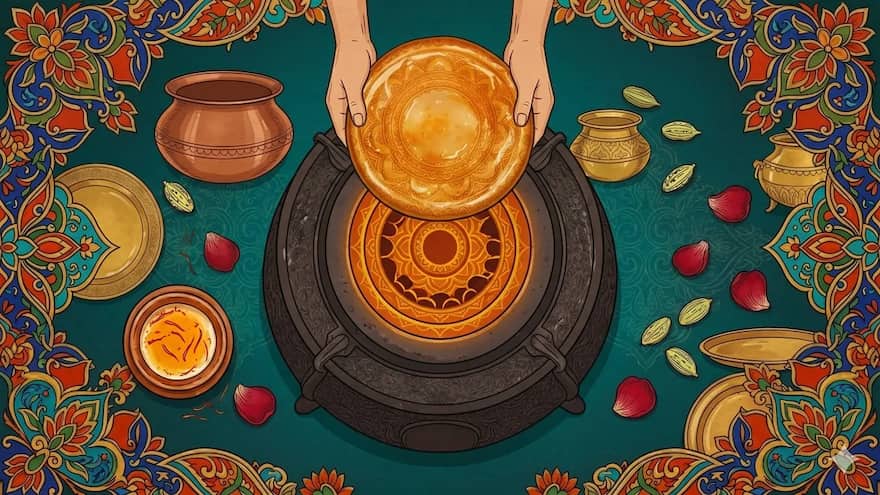
Unlike most breads of its kind, this one is baked not in clay but in iron tandoors, over coal — often tamarind coal — because clay, it is said, would drink up the fat, the fragrance, the very indulgence that defines it.
Brushed with saffron milk, glossed with ghee, perfumed with cardamom, kewra, sometimes even itr, it arrives at the table not as an accompaniment but as a statement:
Ameeron ki roti — the bread of the rich.
And yet, even here, it bends toward something more than luxury. During Muharram, it is shared as tabarruk, a sacred offering. A bread that can belong equally to the feast and the moment of mourning.
Kashmir: Where Bread Becomes Ritual
Further north, the bread sheds some of its courtliness and learns restraint.
In Kashmir, sheermal begins before dawn.
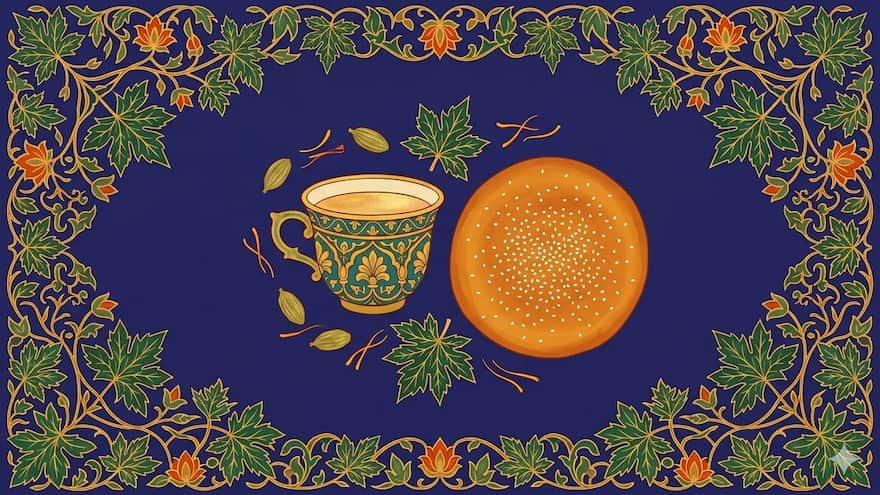
The kandur, the traditional baker, works in the half-light of morning, preparing breads that will anchor the day. Here, sheermal is not plated beside slow-cooked gravies, but dipped into tea — into kahwa, fragrant with saffron, or noon chai, salted and pink.
It is softer here in a different way — slightly sweeter, sometimes enriched with eggs or mawa, its surface scattered with sesame seeds.
And it belongs, above all, to people.
In Rajpora, in Pulwama, it is made with such care that it travels again — this time not along trade routes, but through memory, shipped to Kashmiris living far from home.
At weddings, it arrives as part of Roth Kabhar — sent from a bride’s home to her new one, adorned with nuts and salt, a quiet assurance that she will not go hungry in unfamiliar spaces.
At funerals, it is present too.
Here, sheermal is no longer the bread of the rich. It is the bread of continuity.
Bhopal: The Detour That Stayed
And then, as all travelling things must, it changes again.
In Bhopal, sheermal takes on a shape you might not expect — rectangular, edged differently, carrying within it a faint echo of elsewhere. The French Bourbons, invited by the royal family, leave their mark not in architecture alone, but in flavour: cloves folded into the dough, chironji lending it a new texture.
It is a small shift, but enough to remind you — this bread has never been singular.
One Bread, Many Lives
If you were to place them side by side, the differences would be easy to name.
Lucknow’s sheermal, gilded and perfumed, made to sit beside kebabs and qormas.
Kashmir’s, sesame-speckled and gentle, made to be torn and dipped into tea.
One belongs to the dastarkhwan. The other to the morning hearth.
And yet, both begin the same way — with milk worked into flour, with a softness that is deliberate.
What Stays
For all its movement, sheermal has never really left anything behind. It has only absorbed — milk instead of water, saffron instead of plainness, cloves where there were none, rituals where there were none before.
It is a bread that has learned to travel without losing itself.
To arrive, and then to belong.
And if you tear into it — warm, slightly sweet, faintly fragrant — what you hold is not just food, but a map.




