


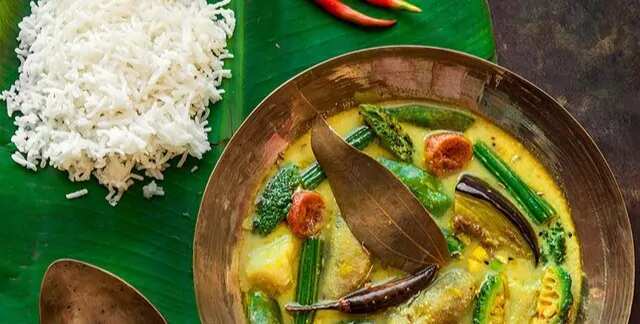
Shukto
Nutritional Value
1729
Calories
per serving
- Fat101 g
- Protein39 g
- Carbs165 g
- Fiber27 g
- Sodium0 g
- Others0 g
- Place of OriginWEST,BENGAL
- CuisineAsian,Indian,Bengali
- Common Ingredients
- CourseStarter & Appetizer
To any food connoisseur, Bengali cuisine starts with maach (fish), bhaat (rice), and mishti (sweets). Often, while discussing these irresistible delicacies, the powerful influence of vegetarianism in the authentic Bengali kitchen fails to get its well-deserved appreciation. In Bengal’s vegetarian platter, Shukto, a delectable appetiser and palate cleanser, occupies a special place, with its interesting history and undisputed nutritional benefits. The dish is commonly prepared with panch phoron (five spices), mustard, bitter gourd, sweet potato, unripe banana, drumsticks, and bori (dried pulse dumplings). It serves as the perfect accompaniment to steamed rice, hot Dal, and Bengal’s favourite, Maacher Jhol.
Food historian Chitrita Banerjee (2005) claims that the word Shukto is derived from Shukuta, which refers to the dried leaves of a plant, usually the bitter gourd. Some historians say that the recipe for Shukto landed in colonial Bengal with 16th-century Portuguese merchants who modified one of their dishes with a local ingredient they could easily procure—the bitter gourd—giving birth to Shukto. It might also be possible, as reports of naval surgeon Charles Curtis (1780) indicate, that Shukto was adopted by the Europeans to combat their troubling digestive health in the sultry Indian environment.
However, most historians consider the roots of Shukto to be embedded in ancient Indian Ayurveda and its popularisation a result of literary, cultural and historical developments of medieval Bengal. The medicinal benefits of consuming bitter as an appetiser had been amply enumerated by philosophers and physicians like Susruta, Charaka, Dhanwantari, and Jeevaka, who rightly believed that a bitter dish helps activate digestive enzymes.
References to Shukto are dotted throughout Bengal’s medieval narrative poetry known as Mangalkavyas. For instance, one of the Kavyas mentions a story where Lord Shiva asks Goddess Annapurna to cook Shukto for him. Narayandeva takes it a step further in Padmapuran by explaining the authentic Bengali way of cooking Shukto, down to the finest details.
Moreover, Shukto is mentioned as a favourite food in numerous biographies of Chaitanya Mahaprabhu, a pioneer of the Bhakti Movement in India. Pratul Chandra Gupta (1986) believes that many elite class Bengali families adopted a primarily vegetarian diet, and therefore Shukto, following Chaitanya’s ways.
To this day, Shukto serves as an indispensable part of an authentic Bengali thali. Contrary to popular belief, the traditional Bengali Shukto can be prepared with neem, jute, cucumber, helencha-saag, milk, and even fish.
Nutritional Value
1729
Calories
per serving
- Fat101 g
- Protein39 g
- Carbs165 g
- Fiber27 g
- Sodium0 g
- Others0 g