


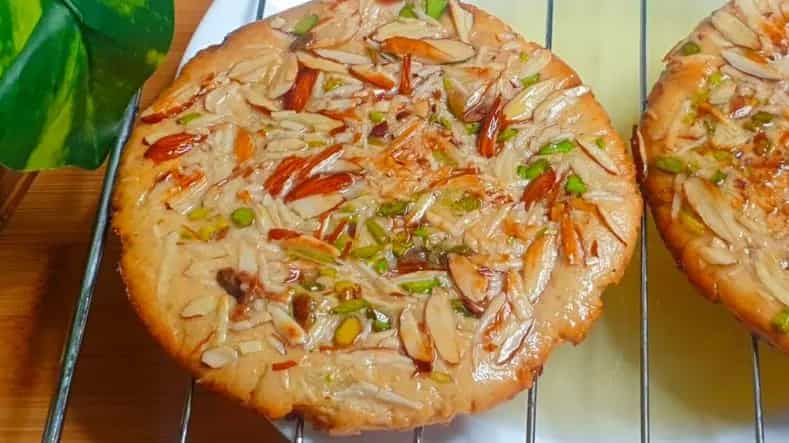
Sheermal
Nutritional Value
325
Calories
per serving
- Fat20 g
- Protein11 g
- Carbs27 g
- Fiber0 g
- Sodium0 g
- Others0 g
- Place of OriginPERSIA,(IRAN)
- CuisineAsian,Middle Eastern,Persian
- Common Ingredients
- CourseMain Course
India has always been a land of bread. Through the repeated foreign invasions that the country has faced, each people have brought their own culinary delights, making the region a hotpot of several cultures.
Sheermal’s introduction into India came through the silk route. A milky flatbread originating in Persia (present-day Iran), Sheermal journeyed across three countries, namely Iran, Afghanistan and Pakistan. The Mughals consumed Sheermal regularly as part of meals. In fact, legend goes, that the renowned Galouti Kebab, known for the detailed manner in which the lamb meat was prepared for the toothless Nawab of Lucknow, with as many as 150 spices, was stuffed inside the Sheermal for the benefit of the Nawab. The combination of the two dishes famously melts in the mouth, and hence was the perfect meal for him.
The Sheermal has been adapted into Indian cities which have a strong Muslim population now. Thus, places like Hyderabad, Lucknow or even Bhopal, have a strong presence of the Sheermal. The shape of the Indian flatbread differs in different parts of India. For example, in Hyderabad, it’s circular with bits of saffron strewn over it, while in Bhopal it is rectangular in shape, almost like the Goan Pav (a local bun variant). The Sheermal is baked in other parts of India, but in Bhopal it is flavoured with cloves. This concept of adding the clove was apparently adapted after the influence of French Bourbons, who were summoned to Bhopal by the royal family.
The Sheermal is consumed in various forms and is often termed the “mother”, who “holds everything together.” The dish is flexibly teamed with a cup of steaming Masala Chai in the morning, but can also be savoured with a flavourful mutton broth for dinner. In fact, it is one of the most consumed dishes during the Islamic holy month of Ramadan. Sheermal goes perfectly with the array of stews (like Nihari, Paya or Haleem) that the community is well known for.
Lucknow has been known as one of the most renowned cities to patronise the Sheermal in modern times. One of the legendary accounts speaks of Mahmood, a resident of Lucknow during the rule of Nasiruddin Haider. It is said that Mahmood opened up a small eatery at Firangi Mahal, known for its lip-smacking Nihari. In a bid to conjure something special to go with this Nihari (rather than the hackneyed Paratha), Mahmood invented the Sheermal. The eatery, named Mahmood’s, was run by the head chef Ali Husaain Sheermal, and unsurprisingly, the dish was named after him. In fact, the bread gained so much traction over the years, that the lane in which Mahmood’s is located, is called Sheermal-wali Gali.
Nutritional Value
325
Calories
per serving
- Fat20 g
- Protein11 g
- Carbs27 g
- Fiber0 g
- Sodium0 g
- Others0 g