


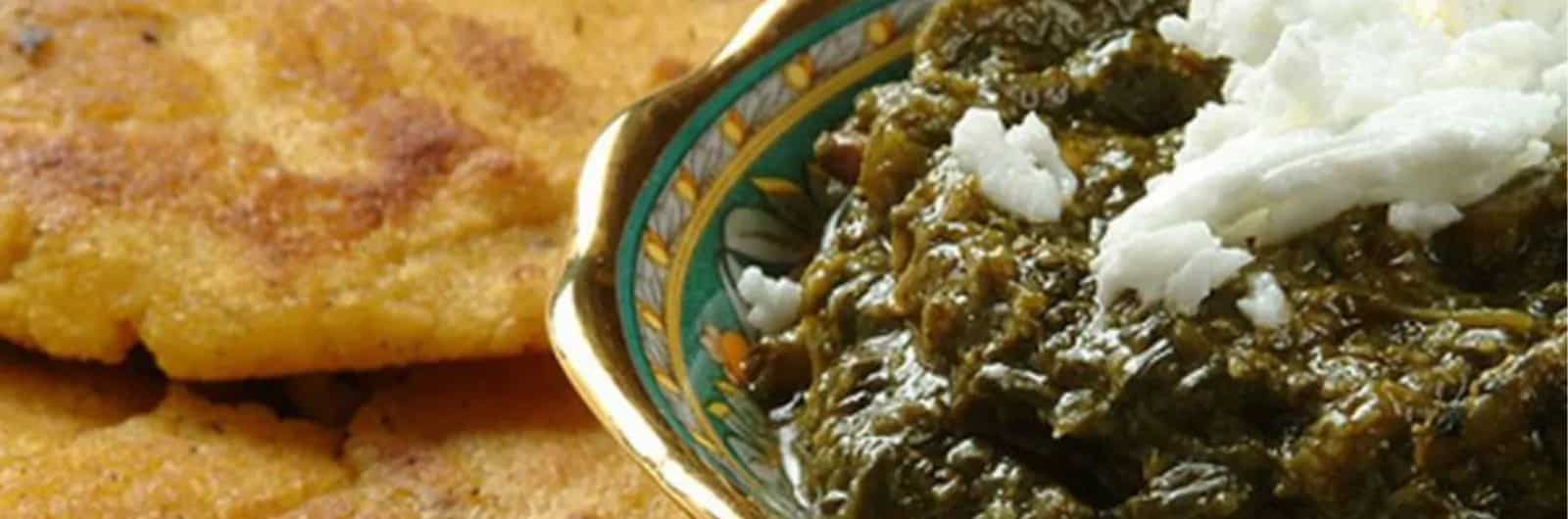
Sarson da Saag
Nutritional Value
314
Calories
per serving
- Fat18 g
- Protein12 g
- Carbs23 g
- Fiber16 g
- Sodium0 g
- Others0 g
- Place of OriginINDIA
- CuisinePunjabi
- Common Ingredients
- CourseMain Course,Side Dish
P unjab is defined in a simple phrase for most people across the world—Sarson da Saag and Makki di Roti. This famous combination has managed to transcend borders of faith, religion, geography and personal biases to become a much-beloved dish.
The first mention of Sarson da Saag was found in Acharanga Sutra, a Jain text dating almost 2,500 years. Sarson da Saag is nothing but the leafy greens obtained from the mustard plant. Saag, a crucial element in Indian platters, are generally the leafy greens that are often prepared with garlic and other condiments to give it a compact flavour. Saag is eaten with rotis (Indian flatbread) or steamed rice. Similarly, Makki di Roti was never a part of the daily consumption in the villages of Punjab. Wheat, as a grain, was consumed by the lower castes. The upper classes would eat Basmati rice.
However, with Guru Nanak’s advent and preachings of a casteless society, community tandoors became a norm. As a result, many middle and upper-middle classes began including wheat breads into their daily meals and soon Makki di Roti became a regular feature. Historically, Sarson da Saag was a peasant dish, as it was a method for farming families to not waste the rest of the plant after mustard seeds were extracted for export and sale. The leaves of the plant would then be mixed with generous amounts of ghee and garlic and cooked in hot woks. Typically, a winter dish, Sarson da Saag is made with oodles of butter, making it an apt inclusion for the exacting winters in Punjab.
Nutritional Value
314
Calories
per serving
- Fat18 g
- Protein12 g
- Carbs23 g
- Fiber16 g
- Sodium0 g
- Others0 g