


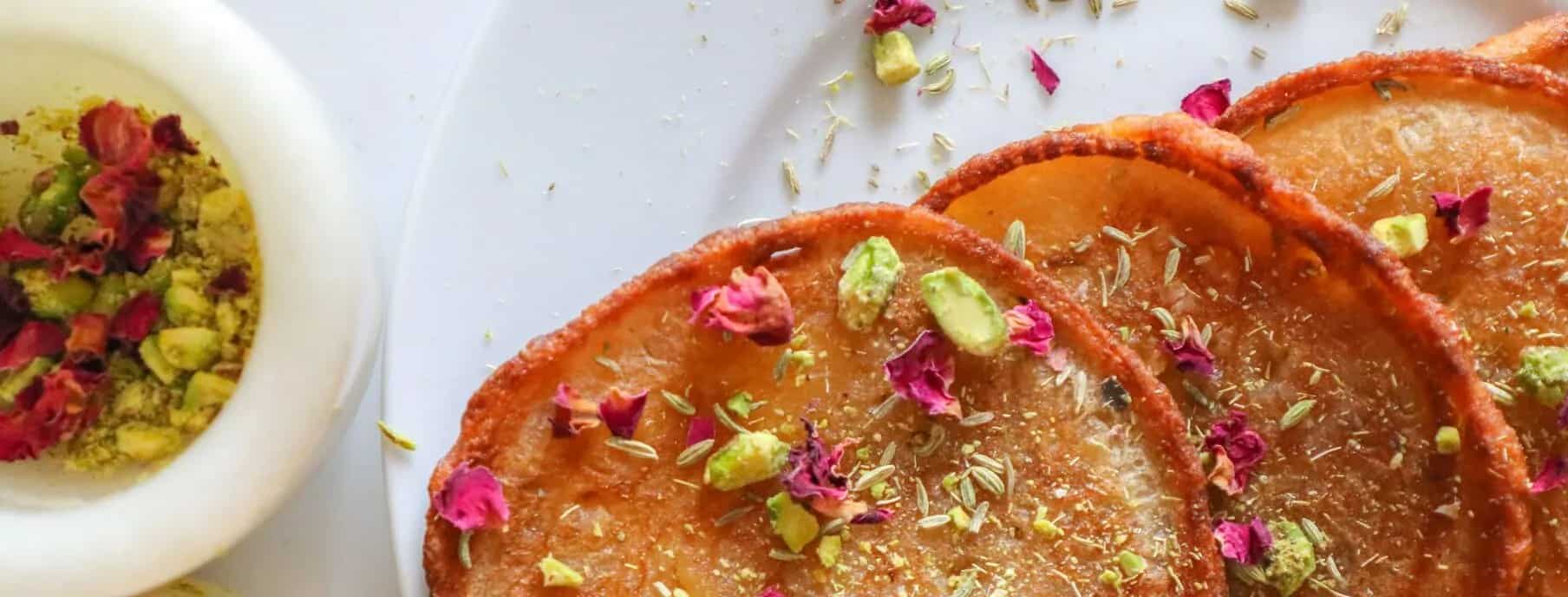
Malpua
Nutritional Value
2220
Calories
per serving
- Fat93 g
- Protein46 g
- Carbs299 g
- Fiber13 g
- Sodium0 g
- Others0 g
- Place of OriginINDIAN
- CuisineIndian
- Common Ingredients
- CourseDessert
If there is one sweetmeat dish that has truly stood the test of time, it has to be Malpua, the fried pancake dunked in sticky sugar syrup. The earliest forms of Malpua were conjured up in the Late Vedic period, and are touted by historians to be the very first form of dessert to be made in India.
In her book Whose Samosa is it Anyway, Sonal Ved observes that the Rig Veda cites many references to a dish named Apupa, which is believed to be the rudimentary rendition of Malpua. Apupas were made with barley flour dough and then flattened to resemble pancakes. The pancakes were deep fried in a vessel filled with ghee and then drowned in honey. The Rig Veda cites that barley was the most commonly cultivated grain at the time, and honey was the only sweetener known to Vedic communities.
Later Vedic texts like the Upanishads and Brahmanas chart the evolution of this sweetened barley cake from its rudimentary version to then being flavoured with additives like Soma juice. Texts from the 2nd-century AD refer to sugar substituting for honey and wheat flour for barley. Cardamom, pepper and ginger shavings were also added to Apupas during this time to strike a sweet and savoury balance. This version was called Pupalika and boasted of a jaggery filling.
In Buddhist Monasteries, the pancakes were made with powdered rice grains and assumed the name Kanapuvam. A non-vegetarian version of this erstwhile vegetarian dish was created in the Islamic courts with the addition of eggs and mawa.
Almost every region of this country today has their own version of Malpua. Amalu, which hails from Odisha, is offered to Lord Jagannath as one of the 56 items of the Chappano Bhog Mahaprasad (a holy offering). In Nepal, Malpuas are made with ripe bananas and flavoured with peppercorns and fennel seeds, and are also referred to as Marpas. Bangladesh also uses ripe bananas for their iteration of this delicious treat.
As religious communities tussle over gods and places of worship, Malpua stands as the truest symbol of secularity. It is as common a feature in Hindu households during Holi as it is in Muslim ones during Ramadan. While it might not be the choicest healthy dessert, it sure will leave your sweet teeth craving for more.
Nutritional Value
2220
Calories
per serving
- Fat93 g
- Protein46 g
- Carbs299 g
- Fiber13 g
- Sodium0 g
- Others0 g