


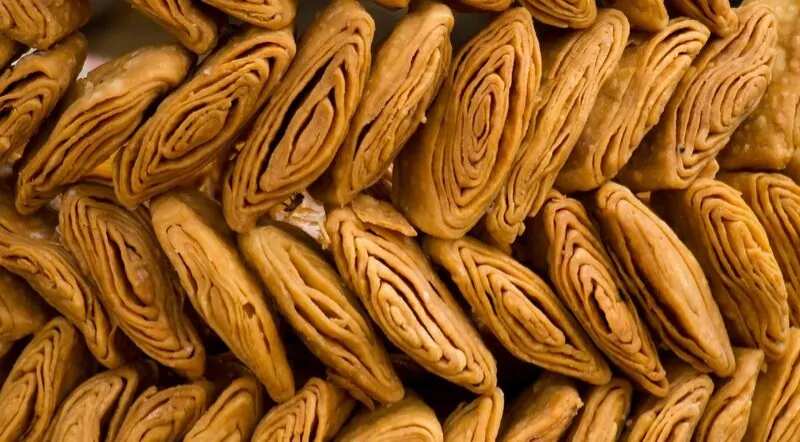
Khaja
Nutritional Value
3395
Calories
per serving
- Fat119 g
- Protein46 g
- Carbs530 g
- Fiber16 g
- Sodium0 g
- Others0 g
- Place of OriginAGRA,,AWADH
- CuisineAgra
- Common Ingredients
- CourseDessert
A unique sweetmeat closely related to the East Indian state of Odisha, Khaja is a delicious wonder savoured by many. Believed to have originated in the princely states of Agra and Oudh, the sweet treat finds presence in modern day Uttar Pradesh, Bihar, Odisha as well as Andhra Pradesh.
The dessert is made by stacking thin layers of the special batter, one on top of the other, individually frying each layer at a time. The mix is essentially made from wheat flour and sugar syrup, often also having the sugar crystals as a part of it to add the extra bite to the dish. Over the years, Khaja has come to symbolise the divine. A mandatory offering to Puri’s holy trinity, this light brown, shallow fried sweetmeat is part of the mahaprasad (special offering to gods and goddesses) to Lords Jagannath, Balaram and Goddess Subhadra. The dry flaky treat is also termed Feni in Odisha and can hardly be consumed by any Odiya without the customary gesture of brushing it against their heads before the first bite.
Interestingly, as much as Khaja has gained popularity in Odisha, the sweet’s genesis was somewhere else. An imported commodity, the treat has been assimilated into the state’s socio-cultural fabric seamlessly. One account links the dish’s roots back to the Maurya Dynasty, situated in Silao, a nondescript district situated between Bihar and Mithila.
Khaja finds ancient references in Indian texts, alluding to the recipe’s presence even multiple centuries ago. The Rigveda and Arthashastra have mentions of this sweetmeat. In fact, Chanakya, the noted statesman and scribe to Arthashastra termed the sweetmeat ideal for ‘power sustenance’. Wheat, as history has proven, was a prized discovery in the Maurya period. When noted Chinese explorer Hiuen Tsang travelled to India and documented the Maurya rule, he mentioned the Khaja. Archeologist JD Beglar, on whose extensive research the Silao Khaja gets the GI (Geographical Indication) tag, wrote in his thesis that the sweet was prevalent during emperor Vikramaditya’s era.
Yet another account of Khaja’s roots trace it back to Andhra Pradesh. Many food historians believe that the South Indian state began the Kakinada Kaja, which further had two variants—Madathakhajas and Gottamkhajas. The former was dry and composed of cylindrical pastries, while the latter was made using ribbons of pastry and had a gooey, rich, sweet centre.
Nutritional Value
3395
Calories
per serving
- Fat119 g
- Protein46 g
- Carbs530 g
- Fiber16 g
- Sodium0 g
- Others0 g