


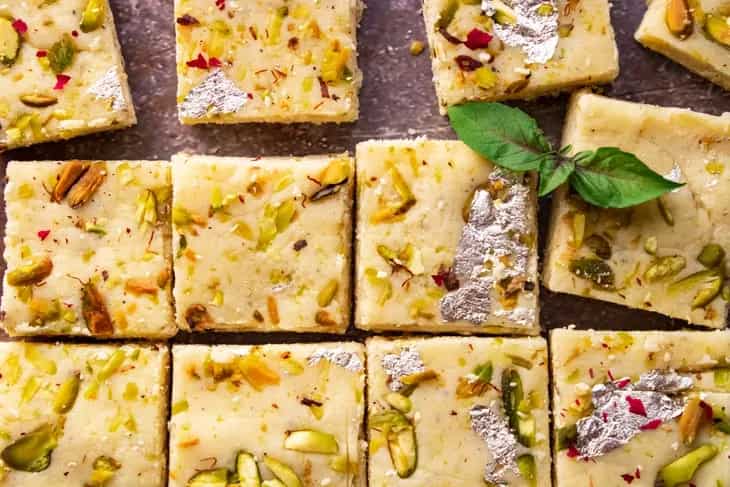
Barfi
Nutritional Value
3242
Calories
per serving
- Fat246 g
- Protein105 g
- Carbs152 g
- Fiber47 g
- Sodium0 g
- Others0 g
- Place of OriginPUNJAB
- CuisineAsian,Indian,Punjabi
- Common Ingredients
- CourseDessert
Elegant in appearance and fairly simple to prepare, Barfi has long been one of the most popular Indian sweetmeats. Its three ingredients are sugar, milk and ghee. The marriage of these three elements forms the basic building block for the plethora of other permutations in the repertoire of Indian sweets. But as old as Indian history may be, Barfi finds a notable mention everywhere.
Etymologically, the word derives its roots from the Persian ‘barf’ meaning snow. The pristine white cubes, with a glint of sparkle on their outer edges (often occurring due to the sugar crystals), lend it an appearance akin to uncut diamonds in their rough form.
The history of the recipe trails back to the North Indian state of Punjab, when Harbans Vig, a wrestler by profession, stumbled upon this invention by mere accident. Legend goes that Vig was quite exasperated with the same drill of consuming milk and ghee every day in order to maintain his fitness levels. The desperate man concocted a mixture of sugar, milk, ghee, and ground nuts into a hot tawa (pan) and unsurprisingly created magic. The rich brown-coloured mash was both crunchy and sweet, and was promptly named the Dhodha Barfi. Since the discovery took place before the Indian Independence struggle, the Vig family shifted to Kotkapura in Punjab from Sarghoda district (in modern-day Pakistan). There, they set up the Royal Dhodha House which has since sold lakhs of orders for this famed sweetmeat. To date, the legacy of Harbans continues in the staunchly guarded secret recipe that goes behind making the Dhodha Barfi.
The ingredients in the Barfi are equally important for its health benefits. The main ingredient, milk, followed by the ground nuts provides the essential minerals, lactose and fatty acids. The nuts are also a rich source of Vitamin E and are high in their fibre content, helping in maintaining skin health.
Apart from this, the khoya variant of the Barfi is also very popular across India. The white sweetmeat is traditionally served as prasad (holy offerings to gods and goddesses). For example, this dish is a crucial element in the bhog served to Lord Jagannath and Goddess Laxmi.
Multiple combinations of the Barfi have cropped up in the recent past as a testament to the dish’s immense popularity. For example, now you have the Kaju Barfi (made from cashews, served majorly during Diwali), Anjeer Barfi (consisting figs, considered an epicurean version of the originally simple dish), or even the Moong Dal Barfi (made from pulses).
Nutritional Value
3242
Calories
per serving
- Fat246 g
- Protein105 g
- Carbs152 g
- Fiber47 g
- Sodium0 g
- Others0 g