


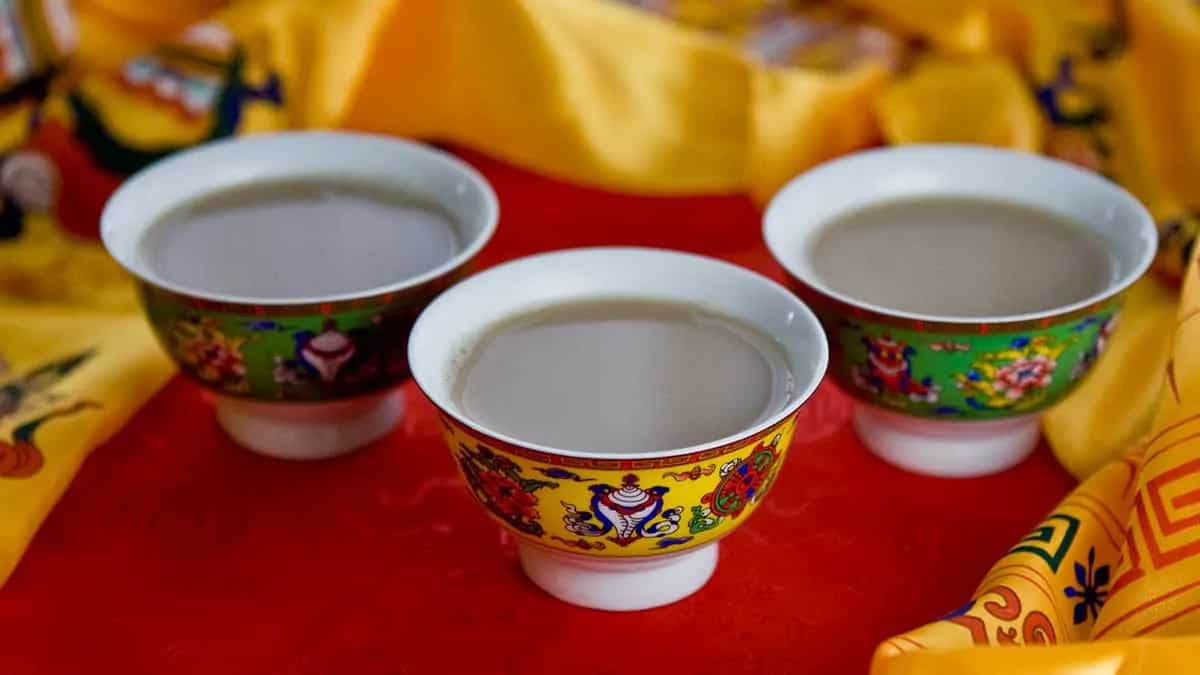
Butter Tea
Nutritional Value
115
Calories
per serving
- Fat7 g
- Protein5 g
- Carbs9 g
- Fiber2 g
- Sodium0 g
- Others0 g
- Place of OriginTIBET
- CuisineAsian,Tibetan
- Common Ingredients
- CourseStarter & Appetizer
A steaming cup of thick, frothy Butter Tea, or Po Cha as locals refer to it, is perhaps the first beverage you’d be welcomed with on your road trip to the rugged mountains of Sikkim or Ladakh. This salty, almost savoury drink originated in Tibet between 1354 and 1618, during the reign of the Phagmodrupa dynasty. During this time, Butter Tea, among other kinds of teas, became a staple feature across Tibetan and Chinese households, notwithstanding social strata. It was also being consumed by monks as well as offered up during religious ceremonies.
The process of its preparation has understandably undergone monumental change ever since its existence in the 13th century. This is a viscous, purple-black drink, unlike your run-of-the-mill milk tea available all over India. Its consistency is close to a soup thickened with cornflour and is the perfect side to a plate of Tsampa, a dish made with wheat or barley flour. This flour is then made into either flour balls or bread or even porridge at times. It’s served specifically in wooden bowls in households, despite the ready availability of porcelain or jade bowls in the markets. These bowls are preserved and passed on through generations as a sign of familial well-being and tradition.
A cup of Butter Tea is made primarily with cow’s milk and tea bags, but the traditional form of the tea would feature a generous dollop of yak milk butter. Since yaks are native to the Himalayan regions, the tea is prepared using the same. However, in other parts of the country, butter extracted from goat or sheep milk is also used as a replacement because of how similar the end product tastes.
Using a similar logic then, this form of tea uses salt as a substitute for sugar and butter instead of milk. The easy availability of salt in the region meant that it could not only be added in the preparation of this popular drink but was historically used as a currency in trade, alongside wool, in exchange for grains and other staples.
This beverage is ideal for consumption at such low temperatures, as the high-calorie content in butter replenishes the body’s rapid rate of calorie burning at higher altitudes. Similarly, the high salt content is also said to keep the body warm. As a matter of fact, this tea is consumed regularly by indigenous communities, the count sometimes scaling up to a whopping 60 cups a day.
Nutritional Value
115
Calories
per serving
- Fat7 g
- Protein5 g
- Carbs9 g
- Fiber2 g
- Sodium0 g
- Others0 g