|
|
|
What separates humans from every species on this planet? Hypocrisy? Rationality? Binge-watching TV shows?
All of the above but scientists believe the moment humans really started separating the wheat from the chaff – literally and figuratively – was when we started cooking our food.
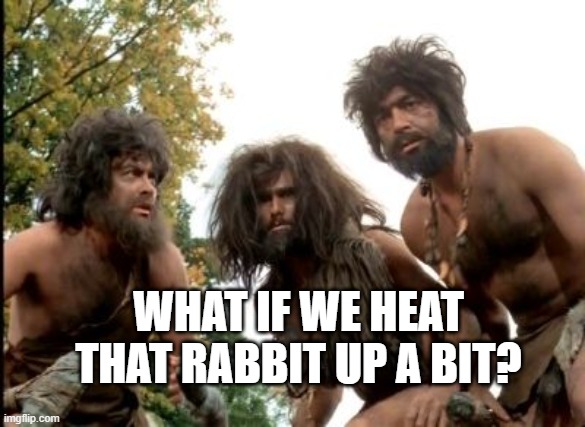
The pivot to being a superior race started with our proverbial Prometheus-like ability to control fire. Now there’s some contention on when we started to cook. Some claim it’s fairly recent, about 500,000 years. Anthropologist Richard Wrangham’s cooking hypothesis on the other hand suggests it started 1.8 million years ago.
The increase in the homo erectus’ brain size coincided with the decrease in size of our teeth and digestive tract.
In fact, the size of the brain – the source of all our magical powers that makes us the dominant species on this planet – has always perturbed evolutionists. The brain – for an organ of its size which doesn’t do anything physically – needs a lot of calories to thrive.
And that’s where cooking comes in. By cooking, we could consume more calories, which was the fuel our brain needed, to create the god-like marvels that we take for granted today.
Scott Adams, the author of Dilbert once argued: “We’re a planet of nearly six billion ninnies living in a civilization that was designed by a few thousand amazingly smart deviants.” One can say that those amazingly smart deviants wouldn’t have thought up such remarkable things if their ancestors hadn’t learned to cook food.”
Or in simpler words, we eat therefore we are – human.
So, to celebrate – from an ontological and evolutionary perspective – the greatest achievement known to humankind, we present Foodgasm by Slurrp.
Like the perfect meal it has – a spiritual touch, an appetizer, a main course, a dessert and of course our favourite thing from the restaurant – a takeaway bag.
This week’s food trail begins from the IPL final held at the Narendra Modi Stadium in Ahmedabad. While the Gujarat Titans lifted their first trophy after an electrifiying opening ceremony, the BCCI also showcased the world’s biggest jersey earning it the Guinness World Record. And that’s where we start…
|
|
The Spiritual Touch 🍸
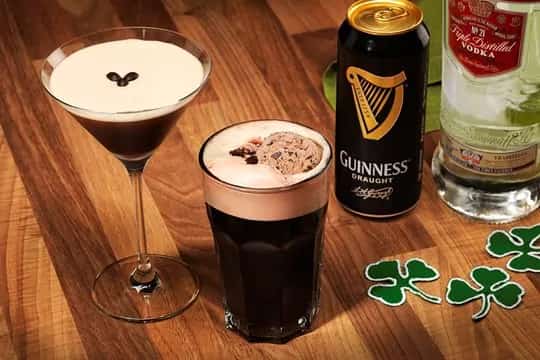
Guinness Cocktails
Guinness for the uninitiated, is an Irish stout which played its part in launching the Guinness Book of Records when Sir Hugh Beaver, managing director of Guinness Breweries got into an argument about the fastest game bird in Europe.
Earlier, dark well-hopped beers were called porters and those which were strongest were called “stout porters”.
Since then, Guinness has become one of the most popular stouts across the world. In fact, Guinness came out with a pioneering nitrogen-filled capsule that replicates the draught experience when the can is opened.
So, what do you need for the cocktail? Some regular vodka, rum, espresso-flavoured vodka, cardamom, chocolate ice-cream, cans of Guinness, and the heart and soul of an adventurer.
How do you make it? Glad you asked. Check out the full recipe on Slurrp.
|
|
The Appetizer 😋
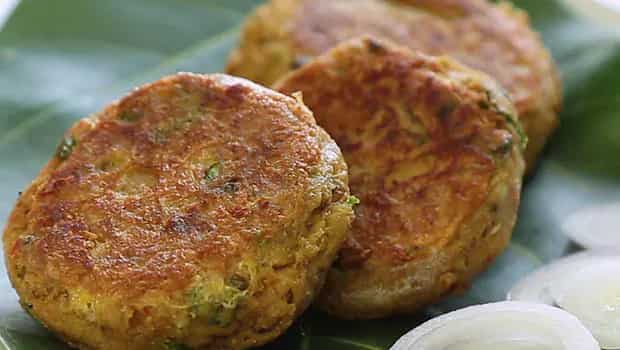
Shami Kebab
Most culinary experts suggest that a stout like Guinness ought to be paired with a Shepherd’s Pie or Blackforest Cake but we are going to try something more regal and closer to home which has all the right culinary traits – the shami kebab.
The shami kebab was ostensibly invented by a cook for Asaf-ud-Dulah, a toothless nawab who had lost his teeth to gluttony.
Historian Lizzie Collingham wrote in her book Curry: “Indeed, Asaf-ud-Dulah became so fat that he could no longer ride a horse. He managed to gain vast amounts of weight despite the fact that his ability to chew was compromised by the loss of his teeth. Shami kebabs are supposed to have been created in order to accommodate this problem. They were made out of finely minced and pounded meat known as qeema. While westerners tend to mince meat as a way of using inferior grades, the Mughals would often mince the best cuts. Qeema is frequently referred to in the recipes given by Akbar’s courtier, Abu’l Fazl, as an ingredient for pulaos.”
Crispy on the outside and buttery soft inside, it is the perfect accompaniment to your drink. Here’s how you can make mutton, chicken and veg shami kebabs.
|
|
The Main Course 🍜
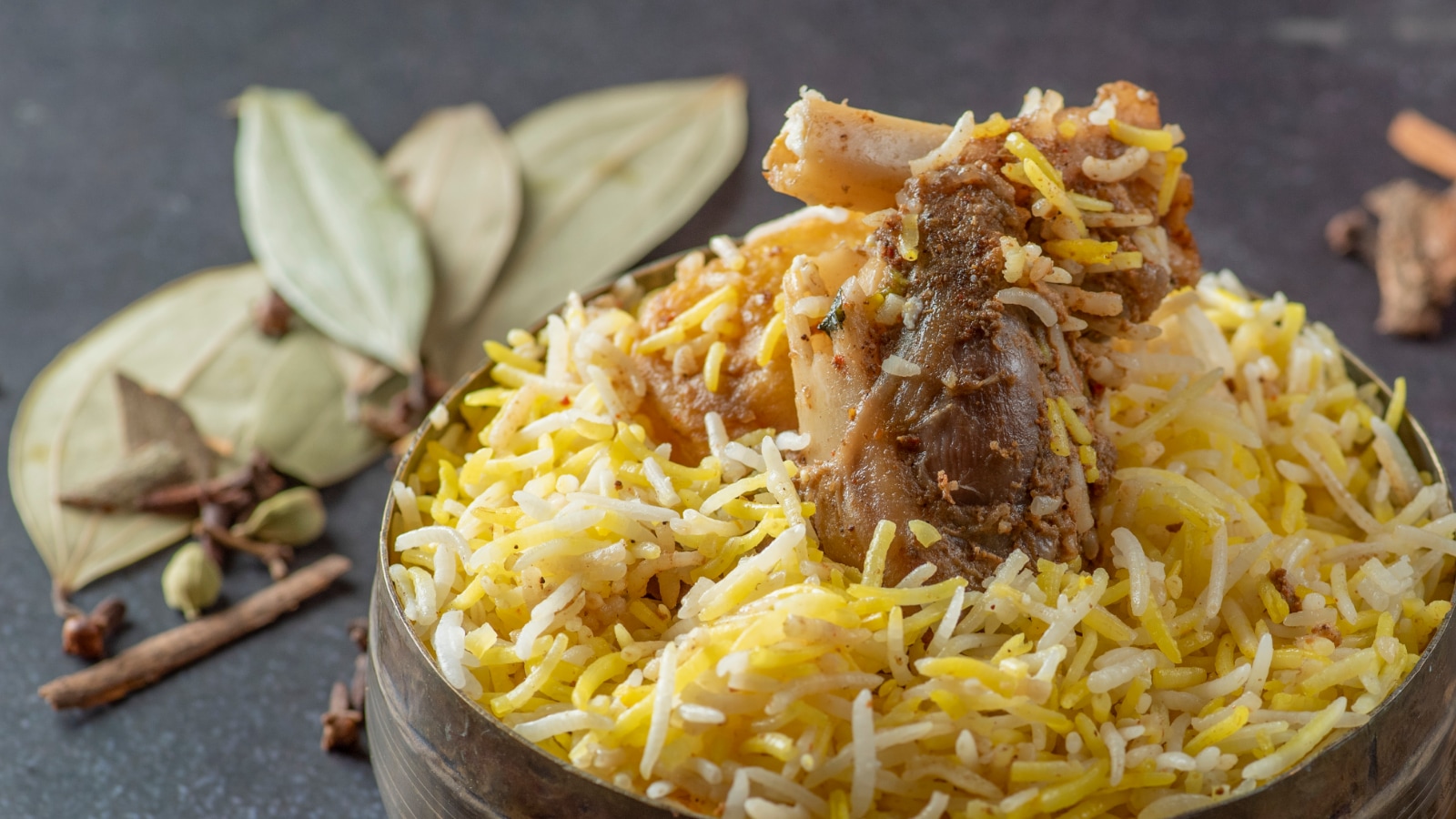
Calcutta Biryani
The humble potato, like the gods, comes in many avatars. French fries, wedges, vodka. Between two yeast-processed flour lumps that Mumbaikars call a Vada Pav.
But where it truly shines – as the crème de la crème or the cherry on top – is as an accompaniment in the Calcutta biryani. There are people who argue that the biryani is better without potatoes. Those people are clearly born without functioning taste buds.
In fact, much like the shami kebab, the current Calcutta-style biryani also has a Nawabi history.
While one urban legend claims that the potato was added as a substitute for meat due to lack of resources, Nawab Wajad Ali Shah’s great-great grandson Shahanshah Mirza disagrees.
Rebutting the commonly held belief that the potato was used as a substitute for meat due to penury, Mirza said that the potato was a rare vegetable and considered exotic.
He said: “In one of the experiments, the chef added potato to the biryani. The Awadhi biryani is cooked in the dum-phukt style. In the dum-phukt style, the lid is sealed over the pot so the steam doesn’t go out. As a result what happens the fragrance, the aroma, the juices of spices, rice, meat, saffron all gets absorbed in the meal, which makes the dish very delicious. So when potato was cooked along with the saffron spices, meat…”
It was so popular that anyone who ate it ostensibly repeated the process and the potato-laden dish became a shining light on Calcutta’s food scene. Here’s our favourite recipe to make the dish fit for kings and nawabs.
|
|
The Dessert 🍨
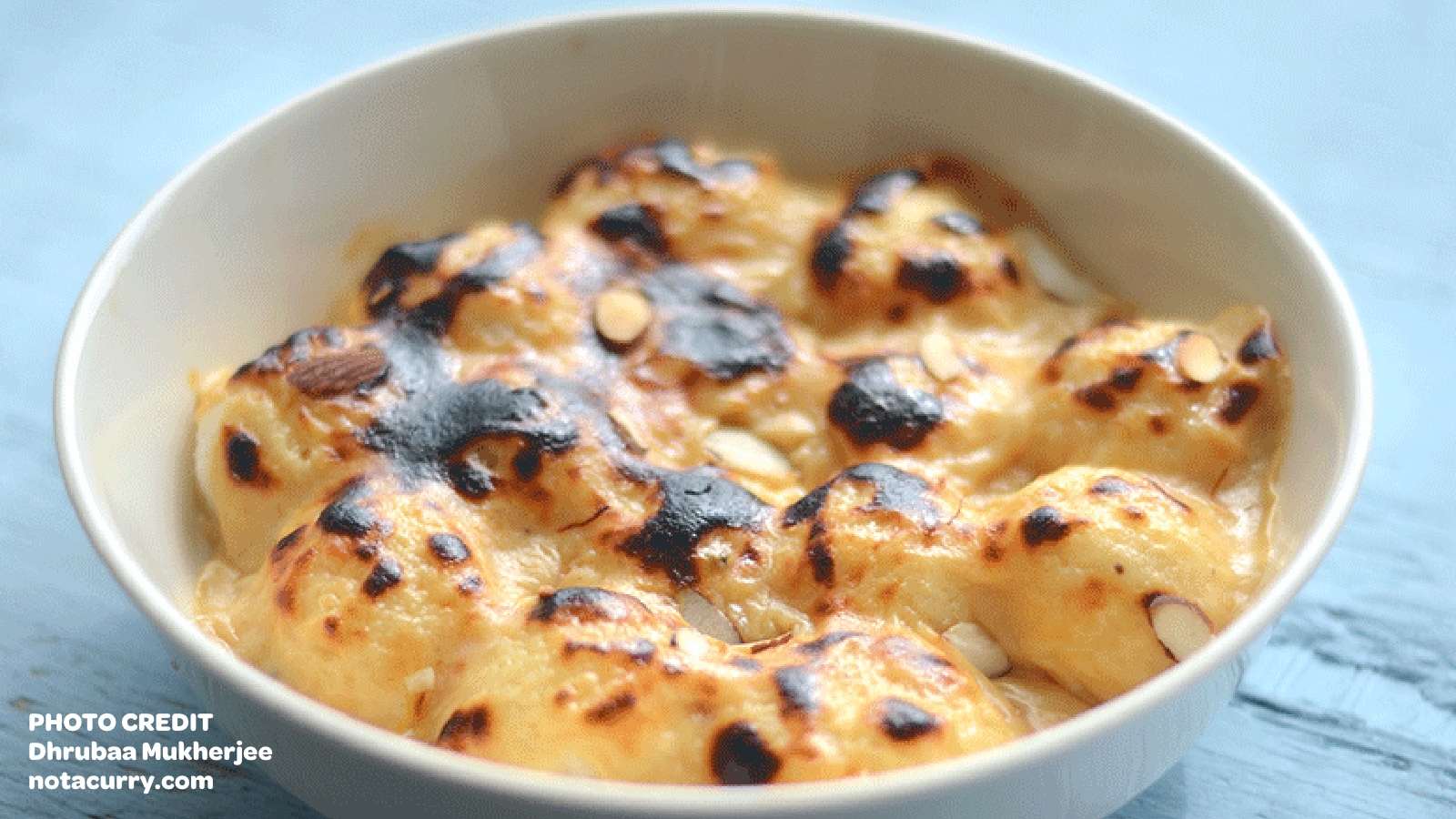
Baked Rasgulla
Since we’re already on the Bong trail, we are going to finish it off with one of the most amazing iterations of one of India’s favourite sweets – the baked rasgulla.
While Bengalis and Odias fight over the ownership of the rasgulla, it's hard to find any historical documentation of the first instance of the baked rasgulla.
Made with condensed milk and chhena, everyone who makes a trip to Calcutta is often asked to return with a dabba from KC Das. However, it’s quite easy to make your own with this fabulous recipe.
|
|
The Takeaway 🥡
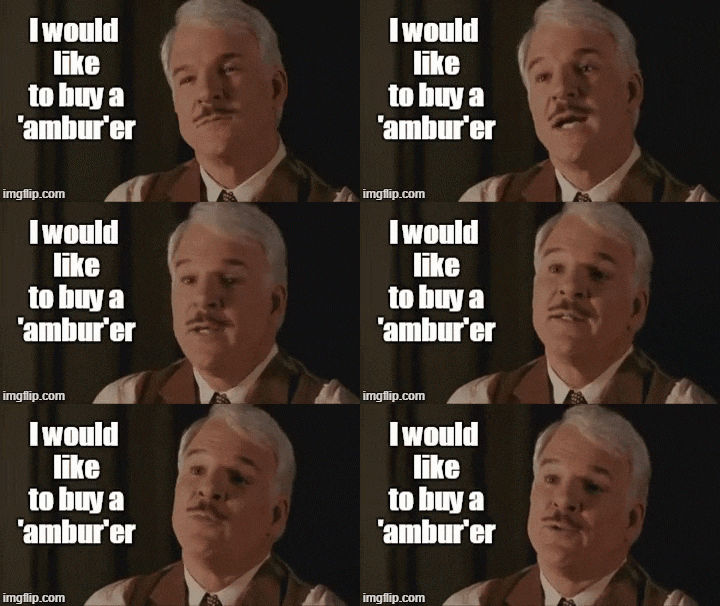
The Hamburger’s Origin Story
While today’s food trail has been a largely desi affair, for our takeaway we will revisit an old classic which is hugely popular in India as well.
Much like the argument whether Isaac Newton and Gottfried Wilhelm Leibniz discovered calculus, the hamburger has an equally-hotly contested origin story.
Most experts agree that while the modern hamburger either originated in Hamburg, Germany or as an evolved hamburger steak in America, the first recorded instance of a recipe similar to the hamburger patty can be traced back to a first-century AD Roman cookbook by Apicius which has a recipe for a “minced meat patty blended with crushed nuts and heavily spiced and cooked”.
The modern hamburger most probably came from the Hamburg steak – a patty of ground meat – similar to the Salisbury steak which was brought to America by German migrants.
By the 1880s, hamburger steaks were served across America. The places which served these steaks also served toast and one thing led to another. The meat found its place between two pieces of bread, and we had another delightful sandwich.
PS: By now you must be lusting for a burger, so here are some excellent recipes for a chicken, lamb and veg burger.
|
|
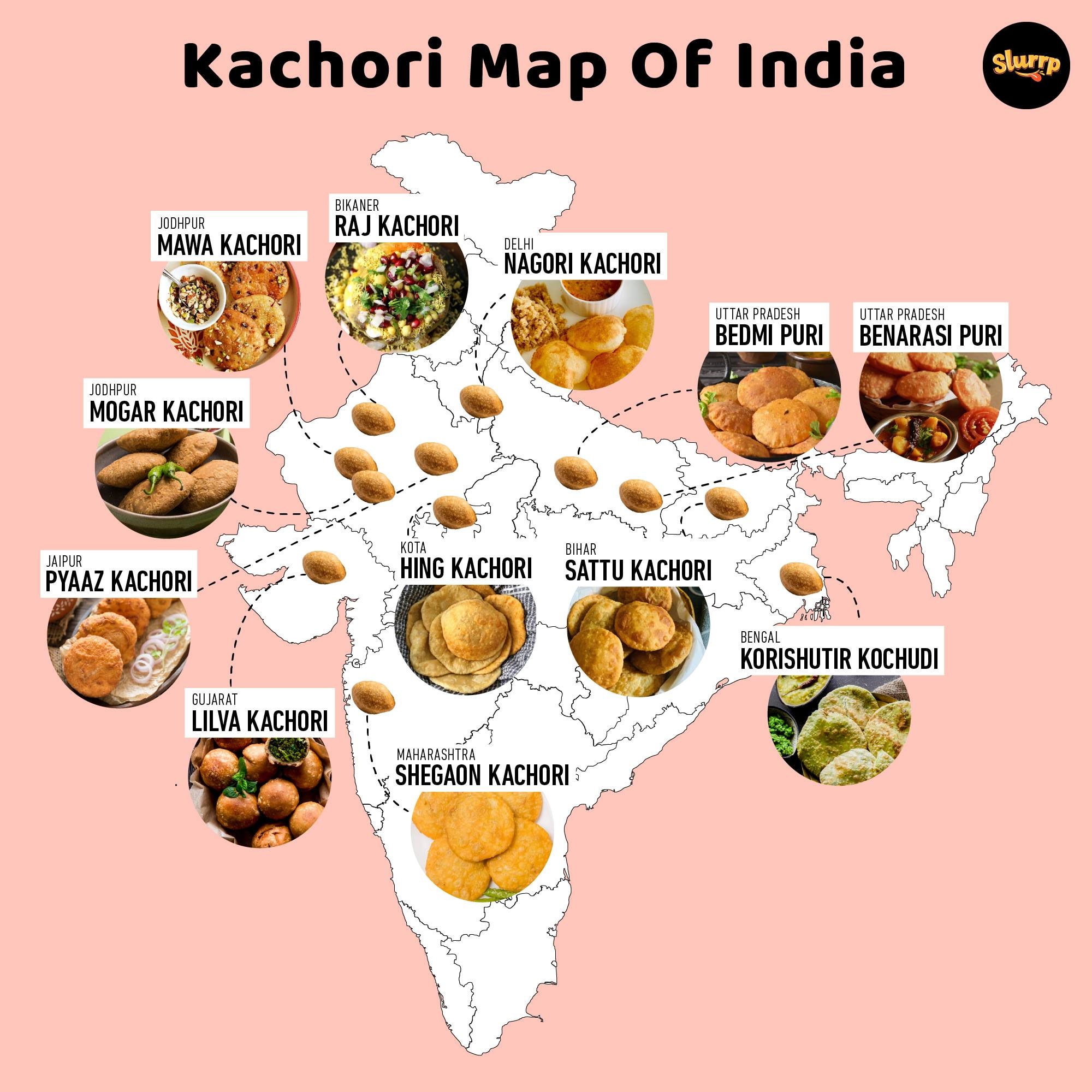
Kachori Map of India
Found this online? You can subscribe here
|
|
|
|
|
|
| |
|
|---|
| Contact Address | | Hindustan Media Ventures Limited, Hindustan Times House, 18-20, Second Floor, Kasturba Gandhi Marg, New Delhi – 110 001, India | | If you need any guidance or support along the way, please send an email to slurrp@htmedialabs.com. We’re here to help! | | Terms and conditions apply. View our privacy policy here. |
|
|
| ©️2021 Slurrp, HT Media Labs. All rights reserved. |
|
|
|
|

| |