


 Share
Share

The moment you mention space exploration, immediately, planets, stunning stars, nebulae, and astronauts in bulky suits come to mind. Hardly anyone actually thinks about the food. Food is rarely part of the picture. Yet every human mission has had to solve a surprisingly domestic problem before leaving Earth. And that is what will the crew eat up there? This automatically makes World Space Week (observed from 4 to 10 October every year) an unexpectedly suitable occasion to look at food. The United Nations established the week to celebrate the contribution of space science and technology to humanity.
The dates commemorate the launch of Sputnik 1 on 4 October 1957 as well as the Outer Space Treaty of 1967. In 2026, the theme is “Rocket Revolution”, reflecting the changing landscape of access to space for the world. And India has a very interesting food story to share. Indian space food has evolved a lot, from nourishing Rakesh Sharma in 1984 with simple desi dishes, to a much more sophisticated menu that has been specially developed for India's most recent human spaceflight programme.
In 2025, food developed with the Defence Research and Development Organisation (DRDO) was successfully flown to the International Space Station during the Axiom-4 mission, where Indian astronaut Shubhanshu Shukla spent 18 days. The main, fascinating part here is that the food does not need to look futuristic to be suitable for space. It just needs to behave differently.
Did You Know These 6 Desi Foods Have Been To Space Already?
Vegetable Pulao
When Rakesh Sharma was the first Indian to travel to space in 1984, aboard the Soviet Salyut 7, his menu included vegetable pulao, aloo chholey, and sooji halwa. The meals had been prepared by the Defence Food Research Laboratory (DFRL) in Mysuru and adapted for consumption in the spacecraft. Now pulao does make a lot of sense as a choice here. It is familiar, prepared in a desi manner, and can be a complete dish on its own instead of being assembled from several individual components. But in orbit, even a grain of rice has to be controlled.
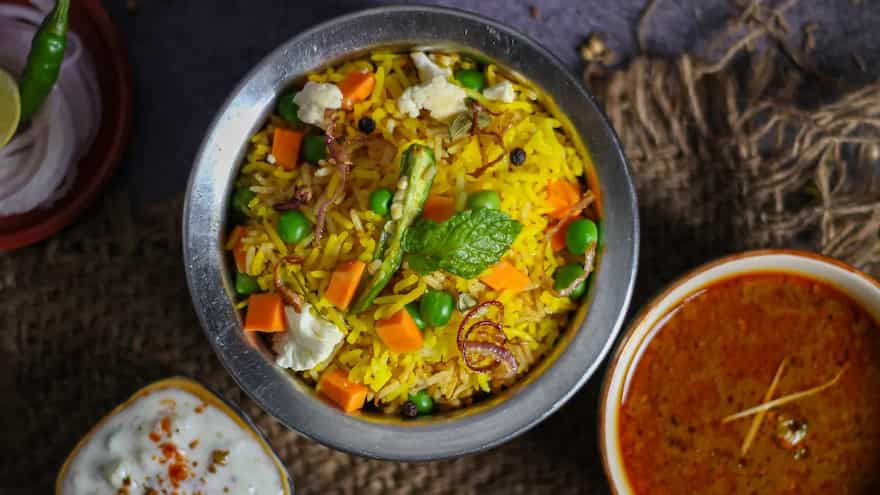
Image credit: Pexels
Food in microgravity cannot be allowed to scatter freely through the cabin, so Indian space-food development had to focus on packaging and formats that minimise fragmentation and make meals straightforward and easy to consume. The DFRL has identified low fragmentation as an important requirement alongside nutritional adequacy and shelf stability for qualifying as space food. Now that is a rather curious transformation and approach. Pulao remains pulao, essentially, but the way it exists and behaves had to change to be space-friendly.
Also read: Astronauts Cannot Eat These 5 Foods In Space
Aloo Chholey
Aloo chholey was another part of Sharma's 1984 menu, giving India's first astronaut something much closer and similar to home cooking than the early space programmes' food tubes and compressed cubes. The choice is revealing and self-explanatory. Space menus have long had to balance nutrition with familiarity and acceptability. Astronauts are also humans; even their taste buds and approach to food deserve a second thought. NASA's historical food research similarly notes that as missions became longer, astronauts needed greater diet variety as well as foods that remained recognisable and appealing.
While every country in the space race approached the matter keenly and in their own way, for India, that meant taking dishes that their astronauts actually knew and liked and re-engineering them for an unforgiving environment in which no ordinary plates, free-flowing gravies or convenient leftovers can exist. Therefore, aloo chholey was not simply a culinary souvenir from Earth. It was an early demonstration that Indian food could be adapted to fit the practical demands of human spaceflight.
Sooji Halwa
Sooji halwa has an unusually persistent place in India's space-food saga. While it was part of Rakesh Sharma's 1984 menu, decades later it appeared again among the foods developed for the Gaganyaan programme. DFRL's reported Gaganyaan menu has included sooji halwa alongside vegetable pulao, biryani, dal makhani, paneer preparations, and various other Indian dishes. Before you get weirded out, listen to reason. There is good practical sense behind choosing a halwa.
Unlike a flaky pastry or buttery biscuit, a dense semolina sweet treat can be packaged as a cohesive preparation that leaves no crumbs behind. It also carries a familiar taste and texture without requiring the astronauts to assemble their food. The larger DFRL programme has tested the foods for nutritional adequacy, sensory acceptability, microbiological safety, and space-suitability by designing packaging around the realities of microgravity. So the halwa's journey is not merely sentimental. It effortlessly demonstrates how a very ordinary Indian sweet can become a surprisingly ideal candidate for space once its processing and packaging are reconsidered and worked out.
Also read: All You Need to Know About Food in Space!
Dal Makhani
Dal makhani may sound like a difficult dish to send into orbit, as it is thick, rich, and normally served as a bowlful alongside rice or roti. Yet it has appeared in the DFRL's documented space-food development for Gaganyaan. This is where the food technology becomes very interesting. DFRL's work includes retort processing, a heat-treatment method that is used to produce shelf-stable foods in sealed packaging.
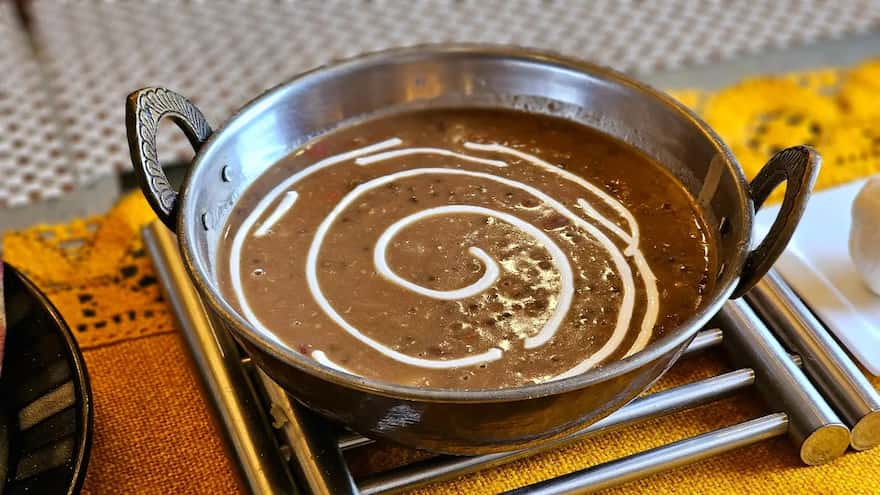
Image credit: Pexels
The laboratory's space-food programme has also developed specialised packaging and heating systems for proper space use. In other words, the dal does not need to be freeze-dried into something unrecognisable and unappetising. A suitably processed preparation can retain a more familiar taste and texture, while becoming shelf-stable and safe for the mission. And that is a considerable culinary upgrade compared to the earlier days of spaceflight.
Vegetable Biryani
How could biryani ever stay away from India's space menu? It simply needed to bide its time to be ready for it. DFRL's Gaganyaan development has included vegetable biryani as well as chicken biryani and chicken pulao. The reported menu was designed around meals that would be lightweight, compact, nutritionally adequate, and easy to consume. And retort processing is very useful here. This is because it can create a shelf-stable meal without the need for conventional refrigeration.
NASA also uses heat-stabilised foods in its own space-food system, alongside freeze-dried as well as various other specially prepared foods. The result is a curious inversion of traditional biryani cooking. On Earth, the epicurean pleasure lies in the freshly cooked rice, aromatic steam, spicy meat, and other layers cooking together in one pot. In space, the achievement is in making those flavours survive a very different journey to provide a similar sense of satisfaction.
Moong Dal Halwa
If sooji halwa represents continuity, then moong dal halwa showcases how far the Indian space pantry has expanded. DFRL has included moong dal halwa among the foods developed for India's human-spaceflight programme, alongside dal makhani, shahi paneer, vegetable biryani, and chicken pulao. By 2022, the laboratory reported developing around 40 varieties of foods for astronauts, including a plethora of sweets, drinks, and savoury meals.
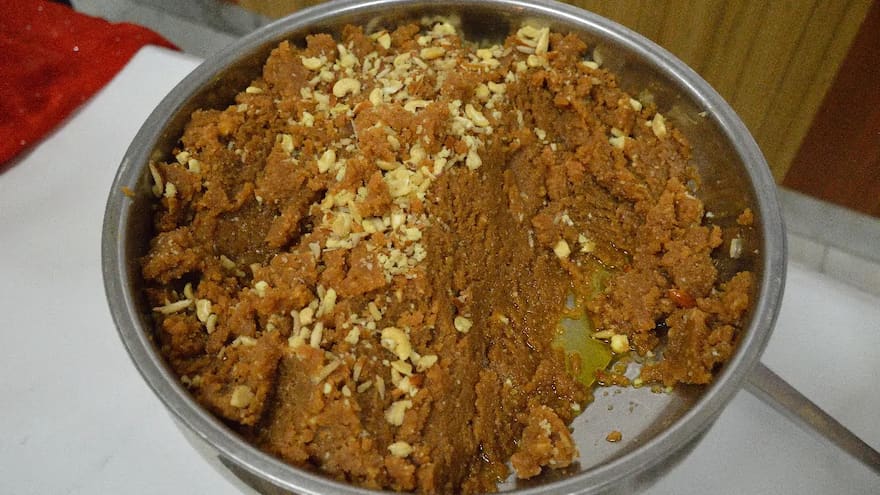
Image credit: Wikimedia Commons
It is not about creating a restaurant menu in orbit, though the idea is very fresh. Food variety matters because astronauts eat the same stored food repeatedly, often for weeks or months at a stretch. NASA's space food research has long recognised that acceptability, nutrition, shelf life, and variety all play a key role in the execution of a successful food system.
For future missions that shall last years rather than weeks, the challenge becomes even greater. NASA research notes that deep-space food systems may require foods with shelf lives of around five years, while also exploring innovative ways to grow fresh produce in space.




