


 Share
Share

On a typical Saturday, the dining room at The Bombay Canteen hums with the choreography of service. Servers sweep past with brass thalis, the bar clinks with ice, and the open kitchen moves at a controlled sprint. But once a year, the burners cool (if only slightly) and the chairs rearrange. The restaurant closes its doors to diners and opens them, instead, to students, young professionals and the quietly curious. For a day, it goes from world famous dining destination, to classroom.
This is the Canteen Open House. Launched in 2025 to mark the restaurant’s tenth anniversary, it grew out of a smaller initiative known as Canteen Class, which had been running since 2017. Initially an collection of intimate, classroom-style sessions that grew into something more ambitious, an entire day dedicated to honest conversations about the realities of building a life in food
In February 2026, as the restaurant marks its eleventh year, the initiative has returned in a second edition titled “The Chef’s Edit”, sharpening its focus on creative entrepreneurship and the often-unspoken mechanics of sustaining a food business. The guest list includes globally recognised chefs, some Michelin-starred, others known for quietly radical formats from a sought after 16-seater in the hills or a micro-bakery in Mysore to a dessert-only destination in Bali. The event itself may last a day. The questions it raises are much larger.
Why Access Matters In Indian Hospitality
For Yash Bhanage, Founder and COO of Hunger Inc. Hospitality, the parent group behind The Bombay Canteen, the impulse behind Open House is personal. He trained in hospitality school and remembers the gap between curriculum and reality. Technique was taught. How to respond under pressure was not. Menu engineering could be diagrammed and the emotional resilience required to survive a failed service could not. “While school teaches you the craft,” he has often observed, “it does not always prepare you for the pace, the failures, the reinvention.”
India’s hospitality industry has expanded rapidly over the past decade. Mumbai in itself has seen thousands of new openings, entries from worldwide giants and the quiet rise of local flavours. There are more restaurants, more formats, more international recognition than you can shake a stick at. But access to qualified and honest mentorship remains uneven. Young cooks may follow global chefs on social media, but few have the chance to ask them difficult questions face to face.
Open House is making attempts to narrow that gap. The entry is free, a deliberate choice meant to ensure that curiosity, not purchasing power, determines who gets to attend. In an industry where masterclasses and summits often come with significant fees, that decision carries weight. The message, “If we truly believe that knowledge, mentorship, and honest dialogue strengthen the industry, then they cannot sit behind a paywall. The message is simple. Growth in hospitality does not come from guarding information. It comes from sharing it. The stronger the next generation is, the stronger the industry becomes. If we want to build a globally relevant hospitality culture in India, we have to widen the circle, not narrow it,” Bhanage suggests.
There is also a distinctly Indian subtext. For decades, culinary prestige flowed in one direction: outward. Indian chefs left for global recognition, validation often arrived from abroad before it was acknowledged at home. Now, with restaurants in Dubai, Singapore and Bangkok led by Indian or South Asian chefs, the conversation feels more circular. Inviting such voices into a Mumbai dining room signals a shift. The dialogue is no longer about catching up. It is about contributing.
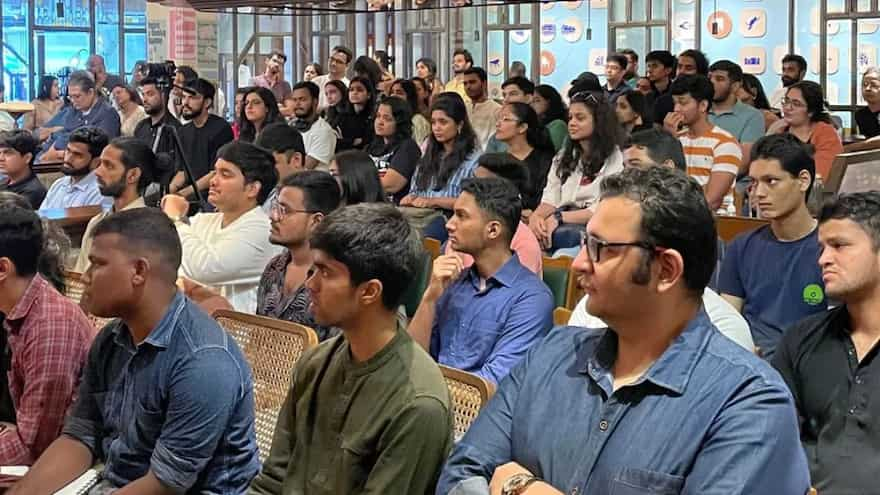 Before their was Open House, there was Canteen Class (Image Credits: The Bombay Canteen)
Expansion, Meet Intent - What Growth Looks Like For Bombay Canteen
Over eleven years, The Bombay Canteen has grown from a single, somewhat audacious restaurant celebrating regional Indian food to a cornerstone of Mumbai’s dining scene. It helped strip back the mystery of fine dining, brough India’s innate Indian-ness to the table and reframe how urban India viewed its own culinary heritage. Yet Bhanage insists that growth was never the end goal. If there is a thread running through the group’s evolution, he describes it as intent. Every project must answer a fundamental question, why should we keep this idea alive?
In an era where restaurant openings can feel driven by trend cycles and investor timelines, that stance is unfashionably patient. “Scale can change the size of the canvas,” he says, “but it should not dilute the purpose. We have always believed in building institutions, not chasing trends. In investing in people, not just concepts. In taking the long view, even when the short term might be easier.”
Canteen Open House is, in many ways, an extension of that philosophy. It treats the restaurant not only as a commercial space but as a cultural one. In India, restaurants have historically been sites of celebration and family gathering. The idea that they might also function as platforms for industry reflection is relatively new.
If the first edition of Open House was about access, the second leans towards depth. “Last year, over 1500 culinary enthusiasts walked through our doors. That response confirmed that the appetite for this kind of access is real,” explains Yash, “This year, with the second edition called The Chef’s Edit, we are bringing together globally acclaimed chefs, including Michelin starred voices, who have built influential spaces across very different contexts. The ambition is simple: make the conversation deeper, sharper, and even more valuable than before.” The framing moves beyond cooking as craft and towards cooking as business - leadership, pricing, positioning, resilience. In other words, what happens after the hype has died down.
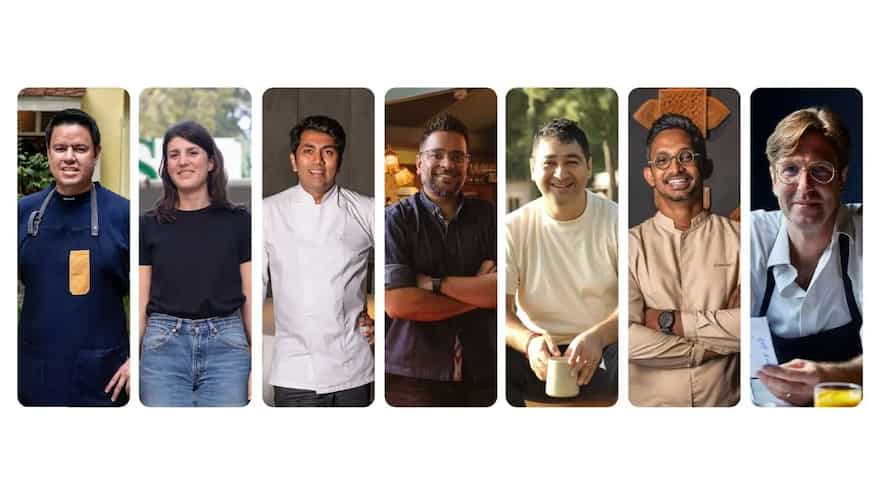 From Left to Right - Chalee Kader, Dina Weber, Himanshu Saini, Hussain Shahzad, Prateek Sadhu, Rishi Naleendra & Will Goldfarb - Canteen Open House (Image Credits: The Bombay Canteen)
Celebrating Rebellion In The Kitchen
The theme of The Bombay Canteen has always oscillated around originality, and the same goes for this new vision of the Canteen Open House. Its lineup reads like a who’s who of pathbreaking cooking. And if the founders set the tone, Chef Hussain Shahzad, Executive Chef at Hunger Inc., shapes the conversation.
Shahzad has long championed the unconventional. At The Bombay Canteen, that has meant reinterpreting regional dishes with a lightness that avoids both caricature and reverence. For Open House, it has meant curating a line-up of chefs who have deliberately stepped outside mainstream definitions of success.
Among them:
- Chef Chalee Kader, the Thai-Indian restaurateur behind Bangkok institutions such as 100 Mahaseth, Wana Yook, Fran’s, and Mickey’s Diner.
- Chef Himanshu Saini, whose restaurant Trèsind Studio in Dubai has earned global acclaim.
- Chef Prateek Sadhu, chef-owner of NAAR, an intimate 16-seater in Kasauli noted on global scales for its localised approach.
- Chef Dina Weber, Germany born, Mysore based founder of the micro-bakery SAPA.
- Chef Rishi Naleendra, Sri-Lankan chef, restaurateur and founder of Cloudstreet and Kotuwa, in Singapore.
- Chef Will Goldfarb, chef-owner of Room4Dessert, a dessert-led destination in Bali.
The common thread is not geography or cuisine. It is conviction.
“There is no single blueprint,” Shahzad has said. “The Bombay Canteen has always championed the unconventional. Not for the sake of being different, but because meaningful work often happens at the edges. The chefs joining us this year have built globally respected spaces, yet many of them have consciously chosen paths that sit outside the traditional definition of success. Smaller dining rooms. Hyper local narratives. Deeply personal cuisine. Distinct business models.”
For young chefs in Mumbai, where ambition is often equated with expansion, this reframing matters. “If someone in the audience walks away feeling reassured that their unique perspective has value, and that there is space in this industry for many kinds of stories, then we have done our job,” he adds. Being able to access and interact chefs who ply this message day in and day out is something Chef Shahzad and the team at Hunger Inc hope to provide. To operate outside the mainstream is not necessarily to rebel, it may simply be to choose clarity over noise.
 (Image Credits: The Bombay Canteen)
The Secret Key To Indian Dining? Context
One of the central themes of “The Chef’s Edit” is giving young chefs and professionals relatable and actionable context. The idea that where you cook shapes what you cook and in this, India offers a particularly complex terrain. A chef in Mumbai navigates different expectations from one in Kasauli or Mysore. Ingredients shift with altitude and climate. Diners carry varied assumptions about authenticity, luxury and value.
In the planned sessions, speakers unpack how geography and audience influence not just flavour but format and pricing. What does it mean to cook Indian food in Dubai? How does remoteness become an asset rather than a liability? When does restraint strengthen identity?
These are not abstract questions which invite more confusion, they are operational ones which drive a purpose. For a generation raised on global food media, the temptation can be to replicate models seen abroad. Yet the chefs invited to Open House offer case studies in localisation, building businesses that respond to their immediate communities rather than imported ideals.
Another recurring theme is failure, stripped of romance. In one session, Chef Will Goldfarb reflects on closures and reinventions, arguing that setbacks can become sites of innovation. In another, younger chefs from within Hunger Inc. speak candidly about missteps and small victories in their early careers. The tone, by design, avoids glorifying struggle. Resilience is discussed not as heroic suffering but as consistency: showing up, refining systems, learning to balance creativity with commercial reality.
For Indian hospitality, still negotiating its post-liberalisation identity, this insistence on relevant context feels timely. The industry is no longer simply borrowing. It is editing, adapting and, increasingly, exporting its own frameworks.
 (Image Credits: The Bombay Canteen)
Restaurant Or Classroom, Or…Both?
In India, restaurants have long been markers of social change. The Irani cafés of Mumbai once served as informal meeting rooms for writers and activists. Five-star hotel dining rooms became theatres of liberalisation-era aspiration. Today’s independent restaurants navigate a landscape shaped by global travel, Instagram and regional pride. Although Canteen Open House occupies a single Saturday on the calendar, its architects are careful not to frame it as a festival. The ambition is slower.
By turning its dining room into a forum, The Bombay Canteen extends that lineage. It suggests that a restaurant can be more than a site of consumption. It can be a site of reflection. On the surface, the answers unfold through panel discussions and Q&A sessions. Beneath that, something quieter is happening. A generation is being told that their questions are legitimate. That there are multiple ways to build a meaningful career in food. That depth can matter as much as scale. Bhanage speaks of the future as one of continuity, not meteoric growth. “The core idea is portable. The need for honest dialogue between experience and aspiration is not unique to Mumbai. If the foundation is strong, there is no reason a version of this cannot exist beyond one address or one city. Ultimately, the goal is not scale for its own sake. It is impact.”
The Canteen Open House does things to its own beat. It values curiosity over exclusivity. Dialogue over hierarchy. Intent over spectacle. When come Sunday, everything is returned to its familiar positions and the burners relit, the dining room will look as it always has. Guests will arrive for dinner, unaware of the morning’s debates about pricing models or the emotional cost of ambition. But the students who passed through may carry something forward, a reframed understanding of possibility.




