


 Share
Share

India is going to celebrate its 79th Independence Day this Friday, but the real-life saga of partition remains so real. While growing up, I heard stories from my grandma, originating from Dhaka, about how they never wanted to leave the country, her childhood, her friends and half of the family. One decision made by the government not only altered the territorial history but also caused many people to face drastic changes.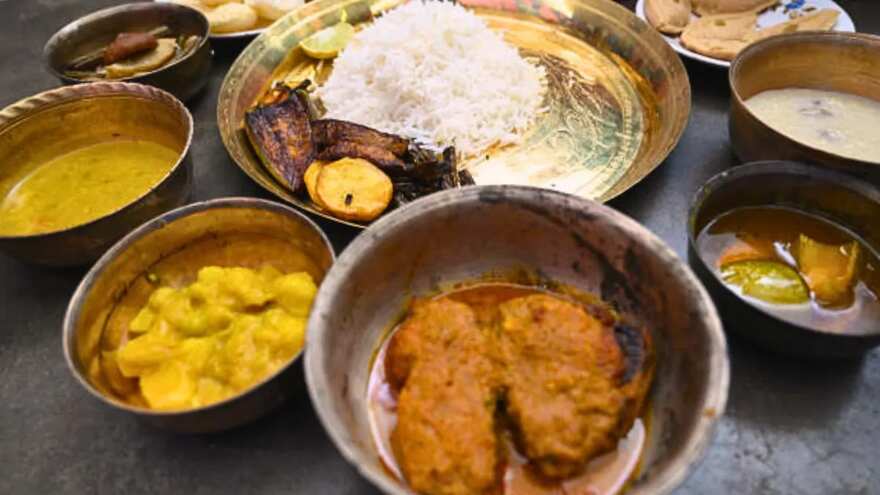
Partition redrew that map overnight. In one stroke, East Bengal became East Pakistan (now Bangladesh), and West Bengal became part of India. The political logic of religion dictated the split, but the reality was far messier. Millions were displaced. Families left behind not just homes and farmlands but ponds full of fish, gardens of gourds, coconut palms, rice paddies, spice jars, and clay stoves that had been in use for decades. My grandparents were among them — Purbo Bongiyo by origin — who came to West Bengal with their children, their cooking habits, and their grief.
15th August 1947 — in the rest of India, the date is often remembered as a singular moment of triumph, the day the British flag came down and India’s own went up. In Bengal, the day is also remembered as the one when the land — and life as many knew it — was cut into two.
Bengal Before Partition And The Changes That Came Along
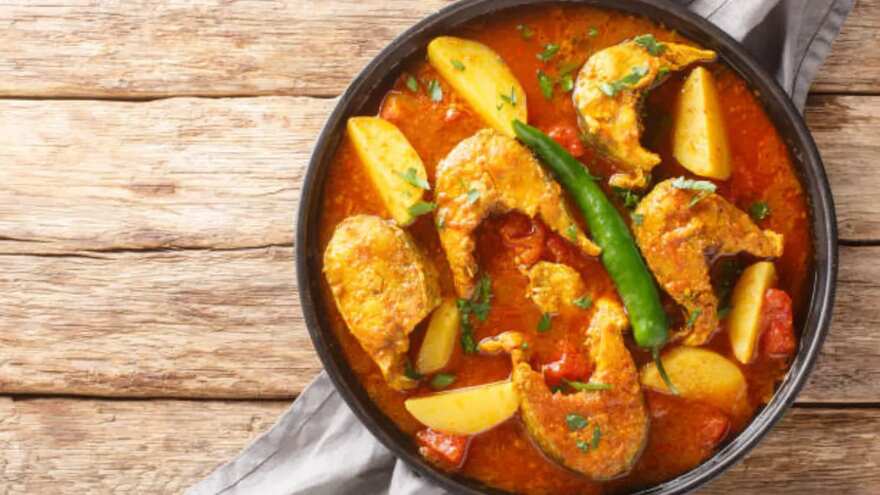
Bengal before 1947 was a vast, fertile, culturally dense region. It stretched from the lush, river-fed plains of Dhaka, Barisal, and Sylhet in the east to the bustling cosmopolitan port of Calcutta in the west. Fish from the Padma swam into kitchens without any thought of borders. Recipes moved from one district to another the way rivers carried silt — naturally, without permission. The kitchens of Bengal were not just cooking spaces; they were cultural maps, where Bangals (from East Bengal) and Ghotis (from West Bengal) shared more similarities than differences.
But despair flowed along with taste. People who crossed over brought their hilsa recipes, their love of mustard oil, and their need to eat wild greens and dried fish all the time. A lot of them had dried loitya shutki wrapped in paper, jars of homemade achar (pickles), and spice blends that were ground with the kind of patience that can only be learned in a chef's family kitchen. They were going to a new place where the language was the same but the food was different.
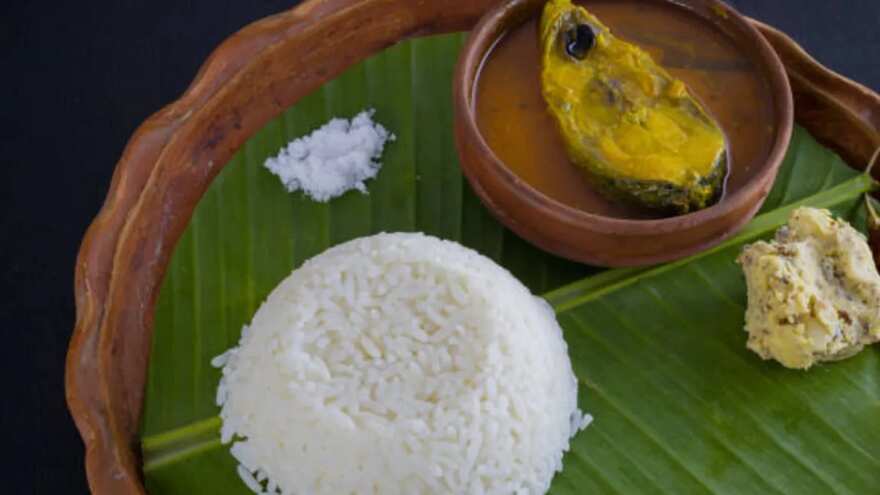
When Bengal was split in two, millions of people from East Bengal moved to the west, bringing with them the smell of food from Dhaka, Barisal, Noakhali, and Sylhet. As a result of colonial Calcutta, Marwari traders, Chinese immigrants, and the need for new foods in a trading port, West Bengal was already a culinary powerhouse. The meeting of the two was, at first, a clash.
Bangals (East Bengalis) brought an unflinching love for foraged greens, fish offal, kochu stems, and dried fish — things the Ghotis (West Bengalis) often turned their noses up at. Soon, neighbourhood markets in Kolkata began selling Kochu Pata Chingri (shrimp cooked in colocasia leaves), Chital Muithya (fish dumplings), and the infamous Shutki Mach — still divisive, still an acquired taste.
The Partition’s Culinary Shockwave: How Borders Changed Bengal’s Food Forever
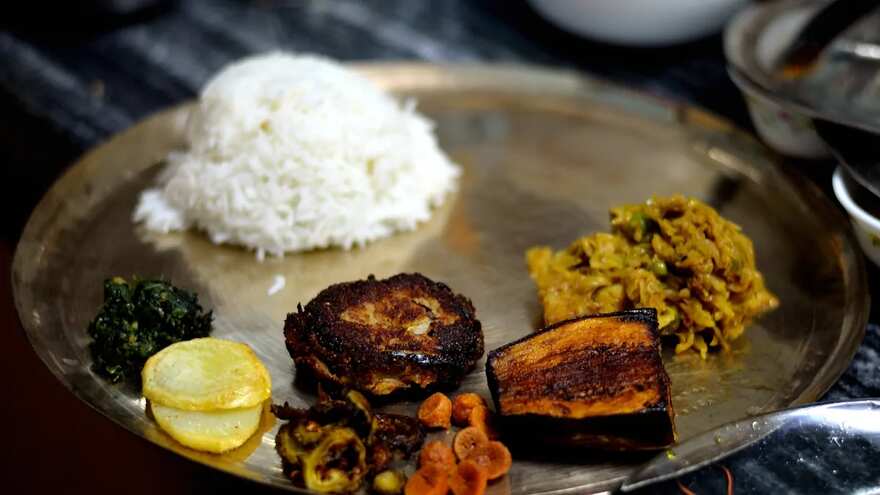
The first and most immediate change after 1947 was the loss of access to ingredients. Partition was not a neat cartographic exercise; it cut across rivers, farms, and fishing grounds. East Bengal, with its rich network of rivers like the Padma, Meghna, and Jamuna, had been the source of some of the finest freshwater fish — hilsa, koi, pabda, chitol. When the borders hardened, so did access. Hilsa, once a staple in both East and West Bengal, became seasonal and expensive in West Bengal, its migration patterns suddenly a matter of political and economic negotiation.
Vegetables, too, reflected the loss. Many East Bengali dishes relied heavily on foraged ingredients — tender stems of bottle gourd (lau donga), taro stolons (kochu loti), banana blossoms (mocha), wild leafy greens, and vegetable peels repurposed into bhartas (mash). These were plentiful in rural East Bengal, where wetlands and homestead gardens provided variety without cost.
In West Bengal’s urban refugee settlements, land for such cultivation was rare, and the city markets didn’t always stock these “country” items. Bangals had to adapt, often replacing their beloved ingredients with what was available — substituting pumpkin stems for kochu loti, or cabbage for banana blossoms.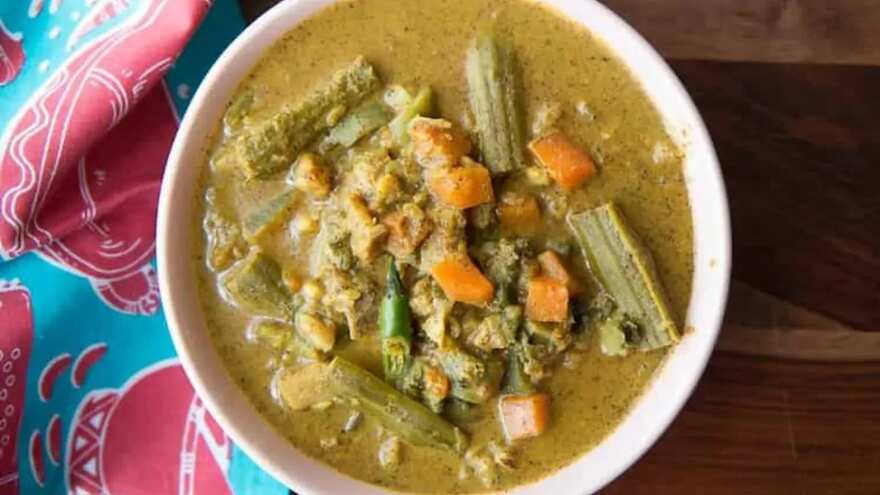
The clash of cooking styles was the second big change. People from Ghoti liked lighter, more delicate flavours. They often cooked with ghee or white oil and started their meals with shukto, a mix of bitter vegetables in white gravy. Bangals brought stronger, more assertive tastes, like fish curries with a lot of mustard, stews with a lot of chili, and the unbelievably spicy shutki mach.
At first, these differences were more than just taste preferences — they became markers of identity in post-Partition Bengal. In the tea shop adda sessions (Chaa-er dokan er adda) and even on the football field, the Ghoti-Bangal rivalry was half in jest, half in earnest, with food at the centre of it.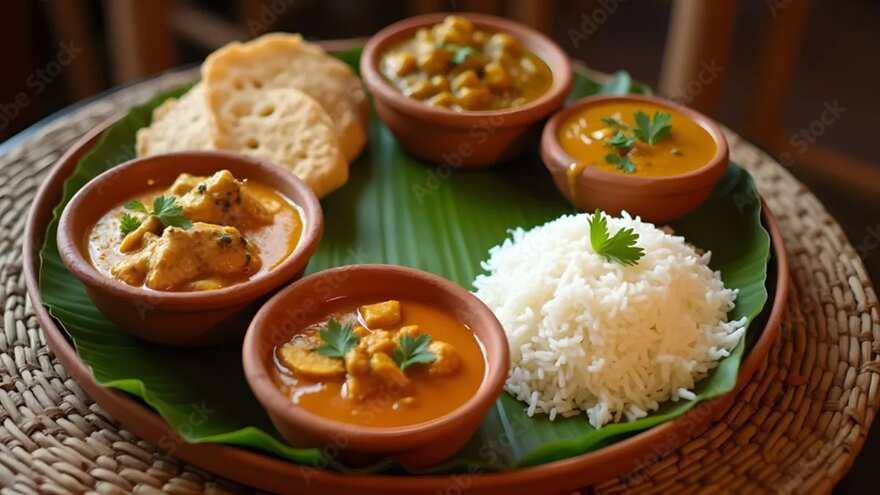
Lastly, the lack of resources led to new ideas. For example, Lucknowi influence could be seen in Kolkata Biryani. However, because of a lack of meat in the city after Partition, each serving had more potatoes and fewer pieces of meat, which became the norm. East Bengali refugees reimagined their recipes to suit available resources, sometimes adding new vegetables to fish curries or creating entirely new forms of shutki preparations with locally dried fish.
Over time, both sides began to borrow. Bangals discovered the appeal of West Bengal’s crisp begun bhaja (fried brinjal) alongside their macher jhol. Ghotis learned to appreciate the depth of a chingri macher malaikari (prawns in coconut milk) on special occasions. Festivals, community feasts, and intermarriages helped speed the process.
Dishes That Crossed the Border And Found Their ‘Forever’
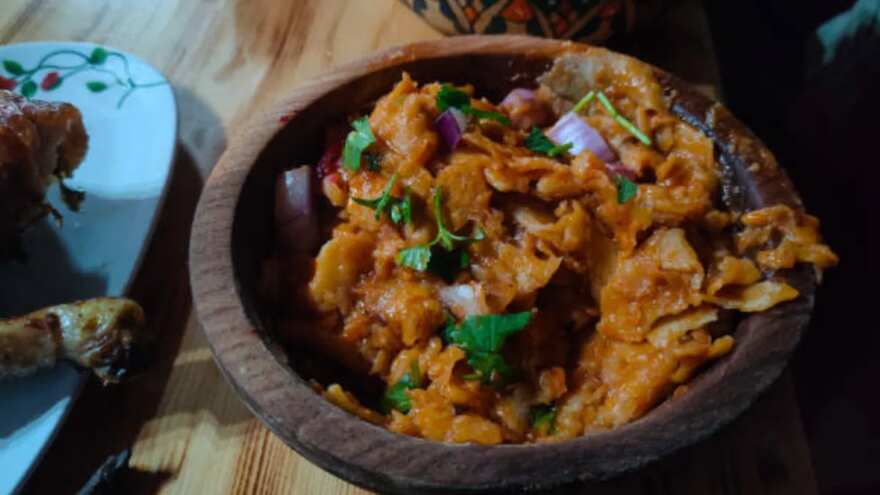
Shutki Mach (Dried Fish)
The most unmistakable Bangal signature. Shutki is not for the faint-hearted — its smell while cooking is notoriously sharp, but the flavour is layered and deeply savoury. In Chittagong and coastal East Bengal, varieties like loitya shutki (dried ribbon fish) and chingri shutki (dried shrimp) were slow-cooked in mustard oil with garlic, onion, and red or green chillies until the oil absorbed their intensity. In West Bengal, where dried fish was far less common, this was initially met with resistance, but over the decades, it found small but devoted pockets of admirers.
Chingri Macher Malaikari
Now a beloved Bengali classic, malaikari has East Bengal written all over it. Prawns — especially golda chingri (giant freshwater prawns) — are cooked in a rich, silky gravy of coconut milk, mustard paste, and delicate spices. The Bangal version leaned heavily on fresh coconut and mustard oil, while the Ghoti adaptations sometimes toned down the mustard for a creamier, milder finish.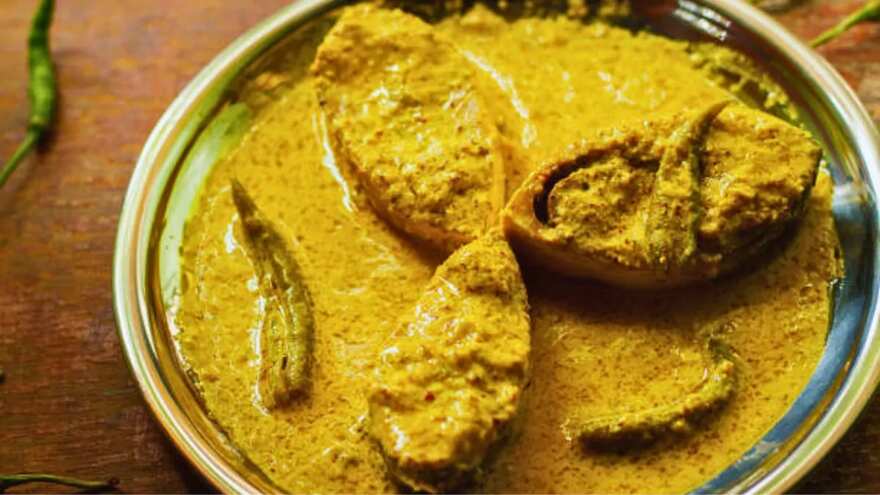
Doi Maach
Fish — often rohu or hilsa — simmered gently in a spiced yogurt base. This dish arrived from East Bengal’s river-rich regions, where dairy was abundant and freshwater fish plentiful. The tang of the yogurt cut through the fattiness of the fish, creating a balance that Bangal cooks prized.
Shorshe Bata Maach
One of the culinary emblems of East Bengal: fish, usually hilsa, marinated in mustard paste, turmeric, and mustard oil, then steamed or simmered. The taste was unapologetically bold — pungent mustard heat matched against the rich oiliness of the fish.
Kochu Pata Chingri
A perfect example of the Bangal instinct to use every part of a plant: colocasia leaves (kochu pata) stuffed or wrapped around prawns, spiced and steamed or slow-cooked. The leaves impart a distinct earthiness, while the prawns bring sweetness and brine.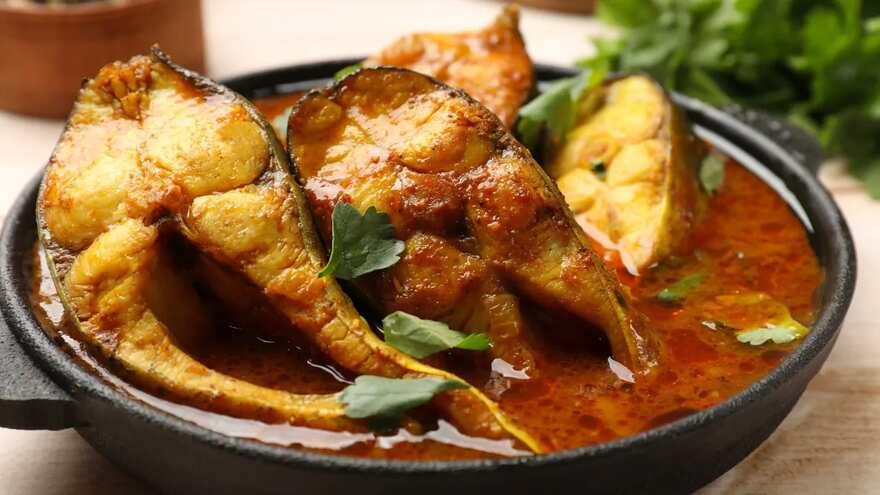
Chital Muithya
From the big rivers of East Bengal came chitol maachh (clown knifefish), whose boneless flesh was shaped into dumplings (muithya), lightly fried, then cooked in a curry. In West Bengal, where chitol was less common, cooks adapted by using locally available river fish.
Holud Pataar Dal
A rare but treasured East Bengali preparation where yellow moong dal is slow-cooked with fresh turmeric leaves. The aroma is unlike anything else — earthy, warm, and slightly medicinal — making it both a comfort food and a seasonal health tonic. In Kolkata, where turmeric leaves were harder to source, migrants often planted them in small kitchen gardens just to keep this dish alive.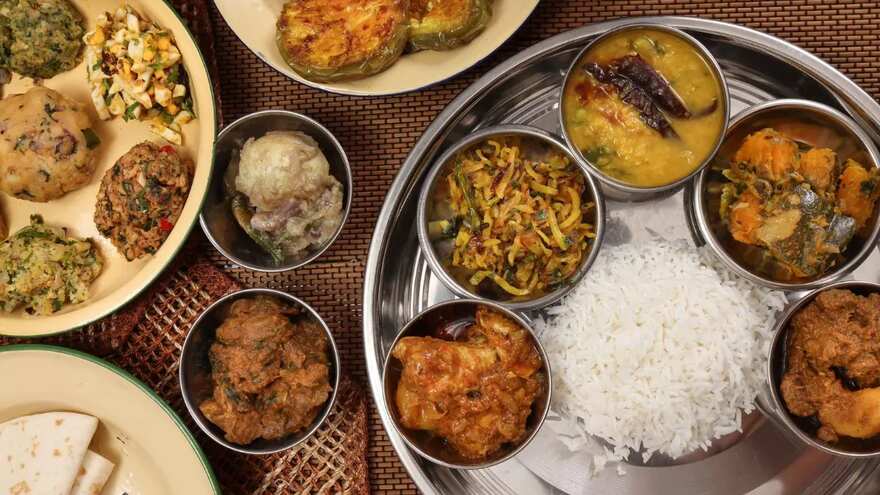
Chaapor Ghonto
A finely chopped vegetable medley cooked with chaapor — pan-fried lentil patties crumbled into the curry. In East Bengal, it was often made with seasonal greens and root vegetables, the patties lending protein and a nutty texture. This was a clever way to stretch scarce pulses into a full meal.
Motor Shaak Diye Koi Maachh (Adapted to Vegetarian)
Traditionally made with koi fish and spinach (motor shaak), this dish was adapted into a vegetarian version in some refugee homes where fish was too costly or unavailable. The spinach was paired with potatoes, brinjal, or pumpkin, spiced in the same mustard-oil base, giving a taste of home without the expensive protein.
Goalondo Steamer Chicken Curry
A dish born in the kitchens of the Goalondo steamer port in present-day Bangladesh, where boatmen’s wives would prepare fiery, rustic chicken curries for travellers. Made with mustard oil, onions, dried red chillies, and minimal garnish, it became a nostalgic refugee recipe in Kolkata.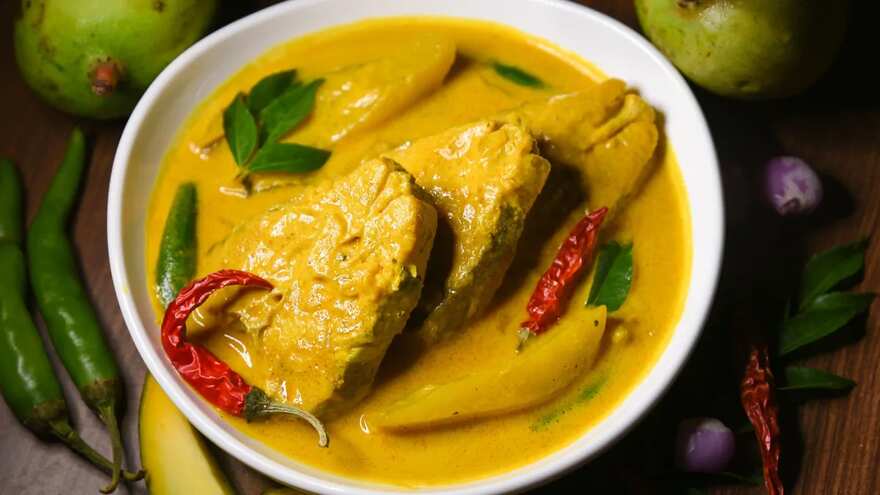
Kala Bhuna & Mezban Curries
From Chittagong and Noakhali came intensely spiced meat dishes like kala bhuna — beef or mutton cooked down until dark, rich, and almost caramelised — and mezban-style curries served at large community feasts. While less common in Hindu refugee homes, they became popular in certain restaurant menus in Kolkata.
Slurrp reached out to an 82-year-old lady, Gobindo Rani Saha, a retired school teacher who came to Bengal with her broken family. Some of her relatives were left behind, and now, they belong to another country, Bangladesh.
While exchanging words with her, she mentioned how sweets have become a part of Bengali cuisine now. “Dudhpuli, nelekata pithe, dal pitha, patisapta, taaler pitha, chaaler payesh - we used to prepare all these sweetmeats at home. Maa taught me all these when I was 12. Preparing mishti doi was another art which I learnt from her. Later on, I taught these to my daughters, and now my granddaughter is trying to learn more about bangali pitha.”
Bengal’s sweet-making traditions were already rich before 1947, but Partition brought in new seasonal, jaggery-rich, and rice-based sweets from East Bengal. These were often less cream-heavy than their Kolkata counterparts, relying instead on coconut, chhana (curdled milk solids), and molasses.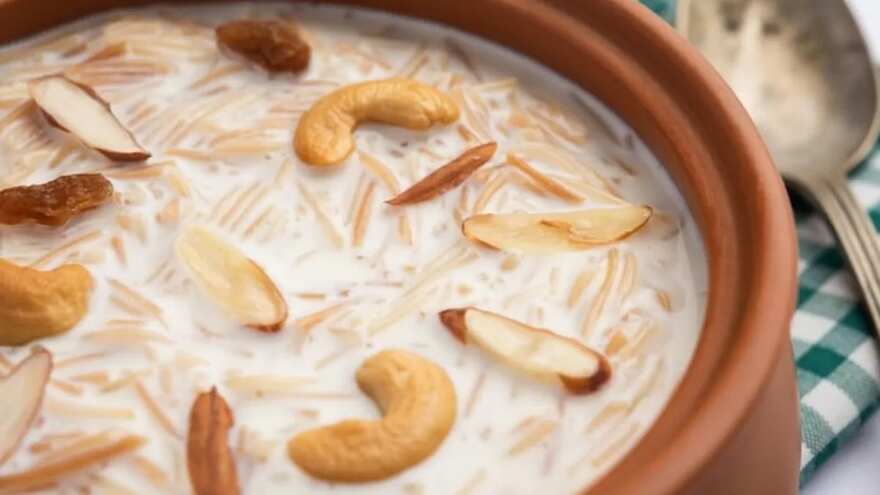
Patishapta
A winter delicacy: thin rice-flour or semolina crêpes stuffed with a mixture of coconut, khoya, and date-palm jaggery (nolen gur). In East Bengal, the batter was often fermented lightly for extra flavour.
Puli Payesh
Rice-flour dumplings, often shaped like small boats (puli), filled with a coconut-jaggery mixture and simmered in sweetened milk. It’s a festival staple in East Bengal; it migrated intact into West Bengal kitchens.
Choshir Payesh
A semolina-and-milk pudding, subtly flavoured and served warm in the winter months. Choshi refers to the hand-rolled semolina pasta used in the dish.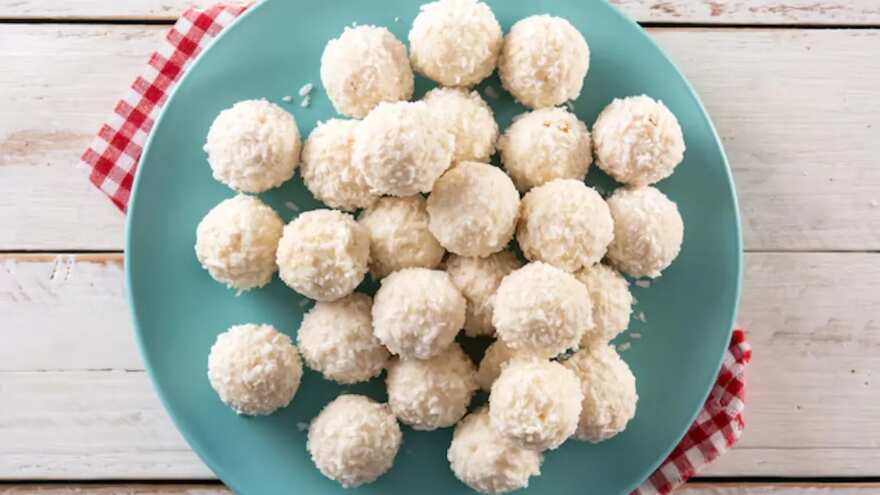
Narkol Naru
Coconut laddoos, rolled with sugar or jaggery, were an East Bengal staple — made during festivals and as travel food.
Moya
Puffed rice bound with date-palm jaggery, often shaped into balls. The East Bengal variant was softer and stickier due to the fresh jaggery used.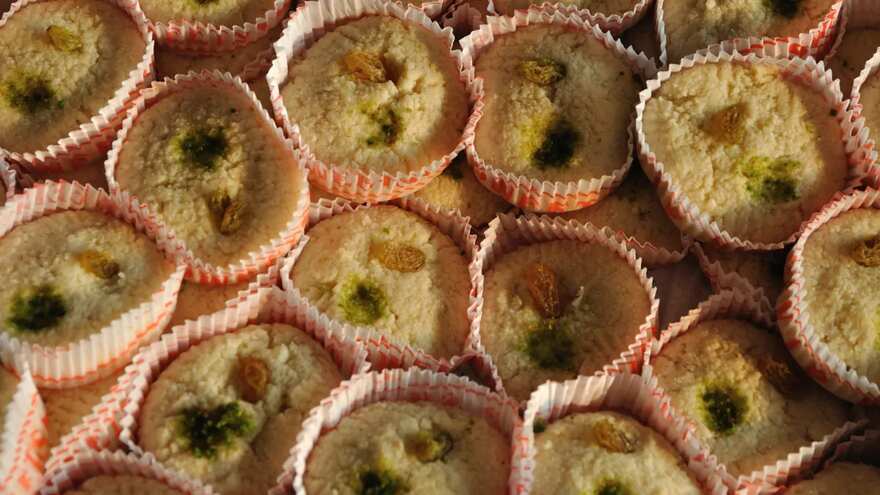
Kolkata’s established sweet shops — like Ganguram’s, Bhim Chandra Nag, and Nakur Chandra Nandy — already specialised in creamier, chhana-based creations like sandesh, rosogolla, and mishti doi. The arrival of East Bengali sweets brought a new textural and flavour profile — coconut-based fillings, jaggery sweetness, and a fondness for winter harvest rituals.
In conversation with Nayana Afroz, a Chef from Bangladesh, who has won millions of hearts, Slurrp got some interesting details about Bangladeshi cuisine.
Slurrp: What are some traditional dishes from East Bengal that have made their way to West Bengal, and what significance do they hold in the shared culinary history of both regions?
Nayana: Mustard Ilish, Prawn Malaikari, Chitol Muithya etc, are some of the dishes that have travelled from East Bengal and have made a place in the West Bengal households also. The refugees from East Bengal brought in food traditions which were rustic, spicier, and of a subaltern nature due to more rural settings compared to the upper-middle-class cuisine of the local West Bengal people. However, these dishes have faced complete amalgamation with the local West Bengal palette and hold a popular place when planning the menu during any formal or homely event.
Slurrp: Can you recall any specific childhood memories of food that shaped your love for cooking, particularly dishes that originated in East Bengal?
Nayana: A very vivid memory that has nurtured the love for cooking in me was my mother preparing fish dumplings or Muithya, as they are called. Watching my mom scrape out the raw flesh of the fish and adding spices to it to make flat balls, and finally preparing a very favourite dish intrigued me very much. Preparing the same and serving to my people, and watching the same happiness that lit up our faces when my mom served us. There are numerous memories of my mother cooking, which have definitely motivated me to cook well.
Slurrp: How do you think the migration of East Bengalis to West Bengal influenced the evolution of Bengali cuisine, especially in terms of flavours and cooking techniques?
Nayana: Migration from East Bengal to West Bengal had quite a significant influence on the evolution of Bengali cuisine, transforming the flavours, cooking styles, and culture.
The strong, spicy, aromatic taste brought by the East Bengali was quite in contrast to the sweeter flavour profiles of the local West Bengal cooking. However, the cooking styles of the East Bengal culture were adopted by the West Bengal people and dishes like ilish bhapa, cooked with mustard paste or prawn malaikari, cooked with coconut milk, became emblematic of the flavourful exchange.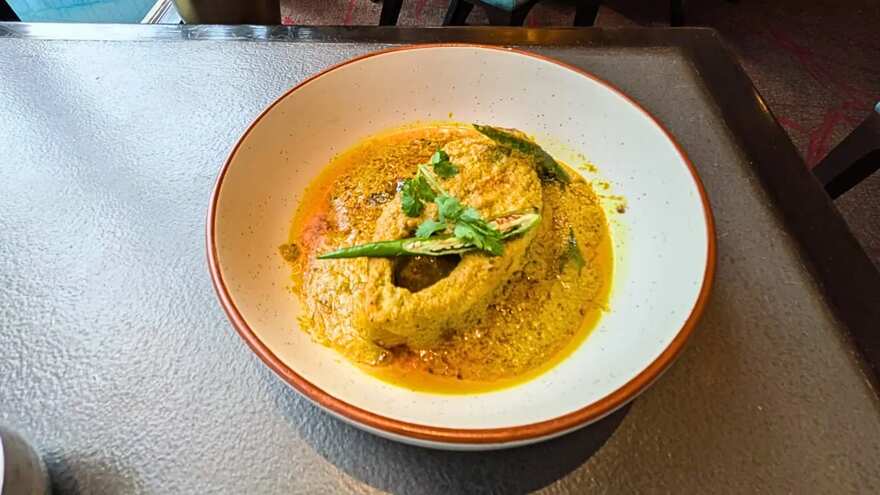
Slurrp: Are there any dishes that you feel represent the spirit of both East and West Bengal, bridging the cultural gap between the two regions?
Nayana: Hilsa, being a very popular fish in both sides of Bengal, bridges the gap between the two regions. While the East Bengal version can be spicier than a West Bengal one, the love for the fish is equal in both regions. This shared love represents the holistic Bengali identity regardless of how it is cooked.
The Patishapta or stuffed crepes can be another example where the East Bengal version was done predominantly with rice flour, while the West Bengal people preferred using refined wheat flour. However, this dish is a hot favourite on both sides of the border, and when it travelled with the East Bengal refugees, it was transformed into crepes made of refined wheat flour.
Slurrp: From your experience as a chef, how do you adapt traditional East Bengali recipes to modern tastes while maintaining their authenticity?
Nayana: I am very particular about maintaining the authenticity of a dish; so while catering to the diner's palate, I don't compromise on that. For example, when I cook a Bangladeshi preparation of Ilish, which requires the use of onion and garlic, I use both but in measured quantities and blend them so well into the gravy that the diners do not experience uneasiness while eating.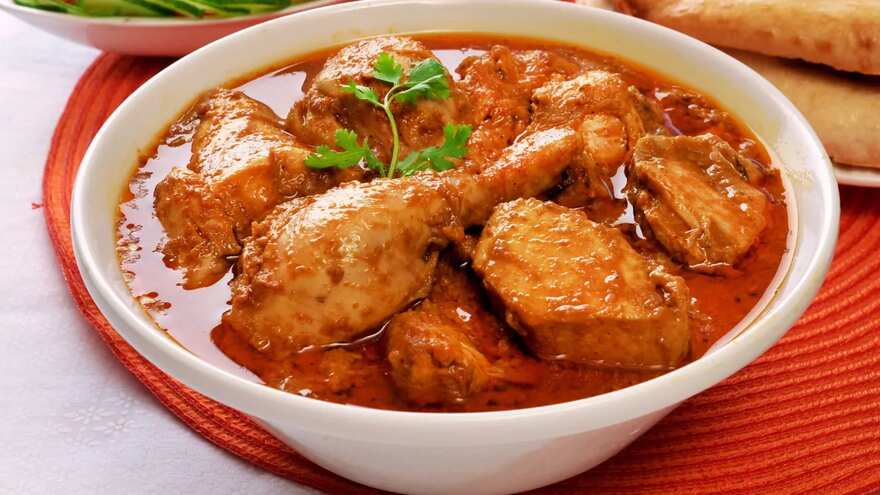
Slurrp: How do the food traditions of East Bengal differ from those of West Bengal, and what are the elements that make East Bengali dishes unique in your opinion?
Nayana: The uniqueness of East Bengal cuisine compared to the West Bengal dishes is that East Bengal cuisine is much more rustic and more extensive; lots can be prepared from very few ingredients. They are much more spicy and bold, and deeply seasonal.
Slurrp: What role do you think food plays in preserving the cultural identity of East Bengalis who migrated to West Bengal, especially in terms of community bonding?
Nayana: Food plays an extremely significant role in preserving the cultural identity of the East Bengalis who migrated to West Bengal. Cooking familiar dishes during family events, comprising recipes passed down from one generation to another, results in community bonding. The memories that the refugees came with were often tied to the kitchen, and sharing those memories in gatherings or while they met otherwise nurtured bonds between them. Food became the glue that helped bind dislocated people in unfamiliar circumstances.
The Ghoti-Bangal divide hasn’t disappeared — it’s still joked about in football rivalries, with hilsa “representing” East Bengal club and golda chingri (jumbo prawns) for Mohun Bagan. Over time, cross-pollination happened: patishapta began appearing in Kolkata sweet shops alongside nolen gurer sandesh; puli payesh found its way into wedding feasts; even narkol nadu got dressed up with dry fruits for urban palates. But in most Bengali homes today, it’s common to have a Bangal-style shutki on Monday, Ghoti-style shukto on Tuesday, and a shared plate of mishti doi on Sunday.




