


 Share
Share

SOY SAUCE is everywhere.
It sits on restaurant tables, slicks your fried rice, anchors your marinades, and turns up in everything from instant noodles to Michelin-starred kitchens. It is, perhaps, one of the most familiar flavours in the world — salty, savoury, dependable.
And yet, most of what we call soy sauce today is a shortcut.
The real thing — the kind that takes years to make, that lives and breathes inside wood, that carries within it entire invisible ecosystems — is quietly disappearing. And on a small island in Japan's Seto Inland Sea, a handful of people are trying to save it.
*
Shodoshima does not announce itself loudly. It is the second-largest island in the Seto Inland Sea, with a warm, dry climate that feels almost Mediterranean. Once, it was known for salt. In the medieval period, its people harvested it in abundance, until overproduction collapsed demand. Faced with surplus and necessity, the island pivoted — turning salt into something more enduring.
Soy sauce was one such transformation.
Its origins here trace back roughly 400 years, when stoneworkers from Osaka — quarrying materials for Osaka Castle — brought with them kinzanji miso, a fermented paste. The liquid that pooled on top of the miso intrigued the islanders. It was clear, aromatic, deeply flavourful. They followed it back to its source, learned the craft, and began brewing it themselves, using their own salt and trading for soybeans and wheat from the mainland.
By the time the Meiji era arrived, Shodoshima had become a powerhouse. As many as 400 independent breweries dotted the island, their wooden barrels quietly fermenting soy sauce in the rhythm of the seasons.
Then came industrialisation.
Large corporations began producing soy sauce in stainless steel tanks, accelerating a process that traditionally took years into one that could be completed in months. Efficiency won. Scale won. The market shifted. And one by one, Shodoshima's breweries began to disappear.
Today, fewer than 20 remain.
*
What they are preserving is not just a method, but a living system.
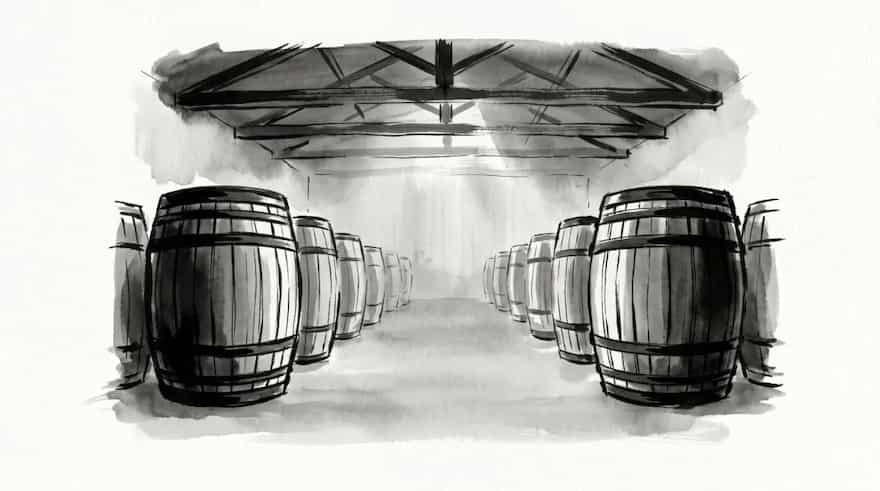
Traditional soy sauce here is brewed in kioke — massive wooden barrels, some over a century old. Unlike steel tanks, these barrels are not inert containers. They are alive. Their porous cedar walls, the mud-plastered brewery interiors, even the ceiling beams, are home to more than a hundred varieties of microorganisms — fungi and bacteria that shape the fermentation in ways no laboratory can fully replicate.
Ask a brewer, and they will tell you: they do not make the soy sauce. The microbes do.
Time is their collaborator. A traditional brew can take up to four years to mature, deepening slowly into something layered, rounded, and complex — a far cry from the sharp, uniform saltiness of mass-produced versions. The flavour that emerges is not manufactured. It is accumulated — by season, by wood grain, by the particular invisible life that has taken up residence in a barrel over decades.
Which is precisely what makes the threat so serious.
Because the barrels themselves are dying.
*
Around 2009, Yasuo Yamamoto — a fifth-generation soy sauce brewer at Yamaroku Shoyu — came to a quiet, devastating realisation. His family's barrels, some 150 years old, were ageing beyond repair. When he tried to order new ones, he discovered that there was only one cooperage left in all of Japan capable of making kioke. And its craftsmen were nearing retirement.
If the barrels disappeared, so would the soy sauce.
Yamamoto made an unusual decision. He left his brewery to apprentice under the last barrel maker in Osaka. He learned how to shape cedar, how to bind it with woven bamboo, how to construct vessels large enough to hold not just liquid, but life.
In 2011, he launched the Kioke Craft Revival Project.
Today, Yamamoto is not only brewing soy sauce — he is building the very barrels that make it possible. Each one is a commitment measured not in months, but in generations. He hosts workshops that draw brewers, chefs, and volunteers from around the world, teaching them a craft that once seemed destined to vanish.
There are now more people learning to build barrels than there have been in decades. It is not a reversal. But it is a beginning.
*
Elsewhere on the island, Keiko Kuroshima is working to change how people understand what ends up on their plate.
Kuroshima grew up in Shodoshima wanting to leave. The island, to her, felt small, limiting. It was only when she returned as an art student, researching her hometown, that she began to see it differently — not as a place of absence, but of astonishing specificity.
She became Japan's first female soy sauce sommelier.
Her work is not in making soy sauce, but in teaching people how to taste it — and the distinction, she has found, is harder than it sounds. In a tasting session, she asks people to slow down. To notice how a well-made traditional shoyu slides cleanly off a chopstick rather than clinging thickly. To register the gentle sweetness underneath the salt, the way the flavour opens rather than closes. To sit with the aftertaste — because in a soy sauce brewed over years, there is one worth sitting with.
Most people, she has observed, have never actually tasted soy sauce. They have only used it.
In a world accustomed to speed, she asks for attention.
*
Between them — the brewer who builds barrels and the sommelier who trains perception — lies a fragile ecosystem of preservation. Not just of a product, but of a way of thinking about food: as something shaped by time, by environment, by patience.
It is easy, perhaps, to think of soy sauce as a constant. A background note. Something interchangeable.
But on Shodoshima, it is anything but.
It is a collaboration between wood and microbe, climate and craft, memory and labour. It is a flavour that cannot be rushed without being changed. And it is, increasingly, a rarity.
The next time you reach for a bottle of soy sauce, it may be worth asking what, exactly, you are tasting.
Because some flavours are made for convenience.
And some are made by time.
***
Fast vs Traditional — What's Actually in Your Bottle?
Most soy sauce on supermarket shelves — including many well-known brands — is produced using a method called acid hydrolysis, or at best, an accelerated fermentation process. Here is what that difference looks like:
Industrial soy sauce
Produced in stainless steel tanks. Fermentation is accelerated using temperature control and additives. The process takes anywhere from a few weeks to a few months. Flavour is sharp, uniform, and consistent — engineered for reliability rather than complexity. May contain added colour, flavour enhancers, and preservatives.
Traditional kioke-brewed soy sauce
Brewed in cedar barrels (kioke) over one to four years. Fermentation is driven entirely by naturally occurring microorganisms in the wood and environment. No two batches are identical — season, temperature, and the specific microbial community of each barrel all leave their mark. Flavour is layered, rounded, and complex, with a natural sweetness and a long finish.
What to look for on the label:
A shorter ingredients list is a good sign — traditionally brewed soy sauce contains only soybeans, wheat, salt, and water. If you see additives, caramel colour, or alcohol (beyond naturally occurring traces), you are likely holding the shortcut.
Kioke-brewed soy sauce from Shodoshima is available internationally through specialist Japanese grocery importers and online retailers. It is more expensive. It is also, in every meaningful sense, a different product.




