


 Share
Share

There is a particular quality to the company of someone who eats with genuine intent. Not performance — not the Instagram-era theatre of photographing a dish before touching it, or the food-tourist's anxious checklist of things to have consumed. Intent. The kind that manifests as curiosity about what is in front of you, willingness to go somewhere unexpected with it, and the instinct — occasionally overriding good judgment — to see what happens when you mix two things that were not designed to be mixed.
Aaron Ronquillo is the Editor for Foreign Business at The Manila Times. His days are spent in the particular register of journalism that demands both granular precision and structural understanding simultaneously — tracking BSP monetary policy, dissecting property market trends, following infrastructure spending, reporting on sustainability commitments that may or may not survive contact with quarterly earnings. It is work that requires a specific kind of attention: the capacity to hold a very large picture in the mind while reading the fine print. He brings the same quality to a menu.
We had agreed on dinner. The venue was The Pantry at the Dusitani Hotel in Makati — a restaurant I had been curious about since arriving in Manila, partly because of its location (the Dusitani sits on one of those Makati streets that manages to feel both central and unhurried), and partly because the name suggested a particular culinary philosophy: not the grand statement of a hotel flagship, but something more considered, more domestic in register, more interested in what actually gets eaten than in what photographs well. It is the kind of name that tends to mean something, or nothing at all. On this occasion it meant something.
Emily, the Maître D, greeted us with the kind of attentiveness that reads as effortless precisely because it has been thoroughly practised. She is the human equivalent of a well-run service: present when needed, absent when not, possessed of the accurate instinct for when a table wants to be left alone with its conversation and when it needs guidance. Over the course of an evening that extended considerably beyond what either of us had planned, she managed the room — and our table in particular — with a consistency that is rarer than it should be. Good service is frequently discussed and infrequently delivered. Emily delivered it.
We sat down. We ordered drinks. And then Aaron opened the menu and encountered, for the first time in his life, Rogan Josh.
The name alone contains a small historical argument.
In Persian, roghan means clarified butter — ghee, the fat of slow cooking, the medium through which spice becomes something deeper than spice. Josh means to braise, to stew, to apply heat with patience. Rogan Josh, by this etymology, means stewed in ghee — a description that is technically accurate but that understates considerably what the dish actually is. A second etymology complicates things, as second etymologies tend to do: in Kashmiri, roghan also means red, and gosht means meat. Rogan Ghosht, then — red meat. Both names circulate. Neither has conclusively displaced the other. The dish continues to answer to both.
Rogan Josh is one of the main dishes in the wazwan — the traditional thirty-six-course Kashmiri feast. To serve it is to make a claim about the importance of the people you are feeding.
Rogan Josh is an aromatic curried meat dish in Kashmiri cuisine dating from the time of the Mughal Empire, made with red meat — traditionally mutton or goat — coloured and flavoured primarily by alkanet flower or root and Kashmiri chillies. But to understand what it is doing on a menu in Makati, you need to follow it backwards through about five centuries of movement.
The dish begins not in Kashmir but in Persia. In Persian cuisine, rogan josh was a dish of meat fried in hot butter. It was brought to North India by the Mughals in the 16th century. The Mughals, whose empire at its peak stretched from Kabul to the Bay of Bengal and whose culinary imagination was formed at the intersection of Persian sophistication and Central Asian robustness, moved the dish eastward and northward when they moved themselves. The reason for the northward movement is a matter of climate as much as conquest. The Mughals ruled from the capital Delhi and one of their favourite destinations to escape the scorching heat of Delhi during summers was Kashmir. Kashmir offered altitude, cool air, rivers, meadows — and a cuisine that was already reaching towards Persia through the Silk Route trade networks that had been running across those mountains for centuries.
What happened in Kashmir is what always happens when a dish arrives in a new geography with different ingredients, different hands, and different religious structures governing what can and cannot be cooked. The dish bifurcated. Kashmiri Brahmins are known for consuming meat, but they have an aversion to the consumption of onions and garlic — the reason why authentic Rogan Josh among Kashmiri Brahmins is cooked without either, flavoured instead with fennel seeds and hing. The Mughal version, by contrast, consists of ginger and garlic in considerable quantities.
This is not a trivial distinction. It is the record of two communities, one of whom imported the dish and one of whom inherited it, each making it their own in ways that reflect their respective cosmologies. The Muslim Mughal version — aromatic with alliums, warm with chilli, the fat and the heat in constant dialogue — and the Kashmiri Brahmin version — quieter, more austere, the fennel cooling the lamb rather than inflaming it — are recognisably related and genuinely different. They share a name and a structural logic: the slow braising in fat, the absorption of spice into meat over time, the characteristic deep red that signals something has been coaxed rather than rushed.
Rogan Josh consists of pieces of lamb or mutton braised with a gravy flavoured with garlic, ginger and aromatic spices — clove, bay leaves, cardamom, and cinnamon — and in some versions incorporating onions or yoghurt. After initial braising, the dish is often finished using the dampokhtak slow-cooking technique. Its characteristic deep red colour traditionally comes from herbs such as the dried flowers or root of Alkanna tinctoria — ratan jot, dyer's alkanet — or from Kashmiri red chilli. The yoghurt, when it appears, does something specific and important: it introduces a mild acidity that softens the fat and brightens the spice, while contributing a creaminess that turns the gravy from a sauce into something closer to a medium — a suspension in which the lamb sits rather than merely swims.
From Kashmir it travelled outward and downward — into the subcontinent at large, into the diaspora kitchens of the Indian communities that spread across the world through the nineteenth and twentieth centuries, into the Indian restaurant menus of Britain that made it, for several decades, one of the most commonly ordered dishes in a country that had absorbed curry into its national identity without necessarily understanding what it was eating. Rogan Josh became, in the Western imagination, a reliable midpoint on a notional scale of heat — hotter than korma, cooler than vindaloo — which is a reduction so severe as to be almost comical when set against the dish's actual history. But it survived the reduction, as good dishes do, by being better than its reputation.
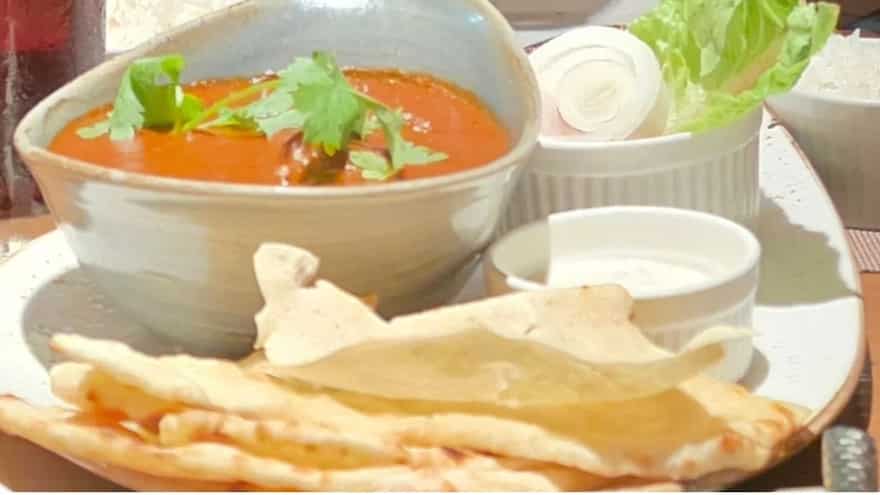
The version that arrived at our table at The Pantry came with basmati rice — long-grained, properly cooked, the grains separate and slightly fragrant with what might have been a bay leaf or a clove somewhere in the cooking water. The gravy was deep and dark red. The lamb was tender in the way that takes time rather than technique — the texture of meat that has been persuaded rather than forced to yield. The spice was present without being aggressive. The fennel was there, underlying everything, doing the Kashmiri Brahmin thing of cooling without diminishing. It was a composed, serious dish.
Aaron tasted it. He was quiet for a moment. Then he looked up.
"I've never had this before," he said, in the tone of someone making a mental note that will be kept.
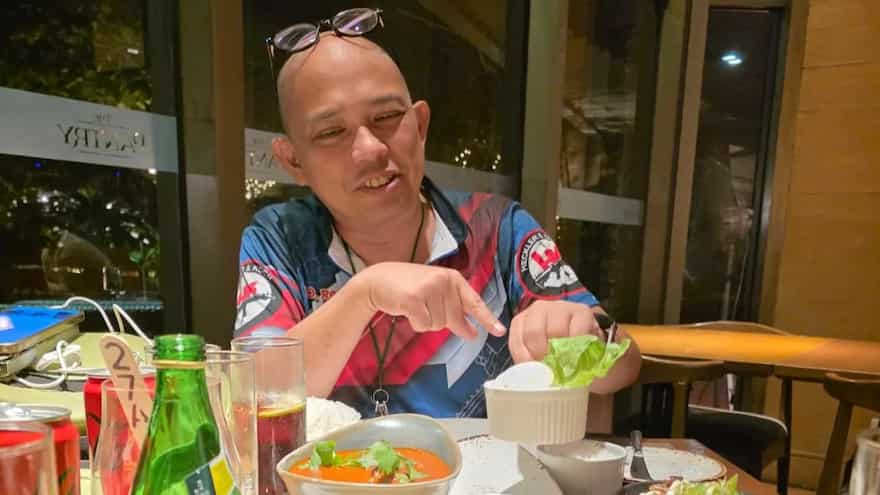
There is a particular pleasure in watching someone encounter a good dish for the first time as an adult. Children eat without biography — they have no previous version of anything to compare against. Adults bring their entire history to a first taste. When it lands well, you can see it: the slight recalibration, the repositioning of prior assumptions about what a category of food is, the moment of genuine surprise. Aaron had that moment with the Rogan Josh. He ate it with the attention it deserved.
My own order had come to the table at approximately the same time: the sizzling sisig.
And if Rogan Josh is a dish of patience and accumulation — of fat and time and the slow deepening of spice — then sisig is its temperamental opposite. It arrives not as a composed statement but as an event.
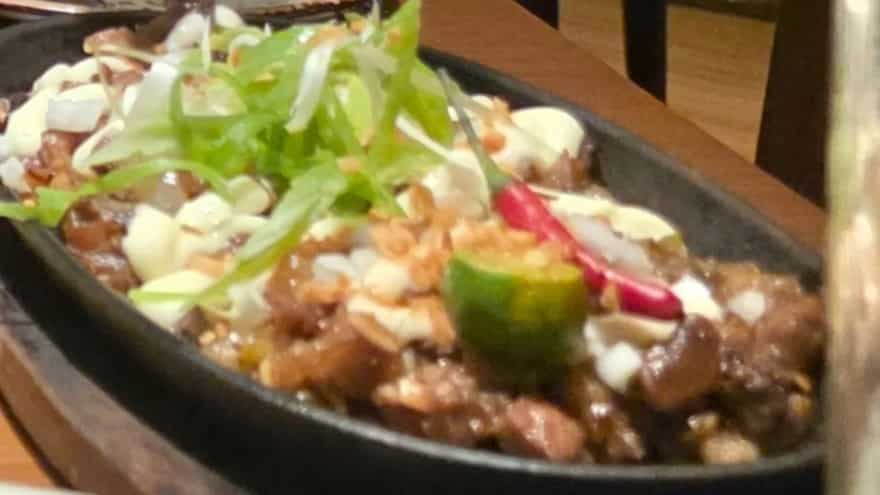
The cast-iron plate reaches the table before the smell does, which is to say the smell arrives first. The oil is still popping at the edges. The chopped pork — charred at the extremities, tender towards the centre, the cartilage doing what cartilage does under sustained heat — sits in its own fat, which is itself doing the work of continuing to cook the dish on the plate in front of you. The calamansi has already been squeezed. The chillies are distributed. The onion has partially caramelised. The whole thing is making a noise that a quieter dish would find undignified.
It is magnificent.
The history of sisig is, if anything, more layered than the history of Rogan Josh — and considerably stranger. The name derives from the old Tagalog word sisigan, which means 'to make sour.' An Augustinian friar first recorded its existence in 1732. In his Spanish-Kapampangan dictionary, Diego Bergaño catalogued sisig as a salad including green papaya or green guava eaten with a dressing of salt, pepper, garlic, and vinegar. In this original form it was entirely plant-based — a palate-awakening acid salad, the kind of thing that appears at the beginning of a meal precisely because sourness stimulates appetite. It was, in the vocabulary of the time, a condiment in the broadest sense: something that sharpened everything around it.
The word sisig in Kapampangan means, simply, sour. The province of Pampanga — from which both sisig and Bringhe (the turmeric-coconut rice I encountered earlier in Manila) originate — has been called the culinary capital of the Philippines, and not without justification. During the Spanish colonial period, Kapampangans were among the first Filipinos trained in friar kitchens and elite households, cultivating a legacy of refined technique and bold flavours. Pampanga is a province that learned to cook from its colonisers and then surpassed them, absorbing technique while retaining the local logic of what flavour is for.
The dish remained in its sour-salad form for some two centuries after Bergaño documented it. What transformed it into something closer to what arrives on a sizzling plate today is a story with a deeply unlikely catalyst: the United States Air Force.
Sisig came to its modern existence when locals purchased unwanted pig parts from the commissaries in Clark Air Base in Angeles City, during the time when the U.S. Air Force was still stationed in the Philippines. The American military presence at Clark brought, among other things, a particular attitude towards butchery: the parts of the pig that the commissary kitchen did not want — heads, ears, cheeks, snouts — were discarded or sold cheaply. The Kapampangans, who have always understood that every part of an animal is an opportunity rather than a problem, bought them. They boiled them, seasoned them with vinegar in the tradition of the old sisig salad, and ate them. This was the transitional form: the pig offal had arrived, but the cooking method had not yet become the sizzle.
That transformation belongs to one woman. Lucía 'Aling Lucing' Lagman Cunanan — born February 27, 1928 — was a Filipino restaurateur who in 1974 established Aling Lucing's, a restaurant in Angeles City. Her restaurant offered a reinvented variant of sisig which soon became nationally famous.
The story of how the reinvention happened is the kind of origin story that food myths are made of — small, accidental, entirely credible.
Based on Aling Lucing's own account, her invention of the modern sisig was an accident. She burned a pig's ear accidentally while grilling it and did not want it to be a waste, so she chopped the pig's ear and put other ingredients on it. The burning turned out to be the point. The char gave the cartilage a dimension that boiling had never produced — a smoky bitterness at the edges that contrasted with the tender, gelatinous interior, a texture complexity that the old vinegary salad had never approached.
Aling Lucing retained the elements of the traditional Kapampangan dish — chopped meat cooked with a souring agent — but kicked things up a notch by grilling the boiled meat, chopping it up, frying it with pig brains and chicken livers, then serving it on a sizzling plate. The three-stage cooking process — boil, grill, sizzle — is what distinguishes properly made sisig from everything that has since adopted the name. Each stage does something irreplaceable: boiling renders and softens, grilling chars and deepens, sizzling on the iron plate concentrates and crisps the exterior while keeping the interior tender. It is a method of controlled destruction, each stage removing something from the ingredient — moisture, fat, softness — so that what remains is entirely itself.
Aling Lucing died in 2008, murdered in her home at the age of eighty, in circumstances that remain among the more tragic postscripts in culinary history. The dish she transformed outlived her by several decades already and will outlive the century. Sisig has become one of the country's most in-demand exports — a dish often championed abroad by local and foreign chefs, bringing Filipino cuisine to the forefront of the global dining scene. Anthony Bourdain ate it at Aling Lucing's and wrote that it had everything he loved about food. He was not wrong, but he was also reporting something that the Kapampangans had known since at least the 1970s. The rest of the world was simply catching up.
The version at The Pantry was excellent. The pig was properly treated — not the rubbery compromise of sisig made from lesser cuts without the three-stage preparation, but the genuine article, with the textural range that only comes from the original method. The calamansi was present in exactly the right proportion: bright enough to cut, restrained enough not to dominate. The chilli was heat without aggression. The onion was crisp. The liver creaminess was there, binding everything together the way a good sauce binds a French dish — not as an addition but as a structural element.
I ate it with the deep satisfaction of something encountered exactly when it should be.
Then one of us looked at the two plates and made the suggestion.
What would happen if we mixed them?
There is a version of food consciousness that would regard this as a transgression. Both dishes have histories. Both arrived at their current form through centuries of specific choices made by specific people in specific conditions. To combine them casually at a table in Makati is, on one reading, to be cavalier with that history.
But there is another reading, which is that this is precisely what food does, and has always done. Rogan Josh arrived in Kashmir because Mughal cooks brought Persian techniques to a mountain valley with its own spice vocabulary. Sisig was transformed when an American military presence in Pampanga discarded pig heads that a Kapampangan cook turned into something extraordinary. Every dish that is worth eating exists because someone, at some point, made an unexpected combination and discovered that it worked. The history of food is the history of these moments: the accident, the substitution, the mixing of what was not designed to be mixed.
We mixed them.

What happened was this: the deep, slow heat of the Rogan Josh — the warmth of cardamom and cinnamon and the earthy sweetness of Kashmiri chilli, the fat of the lamb carrying the spice — met the sharp, bright, percussive energy of the sisig — the char, the calamansi, the heat of siling labuyo, the crunch of cartilage — and instead of cancelling each other out, they did what good contrasts do. They created a third thing.
The basmati rice, which had been performing its usual function of absorbing and moderating, now became the medium through which the two gravies — the dark, slow Kashmiri and the bright, acidic Filipino — could find each other without collision. The lamb disappeared into the pork and vice versa. The fennel undertone of the Rogan Josh lifted the sisig's pork fat in a way that the calamansi alone had not managed. The calamansi, in return, did something useful to the Rogan Josh that yoghurt usually does — introduced an acidity that made the spice more present without making it hotter. The result was a hybrid that had a claim to coherence that neither of us had anticipated.
It was good. Genuinely good. Not good in the way that unusual combinations are sometimes called good out of social obligation to the idea of fusion, but good in the way that means: I would order this deliberately if it were on a menu.
I should note, for the benefit of any reader who might be tempted: this is not universally advisable. It requires two specific things to be true simultaneously. The Rogan Josh needs to be properly made — slow-braised, properly spiced, the lamb genuinely tender — because a compromised Rogan Josh becomes muddy when combined with something as acidic and porcine as sisig. The sisig needs to be the real thing — the three-stage preparation, the calamansi in the right proportion, the heat controlled — because sisig made on shortcuts becomes aggressive when it meets a cream-based gravy and simply overwrites it. At The Pantry, both conditions were met. Under lesser circumstances, the experiment might not survive contact with its ingredients.
Aaron ate it with the expression of someone updating a mental model in real time. He is, as a journalist, professionally accustomed to encounters that displace prior assumptions. He brought that quality to the plate.
"I didn't know this would work," he said.
"Neither did I," I said. Which was true.
We were, by this point, some way into the evening.
Aaron's beat — foreign business, real estate, banking, infrastructure, the BSP — is the landscape through which capital moves in the Philippines, and he moves through it with the particular fluency of someone who has been watching it long enough to see the patterns. He is not cynical about what he covers. He is precise about it, which is a different and considerably more useful quality.
The food had done what good food does in a conversation between two people who don't know each other well: it had provided a shared focus, a set of concrete experiences to which both parties could refer, a subject that required no prior relationship to discuss honestly. We had both tasted the same things. We had both noticed different aspects of them. We disagreed, mildly, about the sisig-Rogan Josh combination — he thought the Rogan Josh overpowered the sisig slightly; I thought the sisig held its own — and the disagreement was the most comfortable kind: the kind where both parties are clearly right about different things.
The mousse arrived.
It was the kind of dessert that understands its role in a meal that has already been substantial: something light, something that cleansed rather than compounded. Dark, not too sweet, with the composure of a well-made mousse that has been given time to set properly rather than rushed to the table. It did what it was there to do without asking for attention.
The carrot cake — sugar-free, topped with pineapple — was the more interesting object. Sugar-free baking occupies a space that is genuinely difficult to navigate, because sugar in a cake is not merely sweetness: it is structure, moisture retention, browning, and the particular quality of crumb that comes from the interaction of sucrose with fat and protein during baking. Remove it, and you must compensate in ways that are not straightforward. The pineapple on top was doing some of this work — its natural sugars providing the browning that the cake itself could not achieve, its acidity brightening the carrot and the warm spice of cinnamon and ginger. The result was not indistinguishable from a conventional carrot cake, but it was not pretending to be. It was its own thing, made within constraints, and within those constraints it was well-executed. I ate all of it, which is the most honest review.
Emily appeared at the appropriate moments throughout the evening — to check that things were as they should be, to time the courses correctly, to manage the pace of service so that we never felt rushed and never felt forgotten. In a restaurant where the kitchen is clearly capable, the service is what determines whether a meal becomes an experience or merely a transaction. At The Pantry that evening, it was unambiguously the former. The care she brought to the room — unhurried, accurate, warm without being familiar — was the invisible architecture within which everything else was able to happen. Good Maître D service is precisely this: it creates conditions. It does not perform.
There is a coda to this evening that belongs in the record.
Walking back along the stretch of Makati that runs past the Dusitani towards the arterials of the business district, I found myself thinking about what had just taken place at that table in terms that were perhaps slightly disproportionate to a dinner between two journalists, but which felt accurate nonetheless.
Rogan Josh and sisig are separated by geography, religion, cultural history, and culinary philosophy. One is the product of a medieval Mughal court's summer migration to a mountain valley, refined over five centuries into a dish of deep patience and aromatic complexity. The other is the product of a Kapampangan woman's refusal to waste a burnt pig's ear, transformed over fifty years into a national institution and a global ambassador for Filipino cooking. One travels from Persia to Kashmir to the Indian subcontinent to the world. The other travels from a sour green salad in 1732 Pampanga to a cast-iron plate outside a railroad track in Angeles City to the menus of London and Los Angeles. Their journeys are nothing alike.
And yet, at a table at The Pantry in Makati, mixed together with basmati rice in a combination that two inveterate eaters arrived at through the simple logic of curiosity, they produced something that neither could have produced alone. The slow and the fast. The deep red and the charred brown. The lamb and the pork. The fennel and the calamansi. The patience of the Mughal court and the accident of Aling Lucing's kitchen.
This is, in a sense, what Manila is. Not a city of coherent synthesis — that would be too neat, and would do a disservice to how abrasive and complicated the intersections actually are — but a city of encounters. Spanish colonialism and American military presence and Chinese mercantile culture and Malay indigenous knowledge and the Indian Ocean trade networks that brought Bringhe to Pampanga from Tamil Nadu via the Straits of Malacca — all of this is present simultaneously, not as a harmonious blend but as a layered, occasionally contradictory, frequently surprising accumulation. Manila does not resolve its influences into a single coherent thing. It holds them in productive tension.
A dinner table is, if you are paying attention, a compressed version of this. Two people with different histories, different professional preoccupations, different relationships to food and eating, arriving at the same table and discovering — through the shared experience of tasting something, and the willingness to see what happens when you push the experiment further than politeness might normally allow — that the encounter produces something neither of them had anticipated.
Aaron tried Rogan Josh for the first time and found it. I had sisig and found it excellent. We mixed the two and found that the combination, implausible on paper, held together on the plate. We had mousse and pineapple-topped carrot cake and the service of Emily, who managed the entire evening with a grace that made it look effortless, which is the only proof that it was not.
Some encounters are merely pleasant. Others are instructive. The best ones are both. This was one of the best ones.
The Pantry is located at the Dusitani Manila Hotel, Makati City.
Avinash Mudaliar is Co-Founder and CEO of HT Labs, and was a speaker at WAN-IFRA Digital Media Asia 2026, held in Manila, 28–29 April 2026.
Aaron Ronquillo is Editor (Foreign Business) at The Manila Times.
All food and beverages in this piece were paid for by the writer. The opinions expressed are entirely and solely his own. No complimentary hospitality, consideration, or benefit of any kind was received from any establishment or individual mentioned. Nothing in this piece should be construed as a formal recommendation or endorsement; readers are encouraged to form their own judgements through their own experience.




