


 Share
Share

BEFORE THE VALLEY WAKES, the ovens are already alive.
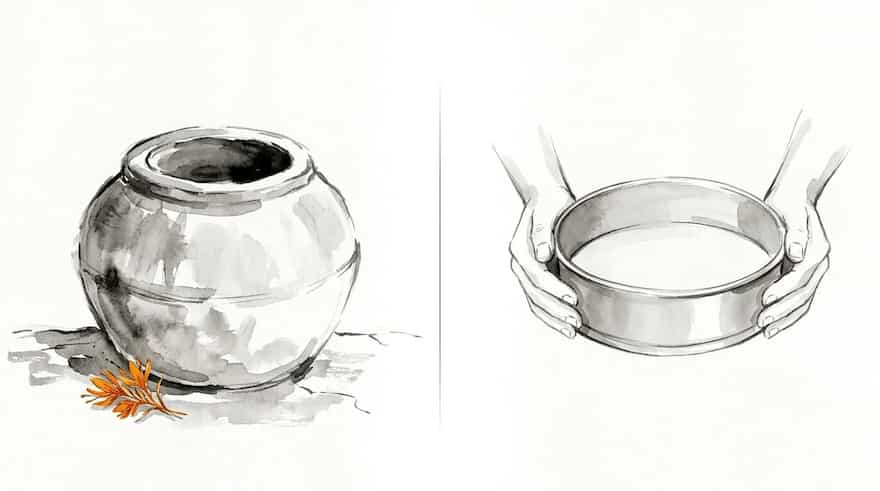
In Kashmir, the day begins not with light but with heat — the slow, steady glow of wood-fired clay tandoors, coaxed into readiness long before dawn. By the time the first call to prayer, the namaz-e-fajr, folds into the morning air, the kandurwans — traditional neighbourhood bakeries — are already at work. Men returning from the mosque stop by with wicker baskets in hand, collecting the day’s first bread. What passes between them is not just currency and loaves, but news, pleasantries, the soft hum of community. The kandurwan, as it has been for centuries, is less a shop than a social axis.
This rhythm, so seemingly fixed, is the result of a long and layered history — one that begins far beyond the Valley.
Kashmir’s baking traditions took shape under Central Asian sultans, who brought with them the tandoor, derived from the Persian tanur. The ancient Silk Road — that sprawling artery linking Kashmir to Central Asia, Afghanistan, Punjab and Iran — ensured that the clay oven became not just an imported technology but an essential part of local life. Bread, in Kashmir, has always been an inheritance.
But history, like dough, is rarely left untouched.
By the 19th century, a different influence had begun to seep into the Valley. Michael Adam Nedou, a Croatian entrepreneur, established Nedou’s Hotel, introducing one of Kashmir’s earliest European-style bakeries. Within its kitchens, English and European chefs trained local apprentices, setting in motion a quieter, more gradual transformation.
The legacy of that encounter survives in the names that still circulate through Srinagar’s baking lore. Haji Mohammad Sultan, trained under Nedou’s patronage, went on to open Ahdoos Bakery in 1918, initially serving tea cakes and biscuits to an English clientele. Sufi Ghulam Mohammad — known to the British as “The Man with the Golden Fingers” — mastered the art of intricate icing, Danish pastries and sugarcraft before founding Shalimar Bakers in the 1950s. What began as apprenticeship became adaptation; what was learned was not merely replicated, but absorbed into the Valley’s evolving palate.
Yet for all these additions, the heart of Kashmiri baking remains stubbornly local, anchored in the kandurwan.
The profession itself is often hereditary, closely associated with the Sofi caste. In places like the century-old Sofi Bakery in Bandipora, fourth-generation bakers such as Hilal Ahmad Sofi continue to tend wood-fired clay tandoors, preserving a craft that is as physical as it is precise. The work is manual, exacting, and unrelenting — a daily act of repetition that resists automation.
And then there are the breads themselves, each carrying its own rhythm, its own place in the social fabric.
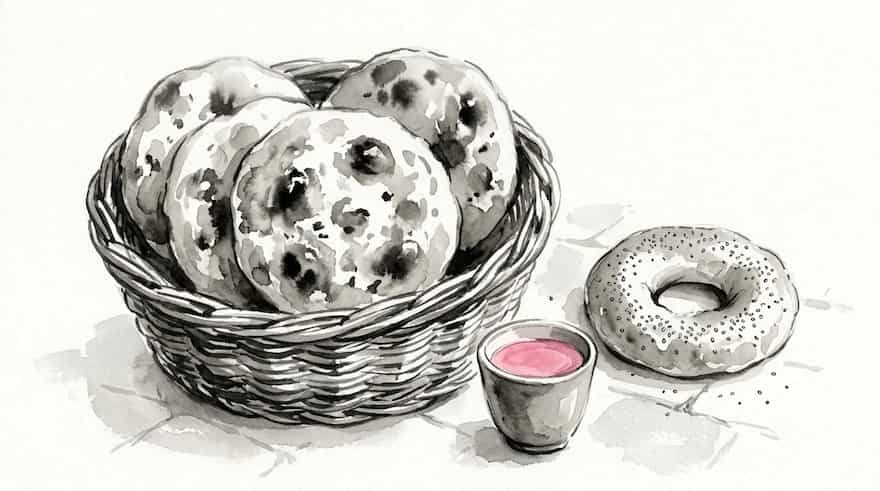
Girda and lavasa form the daily grammar of eating. Girda, thick and round, emerges with a blistered exterior and a soft, pillowy interior, often paired with butter or jam. Lavasa, thinner and more pliable, is baked directly on the tandoor’s floor, folded easily, and eaten with morning tea or barbecued meat. These are not ceremonial breads; they are the scaffolding of everyday life.
Others are more deliberate in their appearances. Telvor — or tsochwor — arrives ring-shaped and sesame-studded, reminiscent of a bagel, served to guests alongside the salty pink noon chai. Baqerkhani, rich and flaky, belongs to slower hours, to long conversations, and to the rituals of marriage where its presence is considered indispensable. Kulcha, dry and dense with a longer shelf life, often marked by a centre of peanuts and sesame seeds, moves through festivals and family gatherings with quiet regularity.
Bread, here, does not anchor the main meal — that role belongs to rice — but it structures time itself: mornings and evenings, arrivals and departures, solitude and company.
And yet, this carefully held continuity is beginning to strain.
Traditional bakers speak of rising costs — flour, fuel — and of margins that grow thinner with each passing year. The work remains physically demanding, but the rewards have diminished. Younger generations, watching this imbalance, are choosing differently: education, employment beyond the bakery, lives that do not begin before dawn or end in soot and heat. The hereditary chain, once unbroken, is loosening.
At the same time, tastes are shifting.
The late 20th century introduced bakeries like Jee Enn Sons, bringing with them electric ovens, planetary mixers, and a new vocabulary of pastries — Black Forest, White Forest — that signalled a broader palate. More recently, ventures such as Just Baked, staffed by a former Oberoi chef, have sought to meet European standards, while Le Delice has positioned itself within the tradition of authentic French baking. The kandurwan now exists alongside glass counters and refrigerated displays, the clay oven sharing space, metaphorically if not physically, with the electric range.
And then came the pandemic, and with it, an unexpected turn.
During regional lockdowns and the wider disruption of COVID-19, a new generation of bakers emerged — not from inherited tandoors, but from domestic kitchens. Women like Lyka Khan of Bake and Take and Aabiru of A Bake Studio began building businesses through Instagram, crafting customised 3D cakes, preservative-free goods, and eggless or sugar-free alternatives. These home-based ventures did more than respond to demand; they reconfigured the structure of baking itself, shifting it from a traditionally male-dominated, hereditary trade to a more fluid, accessible practice.
What was once passed down is now, increasingly, self-taught.
And yet, despite these changes — or perhaps because of them — the ovens continue to burn.
From the soot-darkened interiors of clay tandoors to the calibrated precision of modern electric ovens, Kashmir’s baking culture persists as a living archive. It holds within it the imprint of Central Asian sultans, the influence of European kitchens, the discipline of hereditary craft, and the improvisation of a generation learning to bake for a digital audience.
Bread, in Kashmir, has never been just sustenance. It is a measure of time, a record of exchange, a quiet witness to the Valley’s capacity to absorb, adapt, and endure.
And each morning, before the world properly begins, it rises again.




