


 Share
Share

CHRISTOPHER NOLAN’s The Odyssey has finally arrived, sending audiences back into Homer's world of Cyclopes, Sirens, witches and wandering heroes.
But while everyone's talking about IMAX spectacle and Matt Damon's voyage back to Ithaca, there's another Odyssey worth revisiting. It begins not with monsters. It begins with dinner.
Ask someone what they remember from The Odyssey and you'll probably hear about the Cyclops, the Sirens or the Trojan hero who spent ten years trying to get home. Ask them what anyone ate along the way and you'll likely be met with silence.
Which is a pity, because Homer seems to have had a remarkable appetite for describing meals.
Not in the modern, food-porn sense. There are no lingering descriptions of bubbling stews or crisp roast skin. Instead, food in The Odyssey does something far more interesting. It tells you who deserves your trust. Every loaf of bread, every mixing bowl of wine and every roasted sheep becomes a moral clue. Strip away the monsters and sea voyages, and Homer's epic begins to resemble an elaborate dinner party where the guest list includes kings, witches, gods, swineherds and one exceptionally rude giant.
The first lesson arrives before anyone picks up a fork.
In Homer's world, a stranger wasn't expected to introduce himself immediately. He was expected to eat first.
This custom, known as xenia—the sacred code of hospitality—formed one of the cornerstones of Greek society. A traveller arriving at your door was offered a seat, water to wash, bread, wine and a meal before awkward questions like "Who are you?" or "Why are you here?" could be asked. Hospitality wasn't merely politeness; it was a sacred obligation watched over by Zeus himself, who bore the title Zeus Xenios, protector of guests.
It's remarkable how often The Odyssey follows this script. Odysseus is welcomed into palaces, huts and halls where food appears almost instantly: bread baskets, roasted meats, wine mixed with water, generous portions served before conversation begins. Homer repeats the ritual with almost liturgical precision, as if reminding his audience that civilisation starts with setting an extra place at the table.
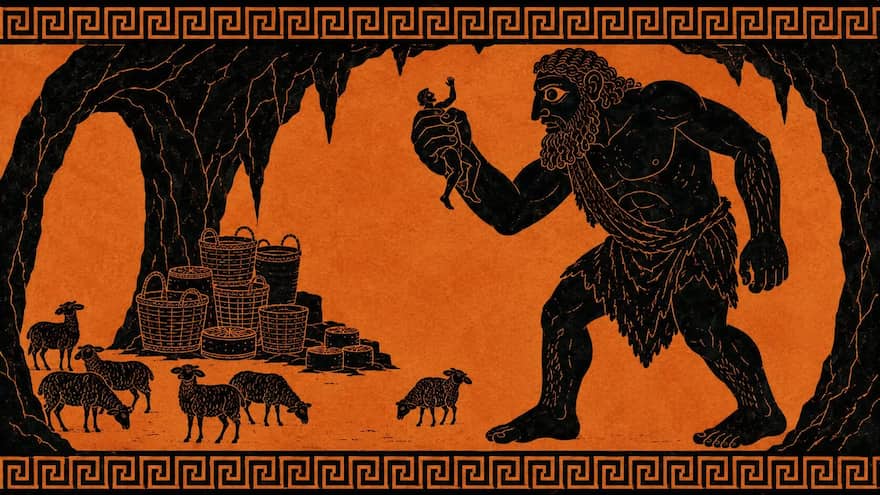
Which is precisely why the Cyclops is so horrifying.
Popular retellings reduce Polyphemus to a one-eyed cannibal, but Homer spends surprising time describing his dairy operation. The giant keeps sheep. He milks them carefully. He separates curds from whey. He stores cheeses in wicker baskets. His cave is practically an artisanal creamery.
If this were a modern food show, you'd happily buy his farmhouse pecorino.
Then he eats two guests for dinner.
That jarring contrast is deliberate. Polyphemus isn't a monster because he lives in a cave. He's a monster because he understands food without understanding hospitality. He knows how to make cheese but not how to share it. In Homer's moral universe, culinary skill alone isn't civilisation. Generosity is.
The wine that blinds him carries its own story.
Earlier in his travels, Odysseus receives an extraordinarily strong wine from Maron, a priest of Apollo. Homer lingers over its potency: one measure of wine diluted with twenty of water, fragrant enough to fill a room. It is less a drink than a diplomatic gift, offered in gratitude for mercy shown during war.
Years later, that forgotten gift becomes the weapon that saves Odysseus' life. The Cyclops drinks it undiluted—as only someone unfamiliar with civilised drinking customs would—and collapses into a stupor, allowing Odysseus to blind him with a sharpened olive stake.
A bottle of wine changes the course of the epic.
Elsewhere, food becomes something stranger.
Consider the Lotus-Eaters, who consume a mysterious fruit so seductive that anyone who tastes it forgets home altogether. Homer never bothers explaining what the lotus is. Scholars have spent centuries proposing everything from dates to narcotic plants. The ambiguity is the point. This is the earliest great literary meditation on comfort food—not food that reminds you of home, but food that erases the desire to return.
Odysseus responds not by debating its ingredients but by dragging his enchanted crew back to the ships by force.
Some meals nourish. Others make you forget who you are. Circe's banquet offers another twist.
She welcomes Odysseus' men with impeccable manners, serving cheese, barley meal, honey and wine—the ingredients of an entirely respectable Greek table. Hidden within the feast, however, are enchanted herbs that transform the sailors into pigs.
It's one of literature's first cautionary tales about accepting food from strangers.
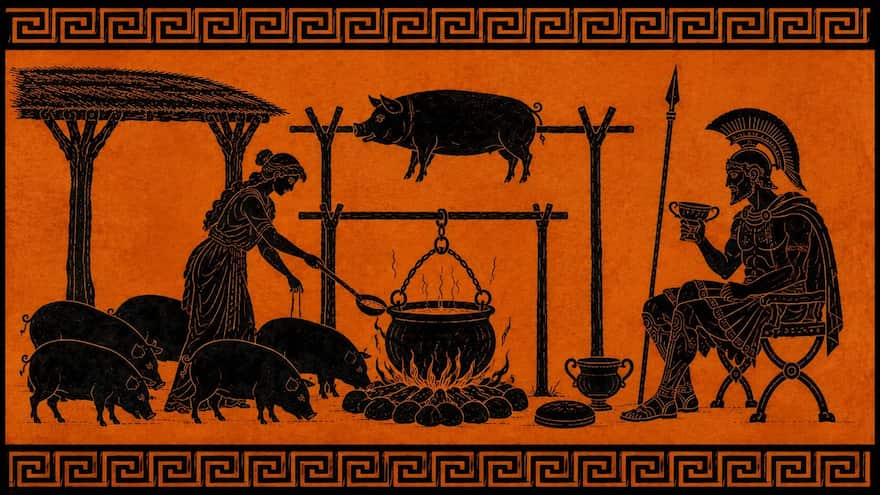
Curiously, Circe herself isn't interested in cooking. The meal exists purely as theatre. The food isn't dangerous because of what it contains; it's dangerous because hospitality has become performance rather than kindness.
Not every meal is deceptive. Some are deeply moving.
One of the quietest heroes of The Odyssey is Eumaeus, the loyal swineherd who welcomes a ragged, unrecognisable Odysseus into his humble hut. He has little to spare, yet he immediately lights a fire, slaughters a pig, bakes bread and pours wine for the stranger before learning his identity.
It's an act so ordinary that it's easy to overlook.
Yet this modest supper may be the most important meal in the poem.
Kings host feasts because they can. Eumaeus hosts one because it's right.
If Polyphemus represents failed civilisation, Eumaeus represents its highest form.
Then there are the suitors.
While Odysseus wanders the seas, dozens of aristocrats occupy his palace, feasting daily on his livestock, draining his wine stores and consuming his household as they compete for Penelope's hand. Homer is relentless in describing their appetites. Oxen, sheep, goats, bread and wine disappear in endless succession.
Their gluttony isn't merely comic. It's political.
The suitors don't work the land, tend the flocks or hunt the game. They simply consume. Their endless banquets become a metaphor for parasitic power, an aristocracy feeding on someone else's labour. By the time Odysseus returns, reclaiming his home means reclaiming his table.
Perhaps the most haunting food story arrives near the end.
Odysseus' exhausted crew land on the island of Helios, where sacred cattle graze beneath the sun. Their instructions are explicit: do not touch them.
For a while they obey.
Then the winds trap them. Supplies run out. Hunger sharpens into desperation. Eventually, while Odysseus sleeps, the men slaughter the sacred herd.
The scene is almost painfully human. No villainy. No greed. Just starvation.
The meat hisses unnaturally on the spits. The hides crawl. The gods notice. Zeus destroys the ship, leaving Odysseus the sole survivor.
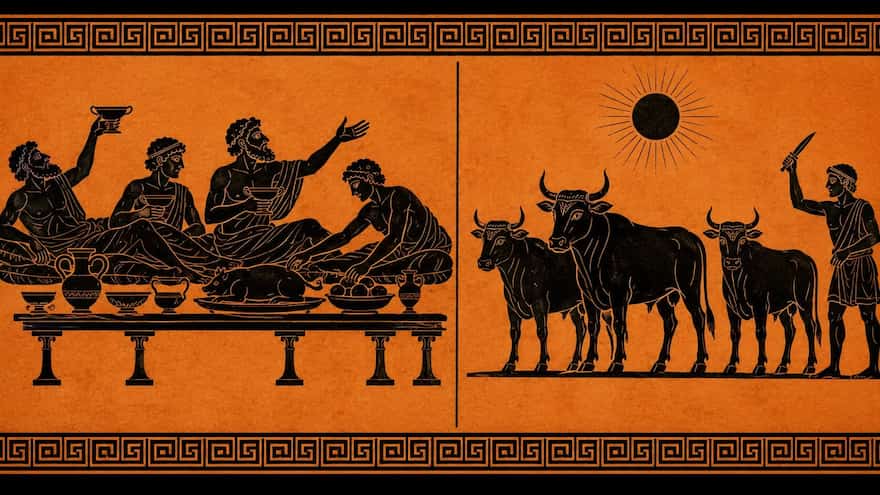
It is one of the oldest reminders in Western literature that hunger can push otherwise decent people into terrible choices.
What emerges from all these meals is an unexpectedly coherent philosophy of food.
Bread appears again and again, usually alongside wine diluted with water. Roasted meat follows ritual sacrifice. Olive oil glistens over simple dishes. Cheese, honey, figs and barley anchor everyday meals. Fish appears less often than modern readers might expect, despite all the sailing, perhaps reflecting the prestige of livestock in Homeric society. Feasts are communal. Eating alone is rare. Food binds families, strangers and kingdoms into temporary communities.
That vision still feels familiar across the Mediterranean.
A loaf of bread passed around the table. Olive oil poured generously. Wine shared rather than hoarded. A guest urged to eat more before explaining why they've come. Thousands of years separate us from Homer, yet many of these gestures survive almost unchanged.
Perhaps that's why The Odyssey continues to resonate.
Yes, it's an adventure story filled with monsters, magic and impossible journeys. But beneath the heroics lies something quieter and more recognisable. Homer understood that you can learn almost everything about a person by watching what they do when someone hungry arrives at the door.
Heroes, it turns out, don't announce themselves with swords. They offer you bread first.




