


 Share
Share

ON A JULY AFTERNOON IN 2017, Zhang Wei sat in the bar of the Waldhaus Hotel Am See in St Moritz, Switzerland. Known to his millions of Chinese readers as Tang Jia San Shao, the 36-year-old fantasy novelist had travelled there with his grandmother, seeking Alpine air and indulgence. The bar, Devil’s Place, was a temple to whisky: more than 2,500 bottles lined the shelves. Amid this sea of amber, one stood out. Its label bore a promise: Macallan 1878.
The bartender poured a dram. Zhang Wei raised the glass, inhaled the century-old vapours, and took a sip. He later posted on Weibo that he had “a good taste” of a whisky that had waited 139 years for him. The bill was nearly £8,000 for that single measure — the most anyone had ever paid for a dram.
What he had really swallowed was the opening note of a scandal.
The St Moritz Deception
The first doubts came not from the taste but from photographs. When images of the bottle appeared in the press, industry veterans began to squint. The cork looked far too fresh. The label, curiously pristine, bore an impossibility: “Roderick Kemp, proprietor, Macallan and Talisker Distilleries Ltd.” Kemp had indeed owned both distilleries — but never at the same time. He sold Talisker in 1892 to purchase Macallan. History does not bend to marketing copy.
Other telltales piled up. The cork showed no signs of a century sealed in glass. The typography felt suspiciously modern.
The hotel, unnerved, turned to Rare Whisky 101 (RW101), a Scottish consultancy that has made a business of sniffing out fraud. Sandro Bernasconi, the manager, sent a sample across Europe to the laboratories of Oxford University. Carbon dating does not lie: the liquid in the bottle had been distilled not in 1878, but between 1970 and 1972.
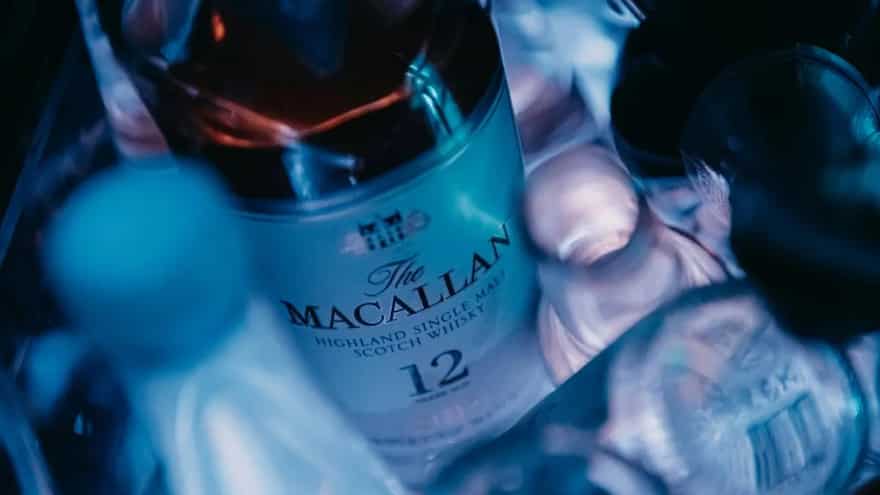
Further analysis at Tatlock and Thomson revealed a blend: 60% malt, 40% grain. Not a single malt. Not Macallan 1878. Almost worthless.
The Waldhaus had sold Zhang Wei the most expensive fake dram in history.
In an act of contrition, Bernasconi flew to Asia to refund him in full. Zhang Wei was reported as “not angry.” Bernasconi later said the hotel felt a duty: their whiskies had to be “100% authentic and the real deal.” David Robertson of RW101 commended the decision, even as he warned of the rising tide of counterfeits.
A History of Illusions
This was hardly the first time Macallan’s name had been unfortunately entangled with fraud. The rare whisky market has long been a hunting ground for counterfeiters, and the brand — coveted, collectible — was a favourite target.
By the late 1990s, antique bottles appeared in ever-greater numbers at auction, many originating from Italy. Between 2000 and 2002, Macallan itself purchased around 100 supposed antiques, some from eBay. They even launched a “Replica” series modelled on these bottles.
But suspicions mounted. Tasting notes on an “1861” bottling described it as “remarkably fresh.” Labels bore the same historical inaccuracy about Kemp and Talisker. In 2003-2004, Macallan tested 16 bottles, dated between 1856 and 1919. All contained post-1950 liquid. Radioactive isotopes from atomic bomb testing — tracers no Victorian whisky could hold — confirmed the deception.
Macallan eventually halted the sales, but questions lingered. Why did the distillery delay announcing the results? Why did its Replica series, replicas of fakes, continue to circulate at high prices? As late as 2018, some dubious bottles were still displayed at the distillery until removed under pressure from critics.
The irony was bitter: a whisky house celebrated for heritage had unwittingly curated a gallery of forgeries.
Fighting the Fakes
The counterfeit trade has grown alongside whisky’s surge as a luxury investment. Rare Whisky 101 estimated in 2018 that £41 million worth of collectible bottles were fake, with 38% of tested pre-1900 samples exposed as fraudulent.
Science has become the industry’s defence. Carbon dating remains the gold standard, particularly effective for whiskies distilled after the Second World War, thanks to the tell-tale spike of carbon-14 from nuclear testing. Costing around £600, the test requires only a few millilitres.

Other weapons are emerging. Distillers are adopting holograms and tamper-proof closures. Researchers in Sydney have developed an “e-nose” — a machine that mimics the human sense of smell and can identify brand, style, and region with astonishing accuracy. And some producers are experimenting with blockchain, issuing NFTs that certify provenance and keep bottles in secured storage until sale.
Yet no technology can entirely protect the romantic allure of a dusty bottle said to be older than the Eiffel Tower.
Buyer Beware
The lessons of St Moritz are not confined to billionaires and oligarchs. Collectors, casual buyers, even tourists seeking a memento can fall prey to fakery. Experts distil the threat into the “three Rs”: refills, replicas, relics. Each can fool the eye and sometimes the palate.
Due diligence is the only safeguard. Check provenance. Inspect labels for poor print or too-perfect condition. Compare bottle shapes and closures against known examples. Approach any pre-1950 whisky with extreme caution. And if the price feels miraculous, assume it is.
As David Robertson of RW101 put it: if you own a pre-1900 bottle, test it. “Most likely not genuine.”
The most pragmatic advice is also the most sobering: buy whisky to drink it. Savour the story in the glass, not the auction value on the invoice. For in this market, even history can be counterfeited.
Epilogue
The dram Zhang Wei sipped in St Moritz was distilled during the disco era, not the Victorian one. He paid for 139 years of history and received just four. The scandal revealed how fragile authenticity can be in a world where rarity commands vast sums.
Whisky is a spirit that prides itself on patience, time, and trust. But as the Macallan scandal proved, even the most revered names are not immune to deception. The bottle may glitter, the story may be irresistible — but the liquid does not always tell the truth.




