


 Share
Share

THERE IS A PARTICULAR HOUR in an Indian summer — just before noon, when the light turns almost white, and the air begins to hum — that belongs to mango pickle.
Not to eating it. Not yet.
To making it.
The mangoes arrive first: raw, hard, unapologetically sour. They are washed, wiped, cut with heavy knives that strike against the seed with a dull, familiar thud. The pieces are spread out — not too long, never carelessly — on old cotton cloths or steel plates, left out in the harshest sun. Around them, a household reorganises itself. Someone slices. Someone roasts spices. Someone measures salt not with spoons, but by instinct, by memory, by the quiet calibration of years.
It feels unhurried. It feels habitual. It feels, above all, like ritual.
But it is not just ritual.
It is a way of managing time.
Because summer, in most of the subcontinent, does not just bring abundance. It accelerates decay. Heat ripens fruit quickly, and then just as quickly pushes it past the point of keeping. Mangoes arrive in excess and leave just as abruptly. What cannot be eaten must be transformed — or it is lost.
Pickling is that transformation.
Long before refrigeration, before cold chains and sealed packaging, there was a more immediate problem: how to make something last in a climate that refuses to let it. The answer was not preservation in the modern sense of freezing or sealing, but something subtler — slowing time down just enough to make survival possible.
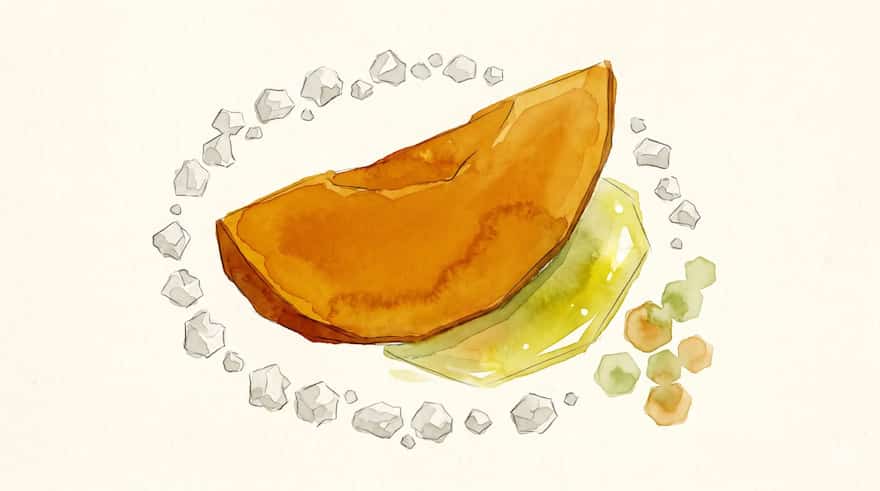
The mechanism is, in retrospect, elegant. Salt draws out moisture, making it difficult for harmful microbes to thrive. Oil forms a seal against air. In some cases, naturally occurring bacteria take over, fermenting the mango, lowering its pH, turning what would spoil into something that actively resists it. The logic is ancient enough that, in parts of Karnataka, traders have long used a simple test to assess a pickling mango’s quality: they light its sap on fire. The longer it burns, the richer its terpenoid content — and the better it will preserve. No instruments. No lab. Just accumulated knowledge, distilled into a flame.
None of this was written down as engineering. But it is engineering.
Together, these processes do something remarkable: they take a fruit that would last days and extend it across months, sometimes years. Not by stopping time, but by bending it.
The instinct itself is ancient. Forms of pickling on the subcontinent date back over 4,000 years, appearing in early culinary references and continuing through Sanskrit texts and medieval cookbooks. By the 14th century, travellers like Ibn Battuta were already documenting the salting and preservation of green mangoes. Later, the arrival of chilli peppers via Portuguese traders would alter the very character of Indian pickles, replacing older sources of heat and giving them the sharp, fiery profile we recognise today.
If the method endured, its expressions shifted — adapting constantly to climate, taste, and need.
In the north, mustard oil — pungent, antibacterial — became both flavour and preservative, carrying spices like fennel, fenugreek, and nigella across months of storage. In Andhra Pradesh, avakaya is not subtle about any of this. Its large mango pieces are coated in chilli and ground mustard — āvapiṇḍi, the powdered seed — cut with almost architectural precision so that spice adheres evenly to every surface. It is a pickle engineered for endurance, not delicacy, and it shows: the moment the jar opens, it fills the room. Gujarat, by contrast, found its answer in sweetness. Chhundo grates the mango fine, adds sugar, and lets the sun do the slow work of concentration — sweetness acting as preservative as much as flavour, with chilli underneath. In the Western Ghats, tiny wild mangoes — appe midi — are pickled whole, their very scarcity shaping how they are prized.
These are not simply regional quirks. They are responses: to humidity, to heat, to what grows, to how long something must endure.
And yet, for all its rootedness, mango pickle has never really stayed still.
Preservation makes food portable. Portability makes it migratory.

In the 19th century, traders moving through Bombay carried barrels of pickled mango across the Indian Ocean, the fruit transformed precisely so it could survive the journey. Among them were Baghdadi Jewish merchants, who brought this spiced preserve to Iraq. There, it took on a new life as amba — its name from the Marathi word for mango. From Iraq, it travelled again, carried by migration into Israel and across the Middle East, where it now appears in shawarma and falafel, as essential as any local condiment.
Elsewhere, British attempts to replicate Indian pickles resulted in piccalilli, a mustard-heavy preserve of local vegetables. In southern Africa, achaar evolved into atchar. In Hawaiʻi, green mango was reinterpreted through soy and preserved plum.
Each version is recognisable. Each one is changed. And that transformation is not incidental — it is built into the logic of pickling itself. A practice designed to make something survive a journey will, inevitably, be changed by it.
Back home, though, the act of making achaar remained stubbornly grounded, even as the pickle itself travelled.
It is work that is rarely named as work.
Hours of washing, drying, cutting, roasting, mixing — performed in the hottest part of the year, often by the same hands, year after year. It is folded into the language of care, of tradition, of “helping out,” even when it demands precision, attention, and endurance. Recipes are not written so much as remembered. A little more salt if the mango feels softer this year. A little less drying if the air holds moisture. Taste, adjust, wait.
What is being passed down is not just flavour, but judgement.
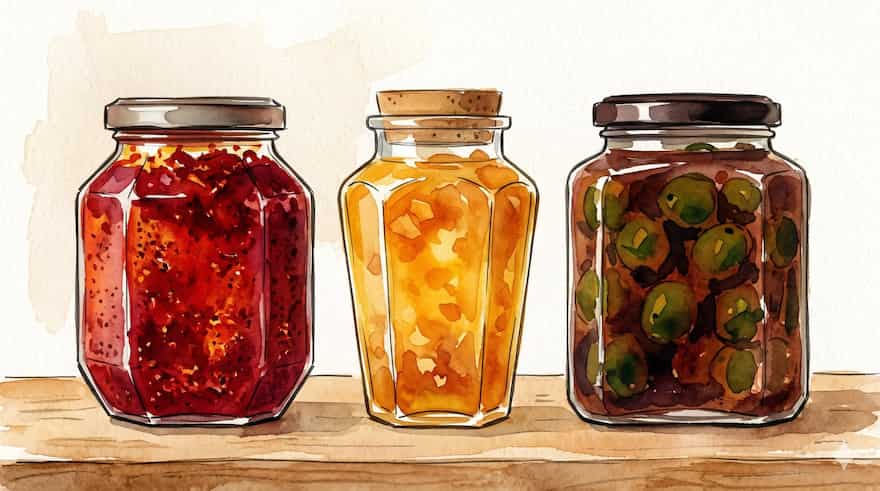
The jars that result — once sealed and set out in the sun — become quiet repositories of that labour. They are shaken, turned, checked, tasted. Watched, almost. Over days, then weeks, the oil loosens, the spices bloom, the mango yields just enough.
And sometimes, they are kept far longer than that.
In some households, mango pickles are preserved for decades — 30, 50, even 70 years — darkening as their chemical composition shifts, their sharpness deepening into something more complex, almost medicinal. A spoonful is taken sparingly, not just for taste but for what it is believed to restore: balance, digestion, a body unsettled by excess or lack.
To eat from such a jar is to taste time itself — not as metaphor, but as accumulation.
And yet, the conditions that made this practice necessary are shifting.
Urban homes rarely have the space — or the sunlight — for large-scale pickling. The slow work of drying and curing has, in many cases, been replaced by convenience. Commercial brands produce pickles at scale, while a newer generation of artisanal makers attempts to recreate the small-batch processes of the past. At the same time, science has begun to validate what tradition always understood: that fermented pickles host beneficial bacteria, that they can support gut health, that what was once necessity may also be nutrition.
But there are pressures that no adaptation easily resolves.
Climate change — through erratic rains, heatwaves, and pests — is already altering mango harvests across India. The raw, firm, high-acidity mangoes best suited for pickling are becoming harder to source consistently. Seasons arrive differently. Crops fail unpredictably. What was once a dependable cycle begins to feel uncertain.
And with that uncertainty comes a quieter question: what happens to a practice built so precisely around timing, climate, and trust in recurrence, when those very conditions begin to shift?
Because achaar was never just about flavour. Or even about memory.
It was about extending the life of something that would otherwise not last. About working with heat, not against it. About trusting that careful attention — salted, spiced, and left to the sun — could hold something in place just a little longer.
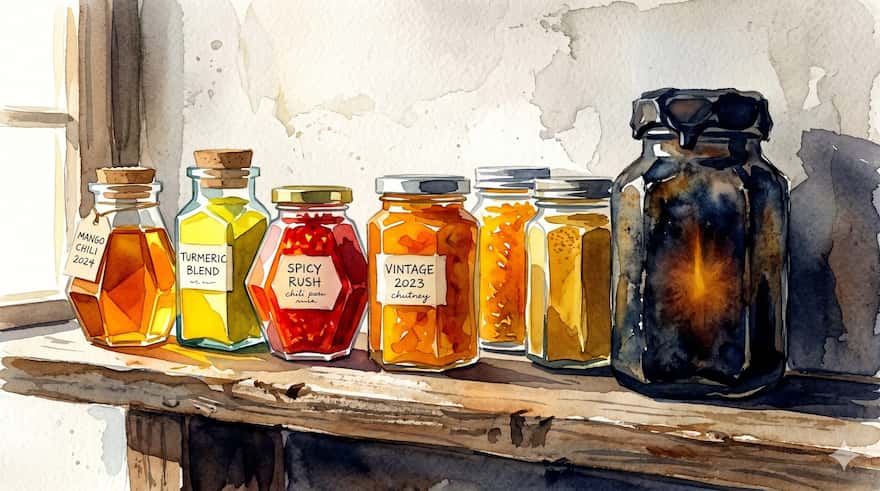
Every jar, in that sense, is an argument against loss.
And perhaps that is why, even now, the ritual persists.
Every summer, when the light turns white and the air begins to hum, the work begins again. The knives, the cloths, the waiting. Not out of habit alone, but out of a deeply learned instinct: that some things cannot be rushed, and some things — once made — are meant to outlast the moment that produced them.
Not indefinitely. Never that.
Just long enough to matter.




