


 Share
Share

YOU KNOW the feeling. The perfectly plated dish arrives at the table. The sauce has been applied with what can only be described as intention. The server describes it in hushed, reverent tones. For a moment, everything feels elevated — you, the room, the meal, your life choices.
But what if the magic on your plate came at a cost you didn't sign up for?
René Redzepi, founder of Noma — the Copenhagen restaurant that spent years at the top of the World's 50 Best list and became shorthand for a certain kind of culinary genius — recently stepped down after 35 staff members alleged he had been physically and emotionally abusive towards them. It made headlines globally. It also made a lot of food lovers quietly uncomfortable.
Because here's the thing: it wasn't really a surprise.
The Bear didn't make this up
If you've watched The Bear — and if you haven't, this is your nudge — you've already had a window into this world. Carmy, the show's tortured protagonist, is explicitly depicted as a product of high-end kitchens like Noma's. The chaos, the screaming, the casual cruelty passed down from chef to chef like a grim inheritance — the show rendered it so accurately that actual professional chefs wrote and talked about recognising every frame of it.
Anthony Bourdain, who spent decades in professional kitchens before becoming the writer and broadcaster a generation of food lovers grew up with, described it plainly in Kitchen Confidential: macho, competitive, aggressive behaviour wasn't an aberration in these environments. It was the culture.
Rebecca Scott, a researcher at Cardiff University who has studied elite kitchen cultures, wanted to understand why. What she and her colleagues found, after speaking to chefs who had worked in these environments, comes down to three things — and they're worth understanding if you care about food, where it comes from, and the people who make it.
1. The kitchen is designed to be invisible
Elite kitchens are almost always hidden — in basements, behind closed doors, far from the linen tablecloths and ambient lighting of the dining room. Scott and her colleagues call this a "geography of deviance": a physical separation that allows a parallel set of rules to develop, away from the scrutiny that governs most workplaces.
One chef described it as being inside a submarine. Another put it more directly: being out of sight, they said, "definitely allows abuse to happen."
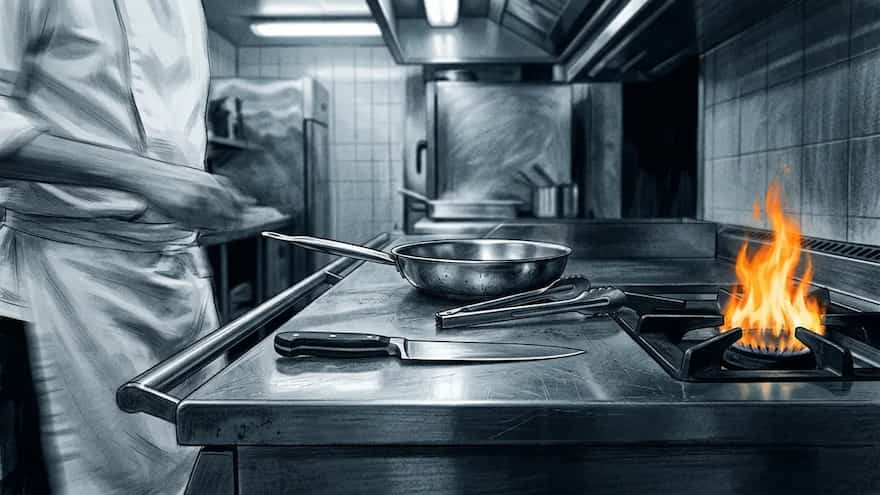
Add to this the heat, the noise, the blades, the relentless pressure of a service, and you have an environment where the conditions for intimidation and violence are almost architecturally built in. The kitchen, in other words, isn't just where the food gets made. It's where normal rules go to take a long break.
2. Suffering becomes identity
Here's where it gets psychologically interesting. In elite kitchen culture, pain isn't just endured — it gets reframed. Burns, cuts, and scars become marks of legitimacy. Enduring a brutal chef isn't just something that happened to you; it becomes part of your professional story, proof that you can handle the heat (literally and otherwise).
One chef Scott interviewed described standing on the London Underground, arm raised to hold the overhead rail, when a stranger looked at the burn marks running up his forearm and asked: "Where are you a chef, then?" His response: it felt cool to be recognised.
Scott calls this "embodied identity work" — the process by which chefs don't just survive suffering, they absorb it into their sense of self. Pain becomes discipline. Discipline becomes skill. Skill becomes the chef they wanted to be. The abuse, somewhere along the way, gets laundered into a origin story.
3. Surviving violence signals you're worth promoting
Perhaps the most disturbing finding in Scott's research is this: enduring abuse wasn't just normalised, it was sometimes actively rewarded.
One Michelin-starred chef described a moment during service when a senior chef held a bread knife to his throat in front of the entire kitchen, threatening to kill him. Shortly after, he was transferred to the group's flagship three-Michelin-star restaurant. The logic, as he understood it: if you can have that happen to you and not flinch, you're the kind of person they want.
This, Scott argues, is why kitchen cultures are so resistant to change. Violence isn't seen as a failure of leadership or a breakdown of workplace norms. It's treated as a filtering mechanism — proof of who belongs and who doesn't.
So what does this mean for the rest of us?
The Noma story is, in one sense, about one famous chef and one famous restaurant. But Scott's research makes clear it's really about a system — one in which the diner's pleasure and the kitchen's culture have long been kept carefully, deliberately separate.
The food you eat at a great restaurant is still great food. That doesn't change. But it's worth knowing, at least once, what the room behind the room sometimes looks like — and perhaps asking whether the industry's slow, painful reckoning with itself is something worth paying attention to.
The Bear, for all its anxiety and chaos, might be the most honest food show ever made. Not because it's dramatic, but because so many people who've actually worked in those kitchens say: yes, that's about right.
This piece is adapted from "Noma wouldn't be the first – in elite kitchens abuse is worn as a badge of honour and suffering is rewarded" by Rebecca Scott, published in The Conversation.




