


 Share
Share

ECONOMICS has a branding problem. Strip away the charts and jargon, and what you’re left with is a discipline obsessed with the same things we are: prices going up, essentials running out, bad decisions compounding slowly, and why someone else always seems to be making money off your groceries. Which is why some of its most enduring ideas are named not after equations, but after food. From the Avocado Toast Index to Onionomics — and most recently, Makhananomics, a term that briefly dominated the news cycle during the Bihar elections — economists have long reached for the language of the kitchen to explain how money, power and policy really move. This A-Z glossary decodes those edible ideas for the rest of us: no economics degree required, just a healthy appetite for understanding how the world works.
A
Avocado Toast Index
- The Menu Description: A light-hearted but revealing measure of housing affordability for millennials. It calculates how many servings of avocado toast one would need to forego to save a 20% deposit on a home in various cities.
- The Kitchen Origin: This index was born from a viral debate in May 2017 after Australian property tycoon Tim Gurner blasted young homebuyers for spending money on "smashed avocado for $19" instead of saving for a house.
- How it Works: Analysts take the average cost of avocado toast in local cafés and compare it against the average price of a 90sq m apartment outside the city centre. It highlights the disparity between discretionary spending and the soaring cost of real estate.
- Real-World Flavour: While initially a grumpy critique of millennial spending habits, crunching the numbers reveals the absurdity of the claim; in many major global cities, one would have to sacrifice thousands of breakfasts to afford a deposit.
B
Beer Game (Beer Distribution Game)
- The Menu Description: A role-play simulation that demonstrates the coordination problems and inefficiencies within supply chains.
- The Kitchen Origin: Invented by Jay Wright Forrester at the MIT Sloan School of Management in the 1960s as a result of his work on system dynamics.
- How it Works: Participants play roles in a four-stage supply chain (retailer, wholesaler, distributor, factory) aiming to meet customer demand for beer with minimal inventory costs. Because players lack visibility into other stages and communication is delayed, small fluctuations in customer demand often result in wild swings in orders and inventory further up the chain — a phenomenon known as the Bullwhip Effect.
- Real-World Flavour: In simple terms, a tiny change at the checkout counter can turn into absolute chaos by the time it reaches the factory. The game shows why “everyone just doing their job” is rarely enough — and why supply chains break so spectacularly.
Big Mac Index
- The Menu Description: An informal way of measuring the purchasing power parity (PPP) between two currencies to see if market exchange rates result in goods costing the same in different countries.
- The Kitchen Origin: Introduced by The Economist in September 1986 by Pam Woodall as a semi-humorous illustration that has since become a global standard.
- How it Works: It replaces the complex "basket of goods" used in traditional PPP calculations with a single item: the McDonald’s Big Mac. By comparing the price of a Big Mac in two different countries, one can calculate an "implied" exchange rate. If the implied rate differs from the actual exchange rate, a currency may be over- or undervalued.
- Real-World Flavour: Also known as "Burgernomics," the index works because the Big Mac is produced locally in over 100 countries using a standardised recipe. However, it has limitations; for instance, it cannot be used in Iceland, where McDonald’s closed down in 2009 due to the high cost of importing ingredients.

C
Cappuccino Index (London)
- The Menu Description: A localised index tracking the average price of a cup of cappuccino across coffee shop chains in London to monitor inflation.
- The Kitchen Origin: Created essentially "for fun" to track price consistency with UK food inflation.
- How it Works: Data is collected quarterly by recording the price of a cappuccino at participating chains. If multiple prices exist (eg, different sizes), the median or arithmetic mean is used.
- Real-World Flavour: The index excludes independent cafés (like Pret A Manger, though an exception is made due to its influence) to focus on chains with more than two branches.
Cherry Picking
- The Menu Description: The practice of selecting only the data or case studies that support a specific position while ignoring contradicting evidence.
- The Kitchen Origin: Derives from the literal act of picking only the best, ripest cherries from a tree and leaving the sour or unripe ones behind, giving a false impression of the tree's overall quality.
- How it Works: In economics and finance, an analyst might highlight a specific timeframe (eg, "stocks are up 10% this month") to claim a boom, while ignoring the 5-year trend, which shows a recession.
- Real-World Flavour: Often seen in corporate earnings reports where companies highlight "adjusted EBITDA" (profit before all the "bad stuff" is counted) to look healthier than they actually are.
Corn Laws (and The Cobweb Theorem)
- The Menu Description: A historical term for protectionism and a theory explaining cyclical price fluctuations in agriculture.
- The Kitchen Origin: The "Corn Laws" were 19th-century British tariffs designed to keep grain prices high. The "Cobweb Theorem" (often called the Corn-Hog cycle) describes the messy cycle of supply and demand.
- How it Works: Farmers base this year's production on last year's prices. If corn prices were high last year, everyone plants corn this year, leading to a glut and a price crash. Next year, no one plants it, leading to a shortage.
- Real-World Flavour: This is why agricultural commodities are notoriously volatile and why governments often intervene with subsidies to smooth out the "cobweb."
F
Feed the Beast
- The Menu Description: The necessity of generating enough cash flow or work just to cover high fixed costs or overheads.
- The Kitchen Origin: A metaphor for a voracious animal that must be constantly fed to keep it from turning on its master (or dying).
- How it Works: If a company builds a massive factory or hires a huge workforce, it creates a "beast" of high overhead. The company is then forced to take on low-margin or unprofitable work just to keep the cash flowing to "feed" these fixed costs.
- Real-World Flavour: Often seen in consultancy or agency businesses where firms aggressively pitch for work they don't even want, simply to keep their large staff on the payroll.
Free Lunch (TANSTAAFL)
- The Menu Description: An acronym for "There Ain’t No Such Thing As A Free Lunch." It expresses the core economic concept of opportunity cost—that every choice involves a trade-off.
- The Kitchen Origin: The phrase likely originated from 19th-century American saloons, where "free" lunches were offered to customers who bought drinks. The food was often salty (to induce thirst), meaning the cost of the lunch was hidden in the price of the drinks consumed.
- How it Works: It posits that resources are scarce. Even if something appears free to an individual (like a government service or a gift), the cost is borne by someone else or society at large. In investment, it warns that "risk-free" high returns are illusory.
- Real-World Flavour: A famous application occurred during the 2008 US presidential debate when Jim Lehrer asked candidates what they would have to give up to pay for a $700 billion financial rescue plan, explicitly invoking the trade-off principle.
G
Groundnut Scheme
- The Menu Description: A synonym for government incompetence and failed colonial development, referring to a disastrous British attempt to cultivate peanuts (groundnuts) in Tanganyika (modern-day Tanzania).
- The Kitchen Origin: Launched in 1946 by the British Labour government to produce oilseeds to alleviate post-war margarine shortages.
- How it Works: It serves as a historical case study in the failure of top-down economic planning. The project ignored local environmental conditions (rainfall and soil suitability) and relied on mechanisation that was ill-suited for the African bush. It cost £36 million (over £1 billion in 2020 terms) and was abandoned in 1951.
- Real-World Flavour: The scheme was so ill-fated that workers had to use surplus Sherman tanks converted into bulldozers (nicknamed "Shervicks") to clear the bush. It became a cultural punchline; in the film The Happiest Days of Your Life, a character mentions a brother who "grows groundnuts in Tanganyika" as a sign of a failed career.

K
Kitchen Sink Regression
- The Menu Description: A derogatory term for a statistical regression analysis that includes a long list of variables ("everything but the kitchen sink") in a desperate attempt to explain variance in data.
- The Kitchen Origin: A critique of economists or analysts who lack a focused theory and instead jam together observations that do not belong together.
- How it Works: By throwing in too many variables, the analyst risks "overfitting" — finding statistical patterns that don't actually exist or have no causal effect.
- Real-World Flavour: Translation: when the theory is weak, the spreadsheet gets noisy. It’s the analytical equivalent of adding every spice in the pantry and calling it a recipe.
L
Latte Levy
- The Menu Description: An environmental charge (specifically proposed at 25p in the UK) placed on single-use disposable coffee cups.
- The Kitchen Origin: Proposed by an expert panel and environmental committees to cut down on the 2.5 billion disposable cups used annually in the UK, of which less than 1% are recycled.
- How it Works: Research suggests that charging a fee (a levy) is more effective at changing consumer behaviour than offering a discount for using reusable cups. The aim is to reduce waste and generate funding for recycling facilities.
- Real-World Flavour: While consumers might see it as a tax, some coffee shop owners fear absorbing the cost would hurt their margins. It is compared to the plastic bag charge, which successfully reduced usage by over 83% in one year.
Lemons (The Market for)
- The Menu Description: A theory explaining how asymmetric information (where the seller knows more than the buyer) degrades the quality of goods in a market, potentially causing it to collapse.
- The Kitchen Origin: Coined by George Akerlof in his 1970 Nobel Prize-winning paper. "Lemon" is American slang for a car found to be defective after purchase.
- How it Works: Because buyers cannot tell a "peach" (good car) from a "lemon" (bad car), they are only willing to pay an average price. That price is too low for owners of good cars, who exit the market, leaving only lemons behind.
- Real-World Flavour: In everyday terms, when you can’t tell what’s good from what’s bad, you stop paying for quality — and quality quietly disappears.
Lemon Socialism
- The Menu Description: A pejorative term for government intervention where taxpayers absorb the losses of failing private firms while the profits remain private.
- The Kitchen Origin: The phrase is often attributed to Mark Green (1974) and is sometimes called "ersatz capitalism." It became prominent during the 2008 financial crisis bailouts.
- How it Works: It describes a scenario where weak companies (lemons) are propped up by state subsidies rather than being allowed to fail as they would in a functional free market. It is often summarised as "socialism for the rich and capitalism for the poor".
- Real-World Flavour: In Icelandic, this concept is vividly translated as Sósíalismi andskotans ("the devil's socialism") or Pilsfaldakapítalismi ("skirt capitalism" — hiding behind mother's skirts to avoid consequences).
M
Makhananomics
- The Menu Description: The economic and political strategy surrounding the production of makhana (foxnut), particularly in the Indian state of Bihar.
- The Kitchen Origin: Coined in the context of Bihar politics, where the state produces 90% of India's makhana but lacks processing infrastructure.
- How it Works: It involves government efforts (like a "Makhana Board") to harness the commercial potential of this "superfood" to court voters, specifically the Mallah community who traditionally cultivate it.
- Real-World Flavour: Despite being a "fitness fad" snack globally, the local industry suffers from a lack of supply chain infrastructure, meaning the raw product is sold cheaply to outside processors who make the real profit.
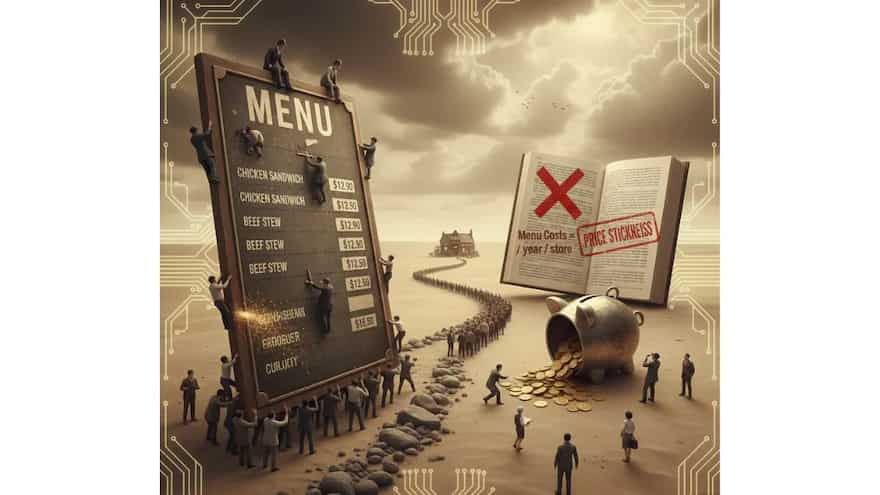
Menu Costs
- The Menu Description: The literal and administrative costs incurred by a firm when it changes its prices.
- The Kitchen Origin: The term originates from the physical cost restaurants face when they have to print new menus to update their prices.
- How it Works: In economics, this concept explains "price stickiness" — why businesses hesitate to change prices even when the market shifts. If the cost of reprinting the menu (or updating computer systems/tags) outweighs the profit gained from the price change, the firm will keep prices static.
- Real-World Flavour: In high-inflation environments, menu costs become less relevant as firms are forced to change prices frequently; in low-inflation environments, they can cause significant rigidity in the economy. Research on supermarkets showed menu costs could be as high as $105,887 per year per store, taking up 32.5% of net margins.
O
Onionomics
- The Menu Description: The relationship between the price of onions and political stability in India. (It applies in China as well.)
- The Kitchen Origin: Onions are an "inelastic" essential in Indian diets. A shortage can trigger inflation and protests.
- How it Works: A glut hurts farmers, while a shortage hits consumers. Because the vegetable is so politically sensitive, price spikes can bring down governments — as seen in 1980 and 1998.
- Real-World Flavour: "When the cost of onions goes up, governments can come down." In 2010, the government banned exports to prevent street protests.
P
Pickle Index
- The Menu Description: An unofficial indicator used by Chinese officials to track the movement of migrant workers based on the sales of zha cai (pickled mustard tubers).
- The Kitchen Origin: Developed by China's National Development and Reform Commission because provincial statistical data was often unreliable.
- How it Works: Zha cai is a cheap staple food for migrant labourers. If sales of the pickle drop in industrial coastal cities and rise in inland provinces, it indicates that workers are moving back home. This helps the government plan for infrastructure and social services.
- Real-World Flavour: A decline in pickle sales in the Pearl River Delta correlated with a slowdown in urbanisation, serving as a distinct "mustard target" for economic planners.
Pork Barrel
- The Menu Description: Government spending allocated to localised projects primarily to bring money to a representative's district, often in return for political support.
- The Kitchen Origin: The term dates back to the pre-Civil War era in the US, referring to a practice of giving enslaved people a barrel of salt pork as a reward, requiring them to compete for their share. It later became a metaphor for public spending.
- How it Works: A politician secures federal funds for a local project (like a bridge or museum) that benefits their constituents but is paid for by taxpayers nationwide. It is often criticised as "fiscal waste" or corruption.
- Real-World Flavour: A famous example is the "Bridge to Nowhere" in Alaska — a proposed $398 million project to connect an island with only 50 residents.
R
Rice Theory of Culture
- The Menu Description: A theory suggesting that the type of farming practised by ancestors (rice vs. wheat) shapes whether a modern culture leans more collectivistic or individualistic.
- The Kitchen Origin: Proposed by Thomas Talhelm, who observed psychological differences between northern (wheat) and southern (rice) China.
- How it Works: Paddy rice farming demands intense cooperation — shared irrigation, synchronised planting, collective labour — while wheat farming is more individual and rain-dependent.
- Real-World Flavour: It’s a theory, not a destiny — but the patterns are striking. Long before office teamwork exercises existed, agriculture was quietly training people on how closely to work together.

S
Salami Slicing
- The Menu Description: A strategy of executing a series of small actions to produce a large result that would be difficult or unlawful to perform all at once.
- The Kitchen Origin: In politics, the term is attributed to Hungarian politician Mátyás Rákosi, who described destroying non-Communist parties by "cutting them off like slices of salami".
- How it Works: In finance (the "salami attack"), it involves fraudulently diverting negligible sums (e.g., rounding errors) from many accounts into a single account, accumulating a large sum over time. In negotiation, it involves extracting multiple small concessions that eventually shift the deal significantly in one's favour.
- Real-World Flavour: A transit worker in Canada stole CA$2.4 million over 13 years by using a magnet to lift coins out of fare boxes one at a time — a literal penny-pinching salami slice.
Sugar High
- The Menu Description: A temporary boost in economic activity resulting from stimulus (like tax cuts or government spending) that is not sustainable in the long term.
- The Kitchen Origin: A metaphor drawn from the burst of energy (and subsequent crash) a child experiences after consuming too much sugar.
- How it Works: An influx of money (stimulus) boosts demand and GDP briefly. However, once the stimulus wears off, the economy "crashes" back to its organic state, often leaving behind debt or inflation (the "hangover").
- Real-World Flavour: Economists described the Russian wartime economy as experiencing a "sugar high" due to military spending and hydrocarbon revenues, predicting a "hangover" as the economy settled. It was also used to describe the US economy's temporary surge following the 2017 Tax Cuts.
W
Wheat Trap
- The Menu Description: A situation where a developing nation becomes economically dependent on imported food staples that its local climate cannot support.
- The Kitchen Origin: Famously coined regarding Nigeria in the 1970s/80s.
- How it Works: As a population urbanises, they often switch from traditional, locally grown coarse grains (like sorghum or millet) to "convenient" bread (wheat). Since the local climate cannot grow wheat, the country is forced to spend valuable foreign currency importing it, hurting domestic farmers and draining national reserves.
- Real-World Flavour: It is a classic example of how changing dietary tastes can wreck a national balance sheet, leading to a dangerous "import dependency" cycle.




