


 Share
Share

The story goes that Thai curries are ranked by heat, the same way a warning label ranks salsa — mild, medium and "you'll regret this." However, when you walk into any kitchen in Bangkok, you'll find the truth is rather layered because colour in Thai curry isn't a spice-o-meter. It’s a signature blend of specific chillies, herbs, and roots, all pounded together in a mortar and pestle to create a rich, flavourful paste. Every curry paste tells you what it's made of before it tells you how it will taste, and once you know how to read that code, a whole cuisine opens up.
What's In The Paste? Everything, Apparently.
Before we get to red, green, and yellow, and other colours in the palette, it's important to understand what a Thai curry actually is. Unlike a French sauce built on a roux, or an Indian curry built on a spice blend bloomed in oil, Thai curry starts with a wet paste, nam prik gaeng. It is made by pounding fresh aromatics like chillies, galangal, garlic, lemongrass, shallots, kaffir lime peel, shrimp paste and coriander root together. This rich paste is cooked in the thick cream from coconut milk until the oil separates and the kitchen fills with a rich, irresistible aroma. Everything after that–the meat, the vegetables, the thin coconut milk that follows is really just an accessory to that first fifteen minutes of wizardry.
The colour comes almost entirely from the chillies used. This is the part most people get backwards.
Red Curry, The Trustworthy Kin
Red curry, gaeng phet, is Thailand's default setting as it's the curry you'll find on nearly every menu. It is made with dried red chillies that are pounded into the paste alongside garlic, shallots, and lemongrass. The result is a paste that's deep brick-red, robustly spicy without being punishing. Furthermore, it’s rounded out with a sweetness that comes from good coconut cream and often a whisper of palm sugar. It pairs beautifully with duck, its richness cutting against the fattiness of the meat.
If Thai curries were a family, red would be the dependable older sibling, the one who shows up on time and never surprises you, in the best possible way. Why do we call it the trustworthy one? Keep reading, and you’ll find that its other siblings aren’t always about what they look like.
Green Curry, The Notorious Bro
Source: Pexels
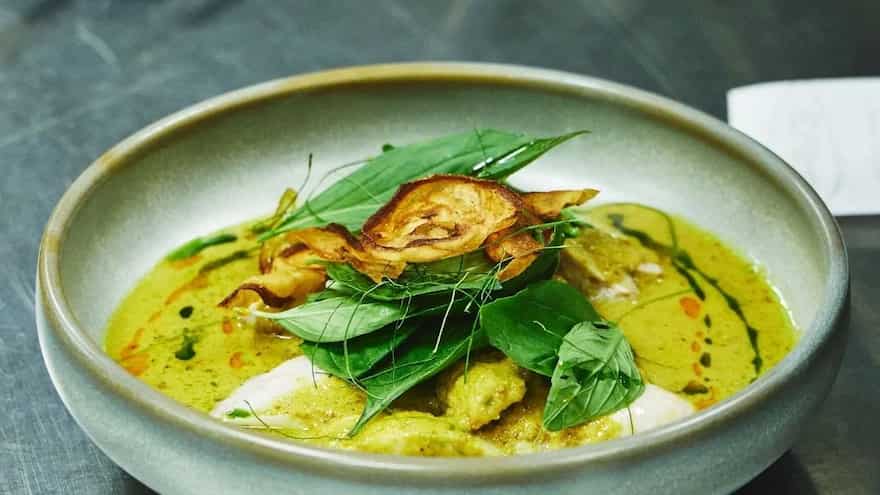
Green curry’s jade colour comes from fresh green chillies (typically the small, ferocious bird's-eye variety) pounded in with a generous fistful of Thai basil and sometimes coriander leaves. It's that distinct freshness that makes it more dangerous than red. Where dried chillies mellow with cooking, fresh green chillies retain a bright, sneaky heat that arrives a beat after you've already decided the dish is mild. Ask anyone who has been lulled into a second spoonful by that "sweet" in the name, and they will tell you how green curry is the trickster of the family.
Green curry is proof that in Thai cooking, "sweet" is a description of the paste's balance and not a promise about how it will feel on your tongue. Ouch!
Yellow Curry, The NRI Who Stayed Back
Yellow curry, gaeng garee, is the curry with the most interesting passport. Its golden hue and unique warmth come from turmeric and dry curry powder, ingredients that arrived in Thailand via trade routes with South Asia and the Middle East. Yellow curry is milder and sweeter than its red and green cousins, often built with potatoes and onions that soak up the sauce like little golden sponges. Also, it is frequently paired with chicken. Moreover, in southern Thailand, you'll find it served alongside roti, another culinary import that's become thoroughly, deliciously Thai.
It's a reminder that "authentic" cuisine is rarely a closed system because it's a running conversation with everyone who has ever passed through.
Could There Be Any More Curries???
Source: Pexels
The red-green-yellow trio may be Thai curry’s most famous faces, but they hardly tell the whole story.
- Gaeng Som, the sour curry of the south, ditches coconut milk altogether, built instead on a fiery-sour base of tamarind and fresh turmeric. It indeed comes as a shock to anyone who thought all Thai curry meant coconut cream.
- Panang curry takes the red paste and pushes it further by making it thicker, nuttier, and enriched with ground peanuts. Also, it is further reduced until it clings to the meat rather than pooling around it like a soup. It has less liquid, but more intensity, almost more like a glaze than a curry.
- Jungle curry is that rebellious cousin who refuses coconut milk entirely, relying on stock and an aggressive amount of fresh chilli and wild vegetables. Born, as the name suggests, from rural cooking where coconut cream was a luxury rather than a pantry staple, it's proof that some of the most exciting versions of a cuisine come from necessity rather than indulgence.
- Massaman curry is rich with cardamom, star anise and cinnamon. Slow-cooked with chicken, potatoes, and peanuts, it's mellow, nutty, and built for lingering rather than sweating. Its warm, spiced flavour can feel more like a Persian-style stew than what you might expect from Thai food. It is another southern influence, shaped by Malay and Indian spice traditions.




