Share
Share

FROM the times of the earliest touring public performances, skits by street troupes, lavish masquerades meant to be staged in palaces, to the Shakespearean era and all the modern-day manifestations of theatre — nary a production would be complete without a passing reference to some item of food or drink. In some cases, an entire story may revolve around the act of eating or cooking or have a meal or dining establishment as its setting. Props that accurately mimic the relevant food and drink then, take on a great degree of importance — not least because of all the safety and infrastructure considerations involved.
See This: Shakespearean Meat Pies Recipe
If food photography has elevated the styling of edible goods into a whole other science (and art), then propmakers for the stage have been making feasts look good under the harshest of stage lights, and across repeat performances — with scant margin for error — even longer. Take for instance the fact that something as seemingly simple as using an organic foodstuff — like flour, cornstarch, custard powder or powdered sugar — is a potential fire hazard, as these are highly flammable materials. One professional guide warns that "throwing flour around on stage, near hot light fittings, could lead to a disaster".
Even discounting for extreme cases, powdered materials on the floor like the ones mentioned above, could cause actors to slip on stage during a performance. The stage cues/directions could also be hidden, causing the cast to make mistakes. A theatre crafts publications reports of the time when a company used real watermelon during a play, and had some of the fruit fall on the stage — the pulp was easily removed, but the juice seeped through the wooden boards and led to an infestation of rats!
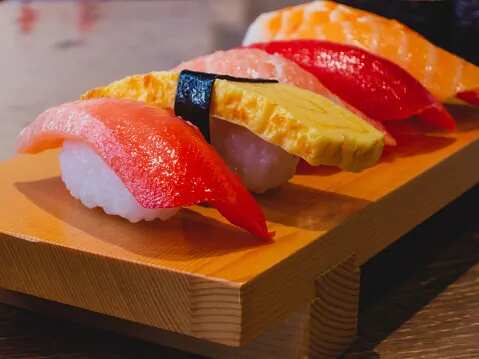
One may wonder why plastic-made or other fake replicas cannot be used in place of real food and drink: the truth is, they often are. Salt dough is among the oldest modelling materials used to make props in theatre; it's been around since the time of the ancient Egyptian civilisation, and making house ornaments and other trinkets from this handy 'clay' was an old tradition in several European cultures. Making salt dough is remarkably easy too — you simply mix any inexpensive flour with salt in a 2:1 ratio, kneading it with water, and then shaping it into the article you require. Food grade paint and other artsy tricks can be used to enhance the illusion of the finished product being the real deal. Once baked in an oven at high heat for a few hours, and sealed with a layer of varnish, a salt dough prop can last for years.
Salt dough, however, is not edible. So what happens in scenes that may require an actor to actually nibble on a bite of food, or take a sip of a beverage? A common trick is to place one platter of easily manageable and non-perishable real food amid the props. A tea-time setting may have the guests help themselves to a dish of cookies while studiously avoiding the fake sandwiches and cakes. Dry/fussy foods are a strict no-no: a prop manager would not want an actor to choke on a cracker or try to debone a piece of fish on stage while they're doing their best to emote! Ice cream is commonly substituted with vanilla frosting. Fruits may be constructed out of cotton. Papier-mâché, foam and Styrofoam form the base for all kinds of theatrical foodstuffs. And of course, if the food isn't going to be actually eaten on stage but the replicas are too expensive or time- and labour-intensive to produce, stage managers may consider having the real item on stage, with several dishes of it refrigerated close at hand to substitute in subsequent acts or performances.
When it comes to drink, like salt dough, there is a common recourse that prop makers have resorted to since the times of Shakespeare. Whether it is a cup of tea or a glass of whisky, there's nothing like a bit of browned, powdered toast blended with water to get a liquid of the desired hue. Mixed fruit juices in place of wine, ginger ale in place of Champagne (when a scene calls for the "pop" and fizz of an uncorked magnum), cotton batting as the foam on a tankard of ale, or a cocktail foam to depict a glass of beer with a good head — there are plenty of tricks at a prop makers' disposal when it comes to spirited impersonations. As for the more outre things that actors may sometimes be required to "eat" — think zombies and human "brains" — there's nothing a little Jell-O won't fix.