Share
Share

Keeping the scenic beauty apart, let's talk about the cuisine, which is deeply rooted in culture. North Eastern cuisine is full of delicacies of almost all flavour profiles since the region has seven of India’s most topographically fascinating states, offering distinct dishes made and even more fascinating cooking styles. Not to mention, the art of creating local beverages that have certain traditions, meanings and the use of seasonal ingredients to adapt to the particular climate the country has, North Eastern drinks need to be talked about more.
Image Credit: Adobe Stock
70% of the Northeastern states are covered in hills and mountains, and they are proud owners of huge heights that account for 35% of the overall part of the Indian Himalayas. Because of its snow-clad peaks, lush woods, rolling meadows, flowing rivers, and infinite stretches of green fields, this region of the nation has a few beverages that change from season to season, and summer is one of them. Be it fruits and vegetables or beverages, summer brings with it a chance to savour everything revitalising to our heart’s content.
From mangoes to watermelons and berries, summer drinks are perfect to quench your thirst and leave you refreshed altogether. But have you ever thought of foods and drinks that are not made with these summer fruits and vegetables? Well, if not, now is the time to think and incorporate these drinks from Northeast India into your summer checklist.
6 Cooling Summer Drinks From North East India
Xaj, Assam
Every tribal group in Assam and the rest of northeast India produces rice beer. These beers are produced with rice and a variety of locally accessible herbs. Rice beer is an essential component of tribal/communal festivals in the region. Rice beers play an important role in the life of tribal people in this region of the world, from infant births to forebears' memorial rites. Ahoms observe rituals throughout the process of creating and serving xaj. In some circumstances, the server must pray to the guests to drink and be cheerful.
Women who make xaj adhere to certain practices. They begin by taking a bath, changing into cotton garments, lighting an earthen lamp, and praying to the gods' forebears for assistance in brewing. They will also make an offering of beetle nuts and areca leaves on a xarai to ensure that everything goes smoothly. Bora, a traditional glutinous rice from Assam, is cooked and spread out on banana leaves to cool before being used to make xaj pani. Meanwhile, the dry cakes are pounded and crushed to a fine texture. This mixture is combined with the cooked rice and spread out for some time. Following this, the mixture is placed in an earthen pot (koloh), sealed, and left to ferment. These xajor koloh, or pots, are now preserved in an isolated location where only a few individuals have access. After 3-5 days, the xaj will be ready to eat.
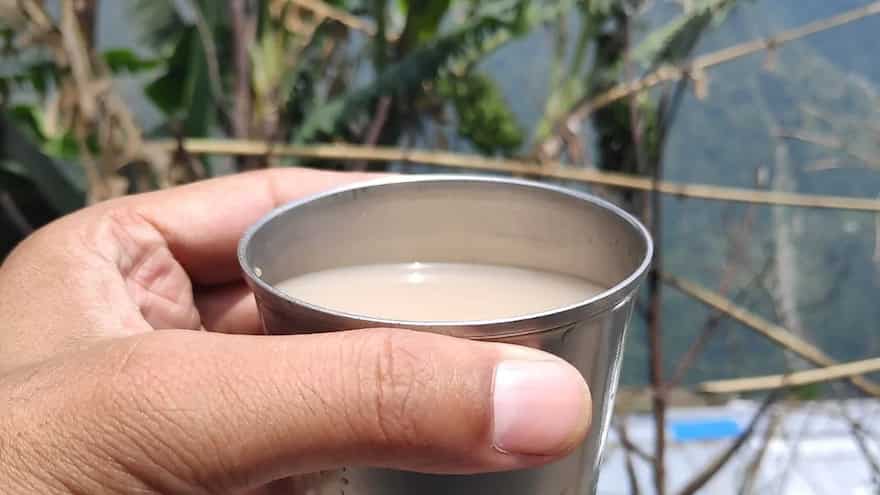
Image Credit: Wikimedia Commons
Chhaang, Sikkim
Chhaang is a traditional Himalayan beer-like drink with its origins deeply embedded in the mountainous regions of Tibet, Nepal, Bhutan, and parts of northern India, particularly Sikkim and Ladakh. This age-old brew is typically made from fermented barley, millet, or rice. To craft Chhaang, the chosen grains are soaked and left to ferment naturally, often in a communal vessel, aided by airborne yeast and bacteria. This spontaneous fermentation process gives Chhaang its characteristic cloudy appearance and mild alcohol content.
The resulting beverage is known for its refreshingly tangy, slightly sour taste, making it a popular choice in these high-altitude regions, where it not only quenches thirst but also sustains locals adapting to the challenging mountain environment. Chhaang is an integral part of the cultural and culinary heritage of the Himalayas, and it continues to be cherished for its unique flavour and social significance.
Kiad, Meghalaya
Sadhier or Kiad is a traditional rice brew created by the Pnar people, also known as the Jaiñtia or Synteng, residing in the West and East Jaintia Hills area of Meghalaya. This historic beverage, since the 1800s, has been required for all religious rituals and major festivals. On such occasions, it is customary for the chief priest to present great amounts of this beverage from a local gourd to their adored gods. During their naming rituals, babies are given a few drops of this traditional drink, which is thought to help the newborn grow well and strong. This traditional drink, like many North Eastern homebrews, is made using thiat, a traditional starting cake, and medicinal herbs.
The leaves of khaw-iang/hawiang and banana, locally known as sla-poshar are dried and powdered into a fine powder. It is combined with a native sticky red rice type called Kho-so to make a fine paste, and then small round cakes are made, sun-dried before being used to make the brew. These circular cakes serve as a natural yeast, facilitating the fermentation process. The local rice variety, Kho-so, is washed, cleaned, and cooked. It is then spread over banana leaves and let to cool. A few things are coarsely crushed and mixed with freshly cooked rice by hand; the mixture is then placed in a cone-shaped basket, carefully covered, and allowed to ferment for two to three days. The fermented combination is yellowish white in hue and is cooked in a special equipment known as shet-kiad, and the distilled beverage is known as kiad. It is served in tall bamboo tumblers with a charcoal chunk in the bottom to keep it tart.
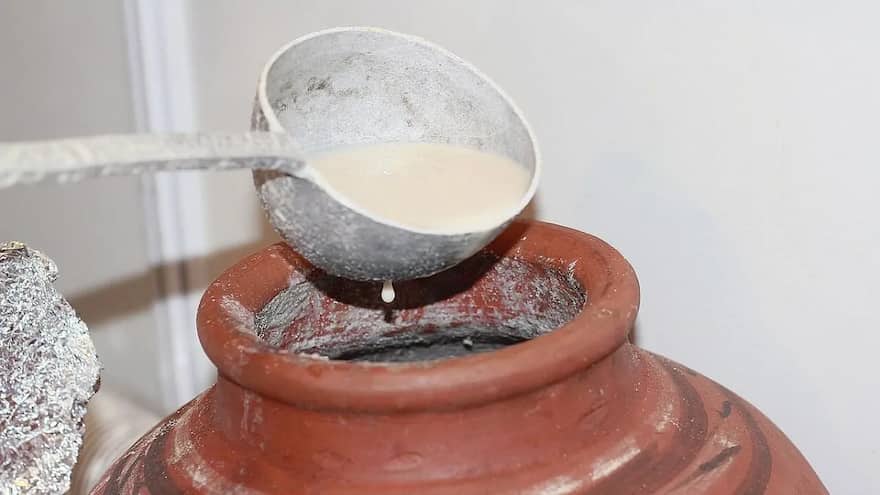
Image Credit: Wikimedia Commons
Apong, Arunachal Pradesh
Apong is a dark crimson organic wine created from temm or millet among the people of Arunachal Pradesh. It is important in the traditional Nyishi tribal group since it is associated with shamanic practices, ceremonial values, and folklore. The Nyishi tribe celebrates the Nyokum Yullo Festival yearly in the month of February, and during the Festival, apong is provided as a staple, distributed to everyone, but it is not a casual drinking session, but rather a religious occasion to invoke the grace of the Nyokum goddess. After gathering millet from the fields, it is sun-dried or, in certain circumstances, cooked over a traditional fireplace in the kitchen. Husk and other undesired weeds are separated from the millet. It is then dry roasted till blackish in a huge wok, turning constantly to avoid burning.
If you overcook or burn the millet, apong will taste harsh. Another indicator of Apong quality is whether or not the millet is lumpy. After the millets have cooled, they are combined with crushed Ipoh cakes [local yeast derived by grinding rice] and placed in an airtight container to begin the fermentation process. It takes about a month for the fermented stock to generate a distinct fragrance, indicating that it is ready. The fermented millet mixture is placed in a funnel-shaped bamboo container known as pottu, which has a tiny aperture on one end. To dilute the fermented stock, warm water is gently and uniformly poured over it using a dried bottle gourd instrument. It takes around 10 minutes for the first droplets to enter the container below the funnel. The container is covered with koham leaves so that apong’s aroma doesn’t come out, and a good quality apong is brewed.
Thekera Sharbat, Assam
Thekera sharbat is an amazing summer drink that is rarely consumed, especially in this region where this fruit is abundant. Although the ingredient is abundantly available and routinely used in Assamese local families during the summer to make tangy curries like tenga, this thekera sharbat is not widely consumed due to its high tanginess. You may still get it in some parts of the state, where the sweet and sour sharbat is enjoyed with delight. Thekera in Assamese or thoikor in Bengali is a sour fruit from the Garcinia genus of the Clusiaceae family that is endemic to Asia, America, Australia, tropical and southern Africa, and Polynesia. This genus includes plants known as saptrees, mangosteens, and garcinias. Garcinia plants are evergreen trees or shrubs that are generally blooming plants (angiosperms).
It is stated that during their battle with the Mughals, the Ahom troops in Assam drank the juice of a certain variety of thekera mixed with jaggery for strength and defeated them effectively. Consuming raw thekera juice with jaggery for strength is advocated in buranji(s), the Ahom age's customary record-keeping technique, which may be termed medieval Assam history. Dried thekera pieces are steeped in water for a time before being used as a souring ingredient in Assamese cuisines. It is an excellent summer beverage that helps alleviate weariness and headaches. To create this drink, soak a few dried thekera pieces in a glass of water for a few hours, then sift the water, season with salt and sugar, and add ice cubes.
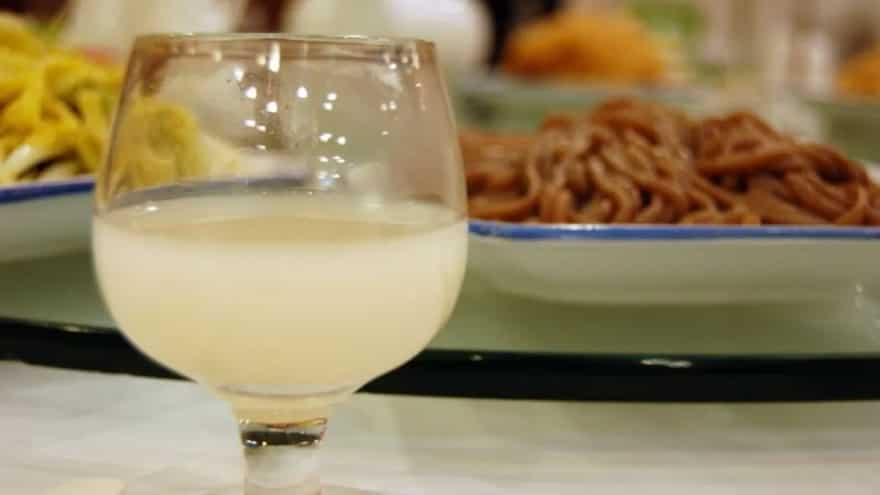
Image Credit: Flickr
Sekmai Yu, Manipur
This rice-based whisky, which originates in Manipur, requires a time-consuming blending process with unpolished rice. The women of the Lois village are well-known for making this drink, which is sometimes their primary source of income. The drink ferments for about a week before being ready for distillation.
Created traditionally with rice and organic yeast, it closely mimics Japanese Sake, and Sekmai refers to the region or locality where the drink is created, similar to Champagne in France or Bourbon whisky in the United States. According to folklore, the drink's influence will only become apparent once you have entered Sekmai's realm. You are free to drink as much as you like as long as you remain within the town. It is exceptional in terms of both quality and potency, and it is employed in ceremonies and local customs.