


 Share
Share

If you're a fan of soups, stews, or any recipe that requires a savoury base, you've likely come across the terms "broth" and "stock”, and while they may seem interchangeable, these two cooking liquids have distinct differences that can impact the taste and texture of your dishes. So, which one should you use in your cooking? Interestingly, both broth and stock have a long history in cooking. Stock has been used in kitchens for centuries, dating back to the Middle Ages, while broth has been used in various cultures for thousands of years. In fact, many cultures have their own traditional broths and stocks, each with its own unique flavour and ingredients.

Image Credit: Pexels & Adobe Stock
Stock VS Broth: What Sets Them Apart In Your Kitchen?
Making broth involves simmering meat, vegetables, and herbs in water for a shorter period of time than making stock, typically one to two hours and is often strained and seasoned with salt and pepper or other spices like garlic, ginger, lemongrass, or turmeric to make a tasty, healthy drink or a light, flavorful base for soups, risottos, and stir-fries. Broth is a versatile kitchen staple that can be made with different meats, such as chicken, red meat, pork, fish, or turkey, and customised with a range of vegetables, such as carrots, onions, celery, leeks, mushrooms, or bell peppers, depending on the desired flavour and nutritional profile.
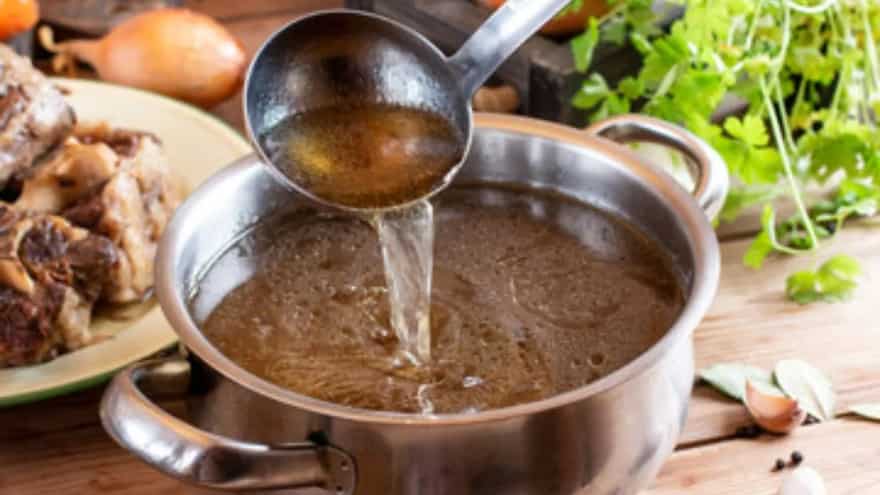
Image Credit: Adobe Stock
Basically, if you simmer bones in water for several hours with some meat, vegetables, and herbs, stock becomes a rich, flavorful broth. Stock is usually seasoned with salt, pepper, bay leaves, thyme, rosemary, or sage to bring out its natural flavours and make it a versatile base for soups, stews, gravies, and sauces. This is often strained and chilled so that the fat and impurities rise to the surface and can be skimmed off, leaving a clear, golden liquid that is gelatinous, nourishing, and rich in minerals, nutrients, and amino acids.
Advantages Of Using Stock & Broth In Cooking
One of the advantages of broth is its versatility in cooking, as it can be used as a mild flavour enhancer, a clear soup base, or a light beverage that soothes and hydrates the body. For instance, chicken broth can be used as a base for chicken noodle soup, chicken pot pie filling, chicken and dumplings, or chicken and rice soup, among others. Vegetable broth can be used as a base for minestrone, lentil soup, pumpkin soup, or mushroom stroganoff, among others.
Moreover, broth can be used to deglaze frying pans, moisten stuffing, cook rice or quinoa, or steam vegetables, among others. Thus, broth bridges the gap between being a nurturing and gentle comfort food and a versatile culinary ingredient that adds depth and flavour to a variety of dishes. When using stock, the liquid has a richer taste which makes it ideal for hearty stews, braises, and casseroles that require a robust, complex taste and texture. Say, you’re cooking red meat stock, this can be used as a base for red meat barley soup, red meat stroganoff, red meat bourguignon, or pot roast, among others, whereas if you’re making a pork stock, it can be used as a base for split pea soup, green curry, pulled pork, or pork chops, among others. Stock can be used to thicken sauces and gravies like béchamel, hollandaise, and mole sauce without adding more fat or flour.
Cons Of Using Broth And Stock In Daily Cooking
There are some downsides to broth, such as its short shelf life, low gelatin content, and lack of body, depending on the ingredients used as a result, broth needs to be refrigerated or frozen if not used within a day or two to prevent the growth of bacteria and spoilage. Also, broth is usually thin and watery, while stock is rich and thick because broth is made by simmering meat or vegetables without bones or connective tissue. Therefore, broth does not have the same nutritional value and health benefits as stock, as it is low in gelatin, collagen, and other proteins that are released from the bones during slow cooking.
This does not mean that stock is better; it just means that everything should always be used in moderation. One of the downsides, compared to making a broth is that stock takes longer cooking time, has higher fat content, and has limited seasoning options, depending on the ingredients used. Stock takes longer to make than broth because the bones and meat need to simmer for several hours to get the most flavour and nutrition out of them and contains more fat than broth because it contains the collagen and marrow from the bones.
This can make some dishes taste oily or greasy; therefore, stock needs to be skimmed, chilled, and degreased before use to reduce its fat content and clarify its flavour. Additionally, stock has limited seasoning options, as it usually relies on salt, pepper, and some herbs to enhance its natural qualities and complement the dishes it is used in.

Image Credit: Adobe Stock
What To Use: Stock Or Broth?
It ultimately comes down to personal preference and the recipe you're making. If you're looking for a lighter, more delicate palate, broth is the way to go. If you want a richer, more complex taste on your tongue, stock is the better choice. But the differences between broth and stock don't end there.
There are also different types of broth and stock, each with their own unique flavour and uses. For example, vegetable broth is a popular option for vegetarian and vegan recipes, while chicken broth is a staple in many kitchens. Beef stock is commonly used in dishes like French onion soup, while fish stock is a key ingredient in seafood-based soups and stews. Both broth and stock have their roles in the kitchen and bring different qualities and benefits to various dishes.




