


 Share
Share

WHEN MERRIAM-WEBSTER crowned slop its Word of the Year for 2025, it was meant as a diagnosis of the internet: a term for the endless tide of low-quality, AI-generated content — junky, superficial, technically impressive but spiritually vacant. Think talking cats. Think Jesus fused with prawns. Think form without meaning, volume without intention.
But slop didn’t begin as a digital insult. Long before it clogged our feeds, it clogged our bowls.
The word’s modern tech meaning feels so apt because it echoes something far older: food designed not for pleasure, but for throughput. Calories without care. Fuel for bodies that need to keep moving so systems can keep running. Before slop was something we scrolled past, it was something we swallowed.
Mud, Dung, and the Sound of Disgust
Part of slop’s enduring power lies in how it sounds. Wet. Loose. A little shameful. The word traces back to the Middle English sloppe, meaning a muddy puddle, and further still to cusloppe — literally, cow dung. Linguistically, it keeps bad company: slime, sludge, muck. You don’t need a definition to know it’s something to avoid stepping in.
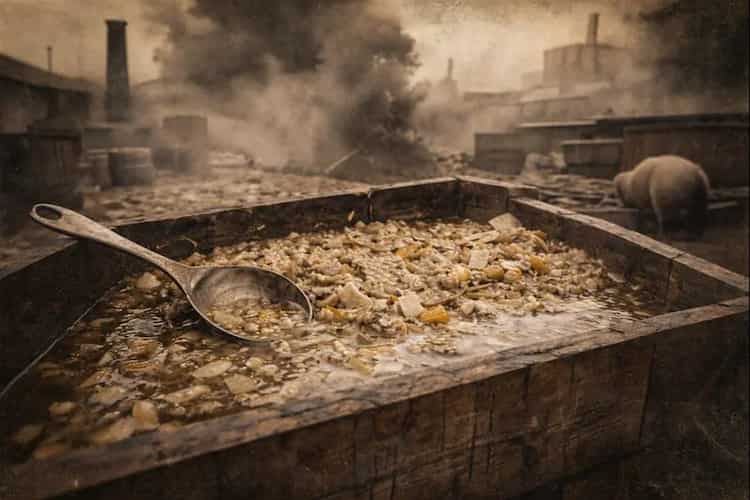
By the mid-17th century, slop had taken on a culinary meaning: semi-liquid food. By the early 19th, it referred not just to thin meals but to household liquid waste itself. Slop was sustenance on the brink of refuse — a grey zone between nourishment and discard.
That ambiguity has never really gone away.
The Trough: When Slop Was Efficient, Not Insulting
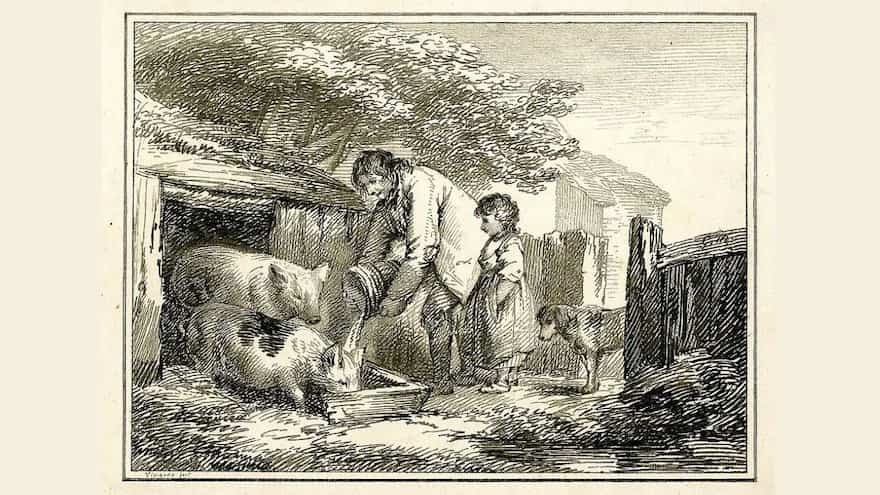
In pre-industrial agriculture, slop was practical. Noble, even. Kitchen scraps were mixed with water and poured into pig troughs, closing a tight ecological loop. Humans ate. Animals ate what humans didn’t. Animals became food again. Nothing wasted. Nothing sentimental.
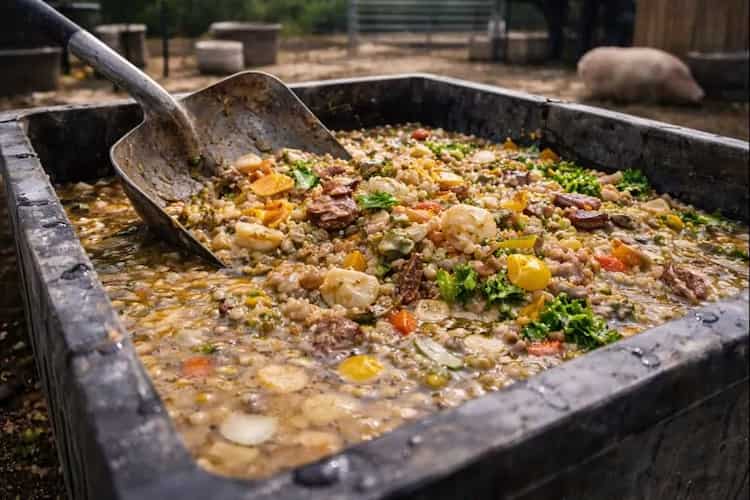
But when efficiency outpaced care, slop curdled into something dangerous. In 1858, New York’s swill milk scandal exposed how distilleries fed cows the boiling mash left over from whiskey production. The animals sickened. Their milk turned thin and bluish, then was adulterated with plaster of Paris and molasses to look wholesome. Thousands of infants died.
Slop, once a symbol of thrift, became shorthand for a system that prized profit over human life.
The Tea Table: When Slop Was Polite
Then came the plot twist no one expects: slop, as an object of beauty.
In the 18th and 19th centuries, the slop bowl was an essential part of refined tea service. Guests poured cold dregs and spent leaves into a communal bowl so their cups could be refilled hot. No tea bags. No sink strainers. Just porcelain etiquette.
These bowls were often exquisite — hand-painted, gilded, made by firms like Spode and New Hall. Slop, here, was managed discreetly, gracefully. Waste was acknowledged but contained. Even elevated.
It’s a reminder that slop isn’t inherently ugly. It becomes ugly when it stops caring who it’s for.
The Mess Hall: Slop as Control
Industrialisation stripped slop of its ceremony and gave it a new job: management.
The Royal Navy’s 19th-century “slop chest” sold sailors cheap, standardised clothing, cementing the word’s association with mass production and sameness. In Victorian London, slap-bangs — cheap, no-frills eating houses — fed clerks who had minutes, not hours, to eat.
Institutions perfected the form. Workhouses served gruel, immortalised by Dickens in Oliver Twist. Modern prisons developed Nutraloaf, a joyless brick of blended nutrients designed to meet requirements while denying pleasure. Reality television found its own version: Big Brother’s punishment slop, a protein-reinforced oatmeal designed to demoralise as much as sustain.
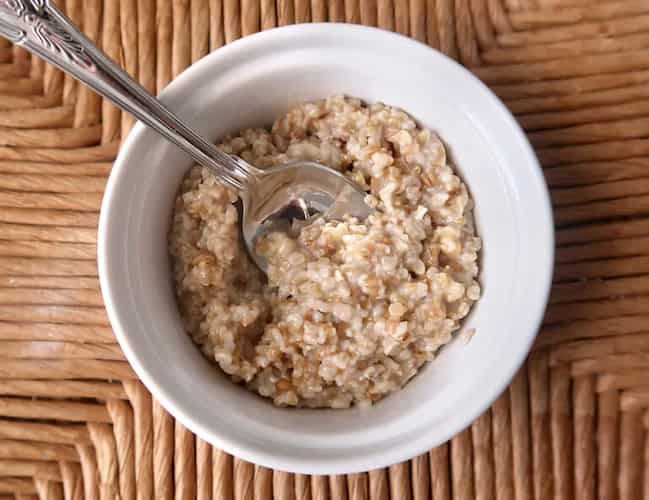
Slop, by now, wasn’t just food. It was a message: you get exactly what’s necessary, and no more.
The Desk Lunch: The Slop Bowl Economy
Which brings us to now. Or rather, to lunch.
The modern slop bowl—popularised by fast-casual chains like Sweetgreen, Cava, and Chipotle — didn’t invent the idea. Ancient Mesopotamia used bevel-rimmed bowls to distribute rationed mash to labourers. The format has always been about scale.
What’s changed is the branding.
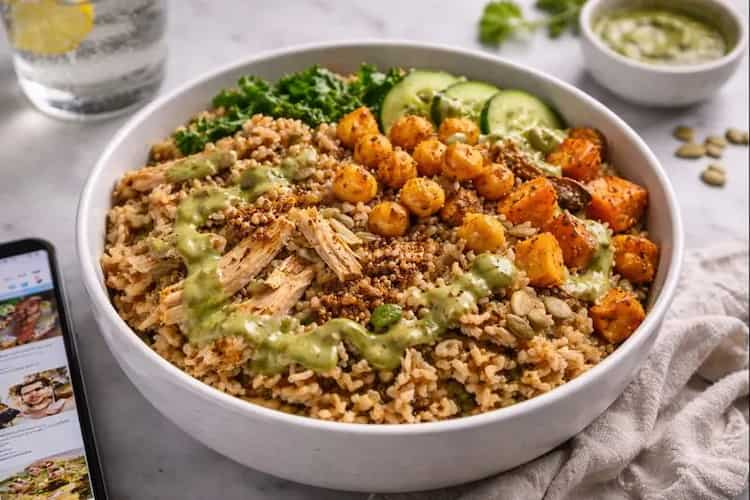
Today’s slop bowl is sold as customisable abundance but engineered for efficiency: a nebulous mash of grains, crunch, protein, and sauce, optimised for macros and eaten while scrolling. It’s food as fuel, a mindset perfected by products like Soylent. Different toppings, same algorithm. Critics note that no matter the cuisine, everything resolves into a familiar crunch-rice-mush ratio.
Defenders argue this is the apex of lunch: high-texture, reliable, endlessly adaptable. One CEO famously shrugged, “It all ends up in the same place anyway.”
Which may be the most honest slop philosophy of all.
Form Without Soul
Linguist Adam Aleksic describes slop as what happens when form outweighs content — when the container thrives but the substance thins out. A flawless AI image with no human intent. A perfectly balanced bowl assembled by an assembly line that mimics care without offering it.
And yet, slop isn’t only a critique. During the pandemic, home cooks reclaimed it. Brown stews. Thick curries. Chilli ladled without apology. A rejection of Instagram plating in favour of warmth and comfort. Slop season — fall and winter — became something to look forward to.
We are repelled by slop and drawn to it for the same reason. It feeds systems. It feeds us. Sometimes those needs overlap. Often they don’t.
So when slop becomes Word of the Year, it feels less like a trend and more like a confession. We recognise the lack of soul. We name it. And then we eat it anyway — because in a high-speed world built on optimisation, a warm bowl of mush might be the only pause we get to choose something, anything, for ourselves.




