


 Share
Share

SARSON DA SAAG does not announce itself as a dish with a long history. It arrives each winter as a matter of fact — a pot of cooked greens, coarse and bitter, eaten with cornmeal flatbread because that is what the season allows. There is no ceremony to it, no special occasion. And that, more than anything else, explains its longevity.
To understand sarson da saag, you have to begin not with cuisine but with agriculture — with a plant that was easy to grow, resilient to cold, and useful in nearly every part.
*
The mustard used for sarson da saag is Brassica juncea, Indian mustard, a variety distinct from the yellow or black mustard grown elsewhere primarily for seed. Genetic evidence suggests that this plant entered the Indian subcontinent in more than one wave, migrating from West Asia and regions around present-day Afghanistan before taking hold across northern India and China.
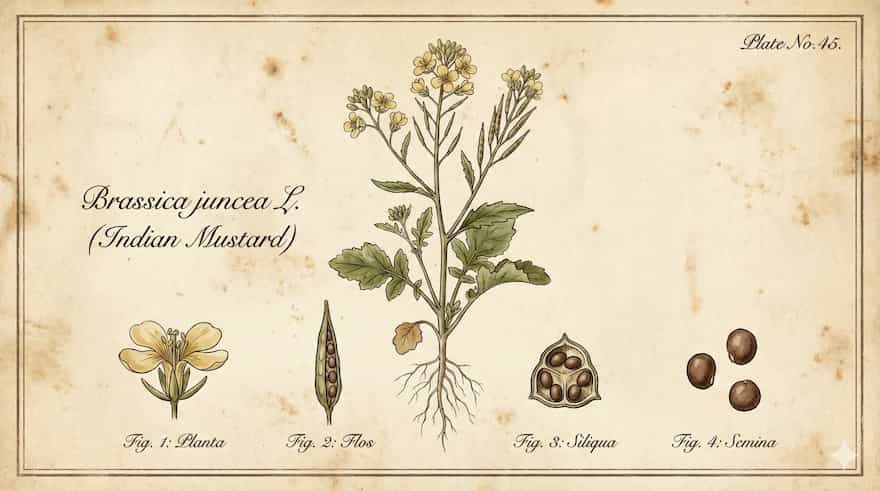
India, over time, became a centre of diversity for oilseed brassicas. Indigenous varieties — toria, brown sarson, yellow sarson, and rai — were cultivated alongside Indian mustard, which today accounts for the majority of acreage under these crops. The Himalayan region is widely believed to be the plant’s point of origin, but what matters more than where it began is where it stayed.
Mustard survived because it worked.
*
The cultivation and consumption of mustard in India can be traced back to at least the Indus Valley civilisation, where archaeological evidence places it around 2300 BCE.
By the 3rd century BCE, sarson ka saag appears by name in the Acharanga Sutra, a Jain text that catalogues foods commonly eaten in the region. That mention matters. It tells us the dish was already ordinary enough to be listed without explanation.
The language confirms this ordinariness. Sarson derives from the Sanskrit sarṣapa, meaning mustard. Saag comes from śāka — simply, greens. The dish is named exactly what it is.
Ancient Indian medical and religious texts reinforce mustard’s place in everyday life. The Atharva Veda and the Charaka Samhita reference mustard oil and seeds for medicinal use, noting its warming qualities and digestive benefits. Ayurveda prescribed it for ailments ranging from liver enlargement to circulation issues. These uses weren’t separate from food; they were part of the same system of survival.
*
If mustard greens were known across the subcontinent, Punjab is where sarson da saag became inevitable.
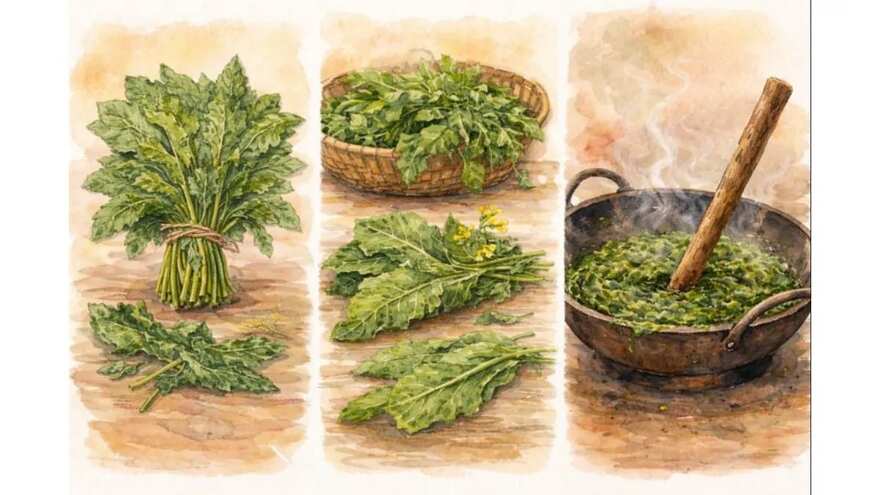
Mustard is a winter crop in the region, sown in November or December and harvested as temperatures drop. It requires relatively little effort, tolerates poor soil, and grows reliably. For an agrarian culture shaped by seasonality, these qualities matter more than flavour.
The cooking method follows the same logic. Mustard greens are tough and bitter when raw. They demand long cooking — hours of simmering — to soften, mellow, and unify. Traditionally, other greens such as spinach or bathua are added, not to dilute the mustard but to stabilise it. Ginger and green chillies bring heat; little else is required.
What emerges is not refinement but cohesion. Texture, not complexity, is the point.
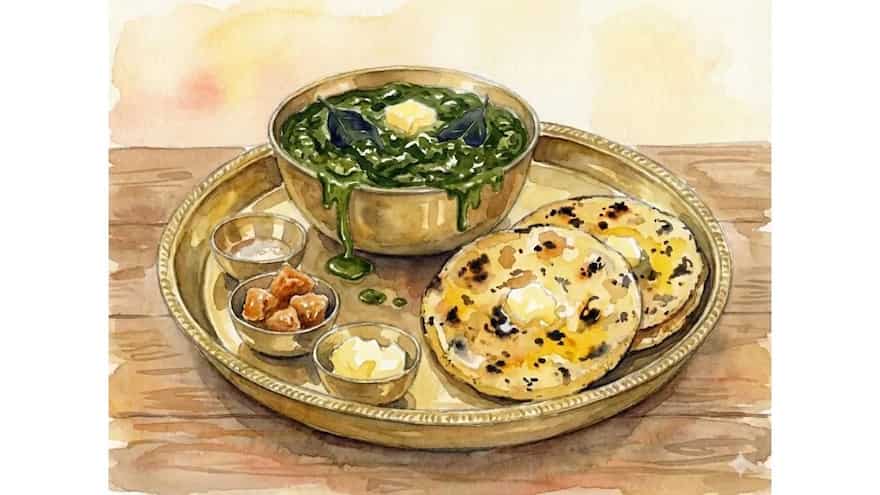
Paired with makki ki roti, an unleavened cornmeal flatbread equally suited to winter harvests, sarson da saag becomes a complete seasonal system — filling, warming, and repeatable. This is why it endured.
*
The idea of stewing tough greens until they submit is not unique to Punjab. Across the Atlantic, in the American South, collard greens — close relatives in the brassica family — are cooked down into what is known as “pot likker.” That tradition, historians argue, travelled with enslaved Africans who planted greens in small garden plots to supplement inadequate rations.
In West Africa, dishes using pumpkin leaves or water leaves follow similar logic: thinly sliced greens, stewed slowly, made sustaining. The resemblance to saag is not coincidental. These are parallel responses to similar constraints.
Meanwhile, Europe took a different path with the same plant. Roman cooks focused on the seed, creating mustum ardens — crushed mustard mixed with grape must — the ancestor of modern mustard condiments. By the medieval period, European courts employed specialists known as mustardarius, tasked solely with cultivating and preparing mustard.
Same plant. Different priorities.
*
Today, mustard greens are often described as a “superfood,” rich in vitamins A, C and K, and containing glucosinolates studied for their potential health benefits. Indian mustard is also used in phytoremediation to draw heavy metals from contaminated soil.
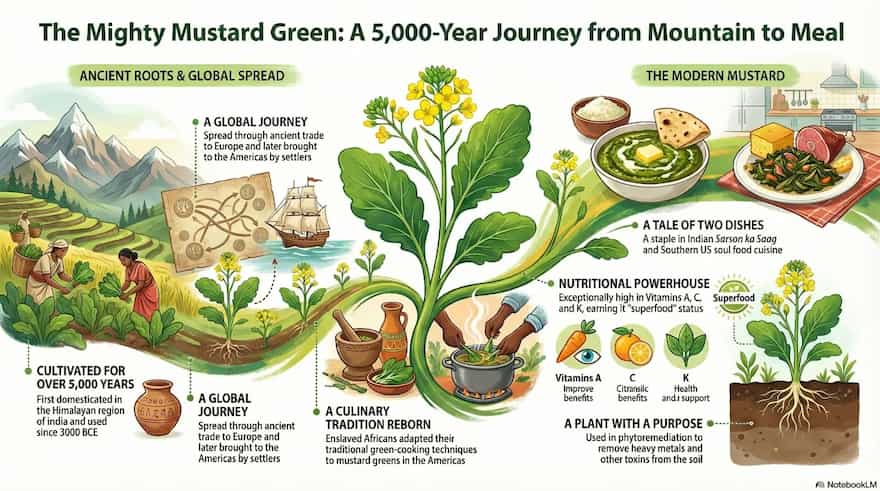
These modern labels don’t contradict the past; they simply rename it. For thousands of years, mustard was valued because it kept people fed, warm, and functioning through winter. Everything else followed.
Sarson da saag survives not because it is fashionable or nostalgic, but because it never needed to be either. It belongs to a category of food that exists because it made sense — agriculturally, nutritionally, economically.
In an era when seasonal eating is framed as a lifestyle choice, this dish stands as a reminder of what seasonality once meant: eat what grows, cook it long enough to be edible, and return to it every winter because it works.
That is not romance. It is history.




