


 Share
Share

THE CANDY CANE is a Christmas mascot built on a kind of delicious deception. It looks so wholesome — a cheerful red-and-white curl of peppermint, practically jingling with innocence. It hangs from trees, fills stockings, stirs cocoa, and melts into childhood memories. But like many holiday foods, its sweetness conceals a far more tangled origin story. Look closely, and you’ll find yourself staring into the long shadow of sugar — a commodity that powered empires, fueled revolutions, and was, for centuries, inseparable from slavery.
The truth? The candy cane didn’t begin as a symbol of joy. It began as a product of an industrial world shaped by human suffering.
The Legend We Love — And the History We Actually Have
For decades, a tidy tale has circulated in churches and children’s books: that a German choirmaster in the 1600s bent straight sugar sticks into shepherd’s crooks to keep young singers quiet during Mass. It’s charming, but historically baseless. There’s no evidence that the story predates the 20th century.

What we do know is simpler:
Early European sugar candies were straight, white, and unflavored. No stripes. No hook. No peppermint.
Striping appears in the mid-to-late 19th century, likely as candy makers experimented with colour patterns that would stand out in shop windows. American newspapers began advertising striped sticks by the 1860s and 1870s. Peppermint gets added as industrial flavour extraction grows cheaper and more precise.
By the 1920s, the red-and-white peppermint candy cane had crystallized — a product of Victorian herbalism, American manufacturing, and the global sugar supply chain.
The Sweetness That Was Built on Suffering
To understand sugar is to understand a profoundly violent history.
From the 17th to 19th centuries, Europe’s hunger for sweetness reshaped the world. Sugar plantations in the Caribbean — Barbados, Jamaica, Saint-Domingue (Haiti), Cuba — and in Brazil became engines of unimaginable brutality. Enslaved Africans planted, harvested, and processed cane under horrific conditions. Life expectancy on some plantations was measured in years, not decades.
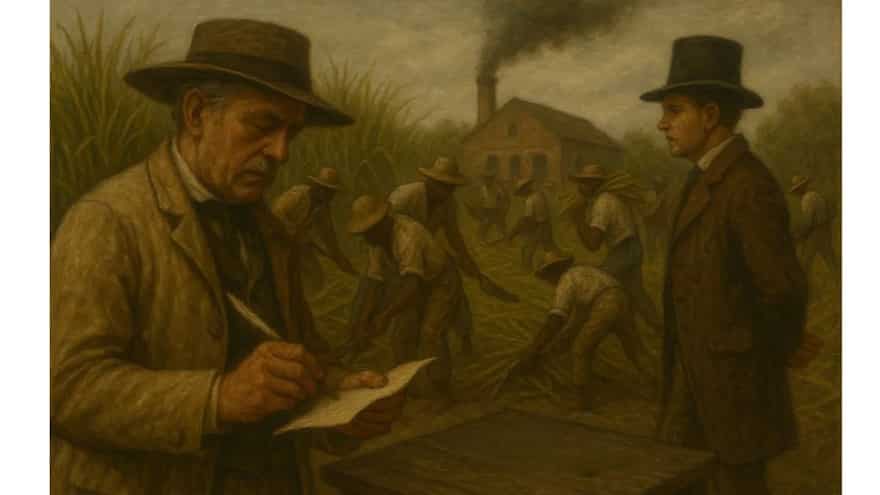
Historian Sidney Mintz, in his seminal work Sweetness and Power, argues that sugar was “the first global industrial commodity,” powering both European wealth and the birth of modern capitalism. Sweetness, he writes, was made possible by “the bitterest of labour.”
By the time candy canes emerged in their modern form, slavery had formally ended — but the global sugar economy it created had already transformed diets, rituals, and industries. The candy cane is, in that sense, a symbolic aftertaste of an older world.
Peppermint: The Victorian Cool Down
Why peppermint? The answer lies in Victorian medicine cabinets.
Peppermint was the go-to cure-all of the 19th century, and was used to settle stomachs, calm nerves, and freshen breath. When industrial candy-making rose alongside pharmaceutical manufacturing, the crossover was natural.
Peppermint:
- masked the sometimes harsh notes of boiled sugar,
- was associated with cleanliness and winter coolness,
- and had a long herbal pedigree.
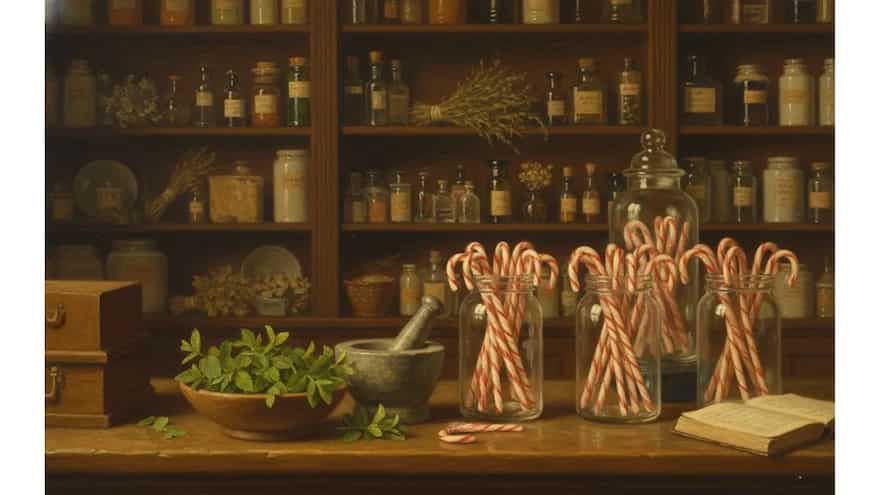
By the late 1800s, peppermint candy sticks were everywhere — apothecaries, corner shops, holiday markets. Add stripes, add a bend, add December, and suddenly you have a seasonal icon.
A Manufactured Tradition (Literally)
Unlike gingerbread or fruitcake, candy canes aren’t medieval survivors or ancient rituals. Their history isn’t folkloric; it’s industrial.
The candy cane’s rise coincides with:
- the mechanisation of sugar refining
- mass production of hard candy
- the commercialisation of Christmas in the 20th century
In 1957, the McCormack family in Indiana invented a machine that could twist stripes and bend hooks automatically. Before that, every candy cane was shaped by hand — a precarious job requiring precise timing and burn-proof fingers.
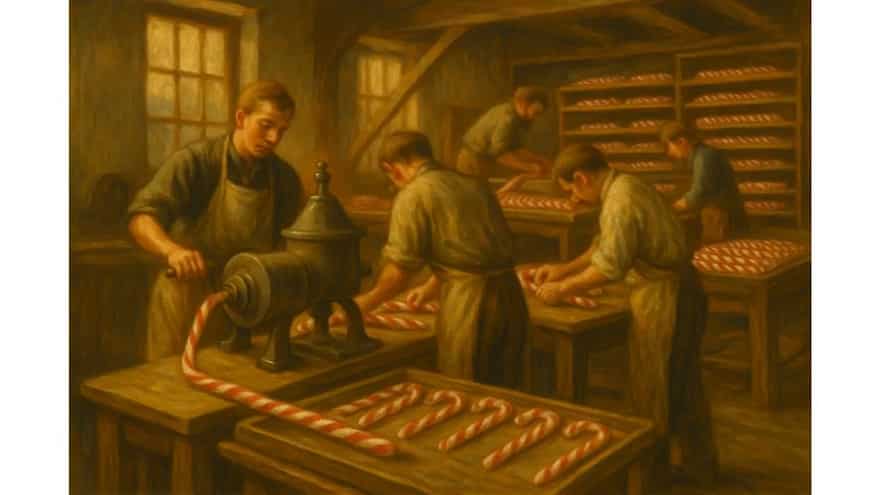
Suddenly, factories could churn out millions. And marketers transformed candy canes from a novelty into a Christmas essential.
We think of candy canes as tradition. Really, they’re a triumph of branding.
Joy on the Surface, History Underneath
Today, we rarely think of sugar as political. But every December, as candy canes line store shelves, we’re surrounded by a product made possible by centuries of colonialism, capitalism, and human exploitation.
And that’s the strange power of the candy cane. It embodies two truths at once:
It is sincere — a symbol of warmth, childhood, and festive joy.
It is complicated — a symbol of a commodity that altered the world, often violently.
That red stripe has a longer history than it lets on.

The Candy Cane, Reconsidered
None of this makes candy canes off-limits. If anything, knowing their history deepens their meaning. They are reminders that even our sweetest traditions carry echoes of the past — some delightful, some difficult.
Every hooked peppermint stick is, in its own way, a map of global history: the rise of sugar, the legacy of forced labour, the growth of industrial candy, and the modern invention of holiday rituals.
So this December, when you hang a candy cane on the tree or crunch one between your teeth, remember: sweetness is never simple. And sometimes the most innocent treats come with the most complicated stories.




