


 Share
Share

FEBRUARY 10 marks the start of the Chinese New Year in 2024, the year of the dragon, and celebrations will end two weeks later with the Lantern Festival. As the most traditional and celebrated holiday in Chinese culture, the Lunar New Year (also known as the Spring Festival) is not only a time to celebrate the beginning of spring but also an occasion for family reunions. In China, a wide range of celebration activities are staged for two weeks: fireworks, firecrackers, festival decorations and a variety of shows. Elsewhere in the world too, where Chinese communities are significantly large, celebrations are planned.
FAMILY FIRST
Family time is of utmost importance in Chinese culture. The run-up to new year’s eve is usually spent travelling, with everybody heading to their hometowns. Houses and flats will get a deep clean in readiness for a fresh year ahead (having to sweep the floor on new year’s day is taboo and associated with sweeping good luck and wealth away).
Every family will have a long list of festival necessities to buy for Chinese New Year, including lots of red decorations, new year outfits and gifts. Festival decorations will be hung up, such as red paper-cuts on windows, and spring couplets and banners on doors. Guarding gods posters will be pasted on entrance gates for safeguarding. Fireworks and firecrackers will be set off to scare away evil spirits and to signal the start of a safe and prosperous new year.
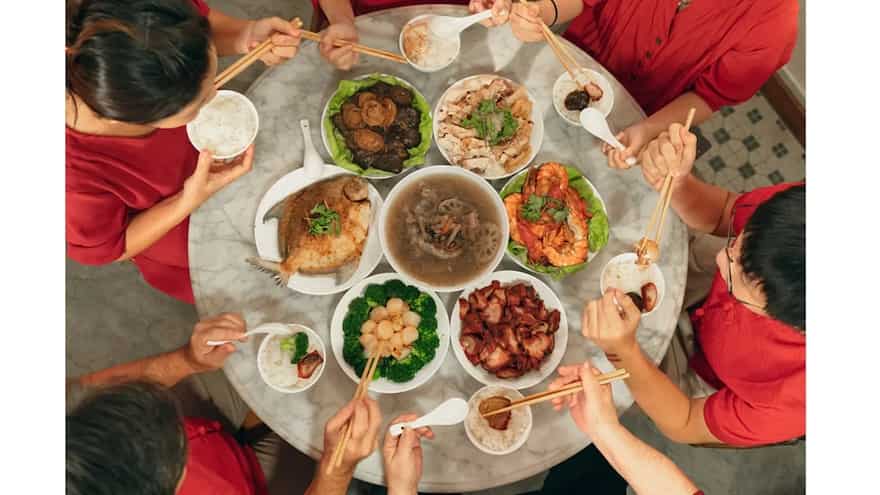
WHAT'S ON THE MENU
Of course, food also plays a crucial part in New Year celebrations and some dishes believed to bring luck will always be prepared – although what they are varies greatly across China.
Fish is a must as it is often seen as an “extra”, symbolising abundance. Sticky rice cake will also be a favourite, and this is because the word in Chinese sounds like “year high”, meaning higher income and promotion. Oranges are considered lucky as the word sounds like “lucky” in Chinese.
There are however some differences depending on where you are. In northern China, people like to eat dumplings as they are thought to resemble gold ingots. Whereas in southern China, you are more likely to have ping-pong shaped sticky rice balls with sweet fillings as it sounds like the word for “togetherness”. It’s also common to have a tray of sweets or a platter of bite-sized treats symbolising reunion and togetherness.
On New Year’s Eve, waiting for midnight, family and relatives will enjoy eating together, playing games like mahjong, and watching the Spring Festival Gala on TV. Whether at home or overseas, this tends to be a must-do for many Chinese families.
CHANGING TIMES
Like all customs and traditions, things change over time. Today, red envelopes are often sent via apps such as WeChat, a messaging app that allows people to make mobile payments. And although the reunion dinner is still important, many Chinese families now prefer to eat out rather than cook together at home.
However, no matter how much Chinese New Year celebrations have changed over time, the heart of the Spring Festival remains the people, a strong sense of togetherness, and the idea that the year to come will be the chance for a new start that is brighter and more prosperous.
Dr Jingjing Ruan is a lecturer in Mandarin Chinese while Catherine Chabert is a reader at the School of Modern Languages, for Cardiff University. This article originally appeared on The Conversation and has been republished under the Creative Commons Licence.




