


 Share
Share

Opening a standard bottle of Champagne on New Year's Eve just before midnight almost seems too simple. Sabrage is an option if you truly want to make the occasion feel grandiose, dramatic, and NYE-coded. The ancient (and perhaps bizarre) practice of using a sabre to open a bottle of Champagne is known as sabrage. In fact, it is just as excessive as it sounds. The narrative dates back to Napoleon's reign during the French Revolution. Locals greeted Napoleon and his army with bottles of Champagne as they triumphantly came home. It was impractical for the soldiers to stop and carefully pop a cork because they were riding horses and had their hands full of reins. Rather, they continued the celebration by swinging their sabres and knocking the top off the bottle. Sabrage appeared out of nowhere.
Another well-known version of the story features the fabled Widow Clicquot (of Veuve Clicquot renown). She reportedly gave Napoleon's officers Champagne in return for having her grapes protected throughout the turmoil. In any case, sabrage soon came to represent triumph, joy, and living in the present. In the present day, sabrage seems appropriate for New Year's Eve. Like ringing in a new year, it's loud, dramatic, a touch dangerous, and completely unforgettable. Because New Year's Eve is a night that merits a little drama with your bubbles.
It's absolutely not something to try carelessly because it might be risky as well. If you're inclined to give it a try, there are a few simple guidelines to follow to ensure that it's done safely and remains enjoyable rather than frightening, especially on a busy New Year's Eve. These five tips and tricks might help you to perfectly sabre a bottle of Champagne!
1. Ideal Cold Temperature
You might want to think twice before using the bottle if it hasn't been refrigerated for at least a day. Nothing ruins a party like a broken bottle of Champagne, and if the bottle isn't properly refrigerated, there's a chance it can burst during the procedure.
2. Look For The Seam
The majority of green Champagne bottles, which are also the most manageable, have a vertical seam that extends from the neck to the base, where the glass's two sides meet. By carefully circling the bottle with your finger until you feel a small ridge, you may identify it. This seam serves as your guide, allowing the sabre to move smoothly along the bottle and strike the neck precisely where the seam meets it.
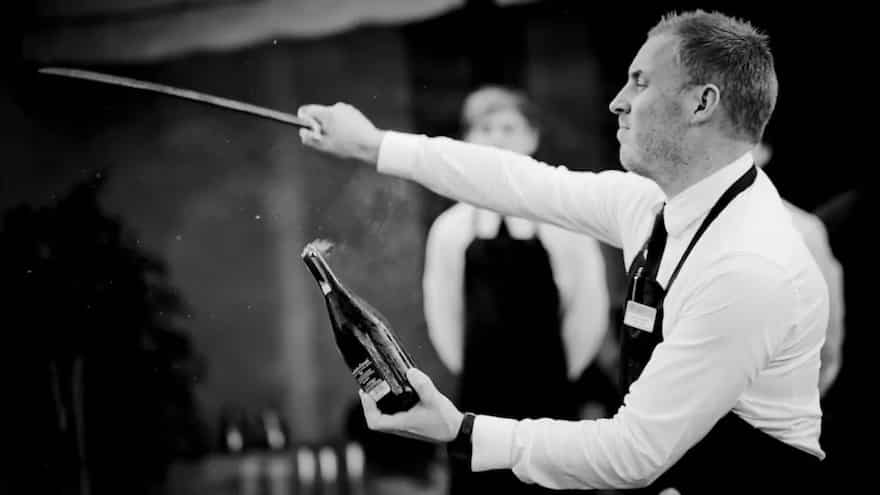
Image Credit: Pexels
3. Adjust The Wire On The Cork
The wire that surrounds the cork, known as the cage, must be adjusted up one notch so that the sabre's blade strikes the bottle's neck smoothly to clear the runway for your knife or sabre. Just untwist the wire, expose the neck by sliding the cage up, and then twist it back around the cork. However, once the wire cage is released, the bottle becomes "live", and the cork could burst at any moment, so be extremely cautious! Although the cage can be completely removed, leaving it in place not only improves the cork's appearance but also makes it simpler to locate in an outdoor environment. To provide your sabre an unhindered passage, remove any paper or foil that may have been around the neck at this stage.
4. Have A Good Grip On Your Bottle
When practising sabrage, you can hold your bottle of bubbly in one of two ways. Either by simply gripping the bottle around the base or by placing your thumb in the "punt", the indentation in the bottom of the bottle and supporting the bottle from underneath with your fingers. Try each one out and choose the one that seems more secure and natural.

Image Credit: Pexels
5. Point The Bottle Away From People, Pets & Breakable Items
Sabrage is meant to be done outside, but if it isn't feasible, make sure the bottle is pointed away from people, animals, and anything breakable. You needn’t use as much force. When you're ready, take a few practice strokes and run the blade along the seam while holding the Champagne bottle away from you at a 45-degree angle to the ground. Next, quickly move the blade "up and out" along the bottle's seam, being sure to make excellent contact where the seam meets the bottle's neck. The top should then pop off! If it doesn't, regroup and just give it another go.




