


 Share
Share

When Jewish families across India light the menorah for Hanukkah, their tables tell stories of both ancient tradition and regional adaptation. The festival commemorates the Maccabees' 2nd-century BC victory over Syrian-Greek oppressors, but it's perhaps best known for its culinary celebration of the 'miracle of oil', that small amount of oil which burned for eight days in the rededicated Temple. From the coconut-infused latkes of Cochin to the spiced bimuelos of Mumbai's Bene Israeli community, Hanukkah foods in India reflect centuries of Jewish settlement. While kashrut, the dietary laws governing food preparation, provides the foundation, each community has embraced local ingredients and techniques, creating dishes that are simultaneously faithful to Jewish tradition and distinctly Indian in flavour.

Image Credit: Unsplash
Why is Hanukkah Celebrated?
During their conquest, the Syrian-Greek army had taken control of the Second Temple of Jerusalem and defiled the holy oil used to light the sacred menorah (candelabra). When the Maccabees regained the Temple, they found that only a minuscule amount of oil was still pure enough to use. They lit the menorah with this, but miraculously, it was enough to keep the flames burning for the eight days it took to procure anointed oil anew. Hanukkah celebrates this miracle and the rededication of the Second Temple.
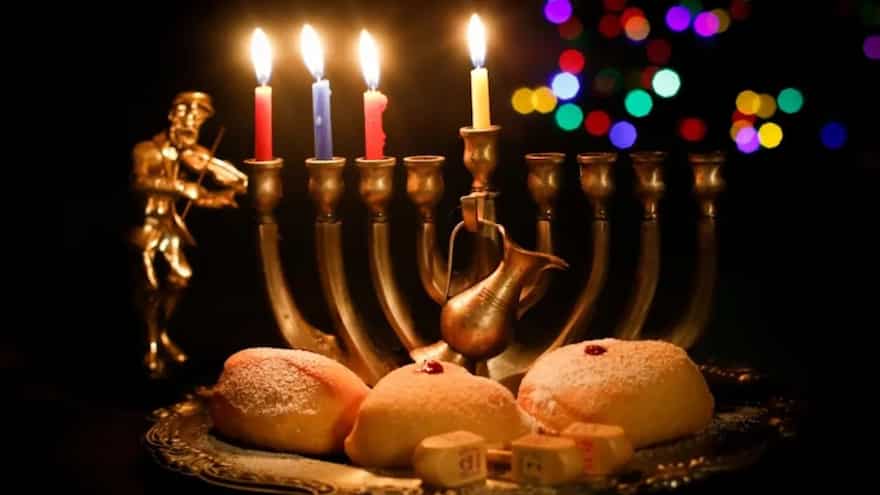
Image Credit: Unsplash
Oil, especially olive oil, has great significance in Jewish tradition. It is seen as representing the highest quality of human wisdom because it always floats to the top of anything it is mixed with. And wisdom gained from the holy scriptures is seen as the highest/purest attribute of all. With its deep-rooted role in the rededication of the Second Temple, oil remains a vital part of Hanukkah celebrations even today. This is why fried foods take centre stage during the eight days of Hanukkah. But what does the community eat in India? Let’s dig into that.
Traditional Indian Hanukkah Menu
Traditionally in the West, latkes or potato pancakes and sufganiyot/sufganiyah are prepared for the Hanukkah table. But in India, the Jewish communities in Kerala, Maharashtra, West Bengal and the Northeast have fused the significance of these festive foods with local influences.

Image Credit: Wikimedia Commons
The Bene Israelis in Mumbai and other parts of Maharashtra, for instance, are likely to have samosas, fried fish like bombil (Bombay duck), bhajiyas and pakoras on their Hanukkah menu. They also prepare a sweet known as malida (flattened rice, powdered sugar, shredded coconut) and sat padar puri (a seven-layered, deep-fried, crescent-shaped pastry with a semolina, nuts and cardamon filling).
Also Read: The Food Of The Baghdadi Jews Of Kolkata
Piyaju is a type of onion or cauliflower fritter (with a chickpea flour base) made by Kolkata Jews, while those from Telangana and Andhra Pradesh rely on ariselu (similar to the anarsa), purnalu (dumplings made of rice flour, jaggery, dals and dry fruits) and pakam (medu vada-like doughnuts) to sweeten their Hanukkah menu. Kochi and Baghdadi Jews in Kerala have pakoras and vadas, of course, but fried delicacies like the pazham pozhi (fritters made of the long Kerala banana known as nendra pazham) and neyyappam (sweet rice dumplings) are indulged in as well, for good measure.
The Jewish communities in the states of Mizoram and Manipur tend to have dishes similar to those of Western cultures, with jam doughnuts and sweet pancakes jostling for space on the table alongside baked confections. The more savoury fried foodstuffs are represented by potato chips and the ubiquitous pakoras.
Although a festival like Hanukkah is supposed to be celebrated at home, most family members have either migrated to Israel or are settled abroad. To bring people together, community spaces like the synagogue celebrate Hanukkah with candle lighting, prayers and get the food catered.




