


 Share
Share

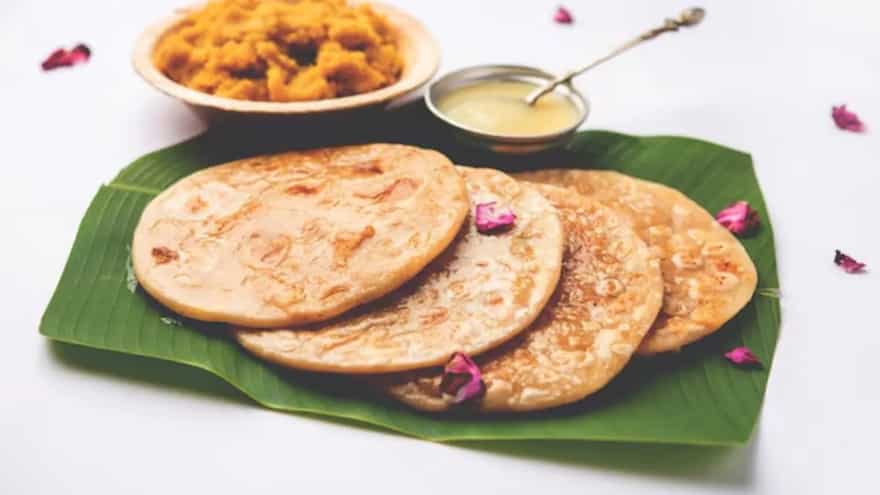
Observed on September 14, 2026 this year, Ganesh Chaturthi marks the arrival of Lord Ganesha. In Maharashtra, the festival transforms homes into spaces of prayer, cooking and family gatherings. Modak may be the sweet most closely linked with Ganesha, but the festive spread goes well beyond it. Puran poli, a familiar Maharashtrian sweet flatbread, is also made in almost every Maharashtrian home during Ganesh Chaturthi. Made by cooking chana dal and jaggery into a smooth, aromatic filling, it is enclosed in dough, rolled thin and cooked with ghee until lightly golden. It is traditionally served warm and can even be paired with katachi amti or milk.
What makes puran poli especially interesting is that the same concept travels across India, having different names. Holige, obbattu, bobbatlu, vedmi and poli may appear to be similar, but the filling, flour, thickness and flavour shift from one region to another.
Puran Poli, Maharashtra
The Maharashtrian version is the most classic and familiar one. Made with a soft dough and a filling prepared with cooked chana dal, which is blended with jaggery, cardamom and often a hint of nutmeg. The filling is rolled within the dough and then cooked on a hot tawa with a little ghee until it turns golden on both sides.
It is soft, a bit chewy and deeply fragrant; in every bite having earthy sweetness of jaggery balanced by the lentil filling. During Ganesh Chaturthi, puran poli is a part of other festive dishes and is often placed on bhog thali as well. In many Maharashtrian homes, the leftover dal water is also used to make tangy katachi amti that pairs beautifully, having a contrast of sweet and tangy taste.
(Image credit: Freepik)
Holige, Karnataka
Karnataka’s holige, also called obbattu, is not just puran poli under another name. The filling itself can vary considerably. A classic bele holige uses chana dal and jaggery, but coconut-based variations and preparations using different lentils are also found across the state. This gives Karnataka’s festive flatbread a wider range of flavours than the usual dal-and-jaggery mix.
The dough is usually made very soft and flexible, allowing the filled bread to be rolled quite thin. That makes the finished holige light, with a slight chew and a bit of roasted edges rather than a thick, cakey consistency. In Karnataka, holige is significantly associated with festivals and celebrations, where it is often served warm with a gracious drizzle of ghee.
Bobbatlu, Andhra Pradesh
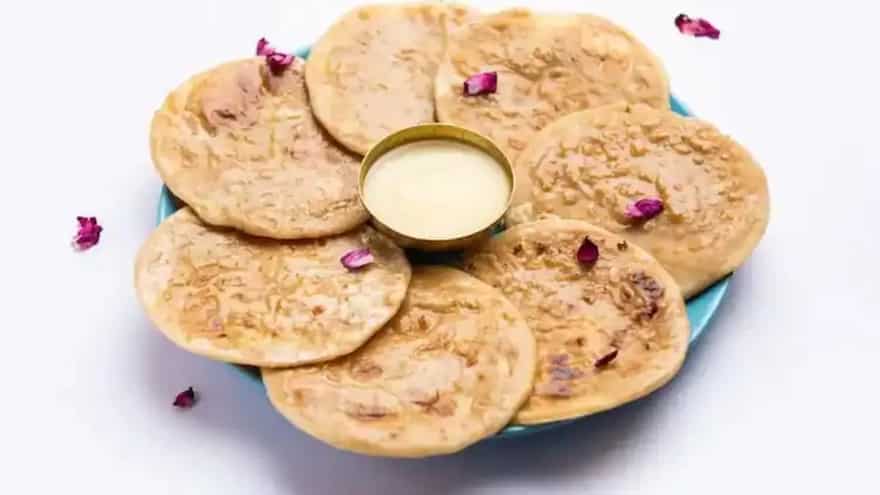
In Andhra Pradesh and Telangana, bobbatlu or bobbattu takes the same stuffed-flatbread idea in a distinctly Telugu shift. The filling is generally made from chana dal and jaggery, but the balance between the sweet stuffing and the outer dough is what sets the preparation apart. Usually, a very soft dough is kneaded with plenty of oil and rested, helping the outer layer get stretched almost paper-thin.
The result is soft, flexible and less about a thick, bread-like bite. Cardamom gives the filling its familiar fragrance, whereas jaggery adds a deeper sweetness than refined sugar.
(Image credit: Freepik)
Vedmi, Gujarat
Gujarati vedmi brings a bit of a different character to these festive flatbreads. The filling may use chana dal or toor dal, with jaggery and fragrant spices. The use of toor dal can give the filling a rather different taste and texture from the smoother, more familiar chana-dal puran. Some people also add cardamom, nutmeg or saffron for a more pronounced festive fragrance.
What makes vedmi appealing is its place within Gujarati festive cooking. It is not necessarily considered a sole dessert; it can be served as part of a larger traditional meal. The combination of dal, jaggery and ghee makes it decadent enough, while the lentil filling keeps the sweetness earthy rather than tasting like a traditional sugar-based sweet.
Boli, Tamil Nadu
Tamil Nadu’s boli has many regional versions, and its filling can go beyond the chana-dal-and-jaggery blend. Thengai boli, for instance, uses coconut in the sweet filling, whereas paruppu boli uses lentils. This makes the Tamil version quite interesting because the same name can refer to various flavour profiles depending on the filling.
Jaggery adds a deep caramel-like sweetness to the thengai poli. The outer layer is kept thin and soft, and the finished poli is often greased with ghee before it is served. Unlike a stuffed paratha, the focus here is on the sweet filling and delicate outer layer.




