


 Share
Share

FEW KNOW that it’s not Durga but Kali, the Dark Goddess, the fierce feminine energy embodying Time, who is central to the Bengali stream of consciousness. Born out of Durga’s rage, Kali is the slayer of demons, whose blood she has drunk to restore cosmic balance. While appearing in multiple terrifying forms, the most enduring image is depicted as being naked and covered in blood, wearing a garland of skulls and holding decapitated demon heads, an open mouth with a blood red tongue hanging out, ready to swallow all that comes in her way in order to create anew. In short, a bloodthirsty Goddess on the rampage. Yet the hint of a smile in her countenance promises new, regenerative beginnings.
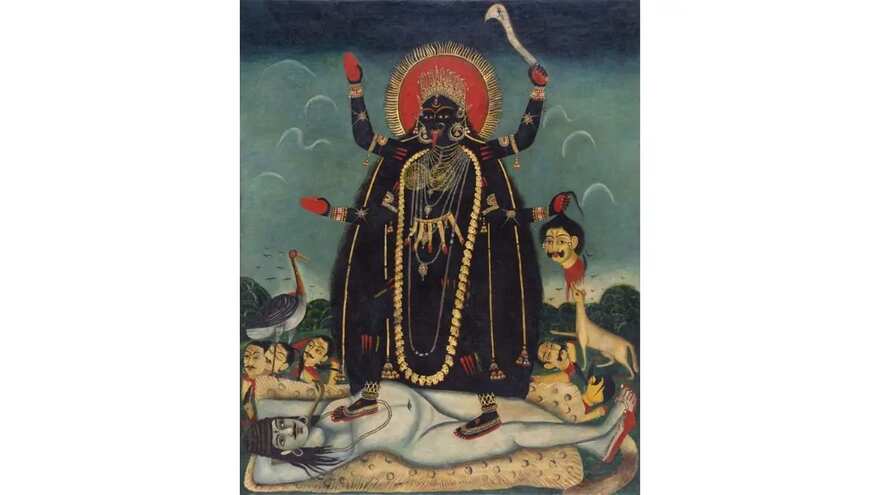
What is important in her worship then is appeasing the enraged annihilator and embracing her as Jagadamba, the universal, compassionate Mother, the primordial energy (Adya Shakti) that redeems, creates, nurtures and protects all life. Where there is life, there must be sustenance. Food, therefore, becomes an important leitmotif in the veneration of the Devi. Sacrificial offerings, termed ‘balidan’, are mandatory and textually prescribed, later consumed as prasad.
The term bali is misunderstood as mere decapitation. In actuality, it means a gift, tribute, an offering or even a tax. It is a thanksgiving for all the sustenance provided, as well as a means of being one with the Divinity in the sharing of food. The object of sacrifice then becomes a substitute for the self (jiva) and its animal-like nature (pasubhava). This involves pasubali (animal sacrifice) prescribed in the worship of Shakti, or kusmandabali (vegetable sacrifice) as per Bhakti traditions, popularised by the 18th and 19th century saints Ramprasad and Sri Ramakrishna Paramahansa. The extreme, dark Tantrik traditions, at one time, resorted to Narabali (human sacrifice).
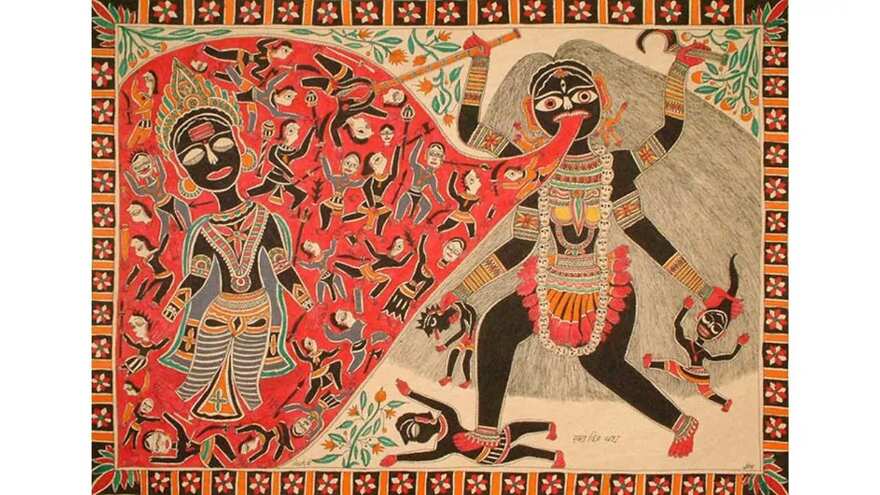
The image of Kali then conjures up the vision of a lust for blood, her wild eyes hint at intoxication. Hence, offerings of sacrificial meat, predatory, carnivorous fish and intoxicants like local liquor (karon) and cannabis drinks (shiddhi) receive unanimous sanction in the scriptures. Since Balidan is a must, the Bhakti traditions decapitate vegetables like ashgourd or sugarcane.
According to scholars, the act of cooking and offering bhog and then consuming it as prasad becomes a metaphor for maintaining the cosmic balance. The absorbed nutrients become blood, flesh and semen, the source of continuity, and at its most refined, the human mind. The undigested food is considered impurity and hence expelled from the body, maintaining the equilibrium between the good and bad. A devotee, therefore, is what he or she eats, as well as the sole actor in its transformation within the body.
As a result, we find a multitude of bhog offerings, each indicating who he or she actually is. Since the goddess is perceived as being part of the self, she is offered the same seasonal foods consumed by the devotees in daily life. The only strict dictum is that the food has to be cooked without onion and garlic. Coarse, parboiled rice is the Devi’s preference along with kalai or biulir dal (black lentils), root vegetables and foraged greens such as colocassia stalks, gourds cooked with fish head, woodfire-roasted lesser carnivorous fish such as shol (snakehead murrel), boal (freshwater shark) and magur (catfish) and meat of the male goat. Since blood red is the Devi’s colour, the offerings are adorned with sindoor and the red hibiscus (jaba) flower.
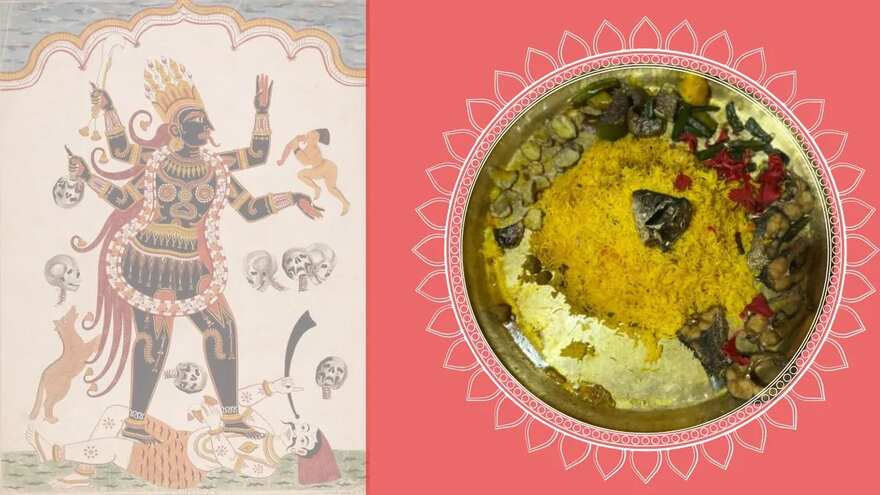
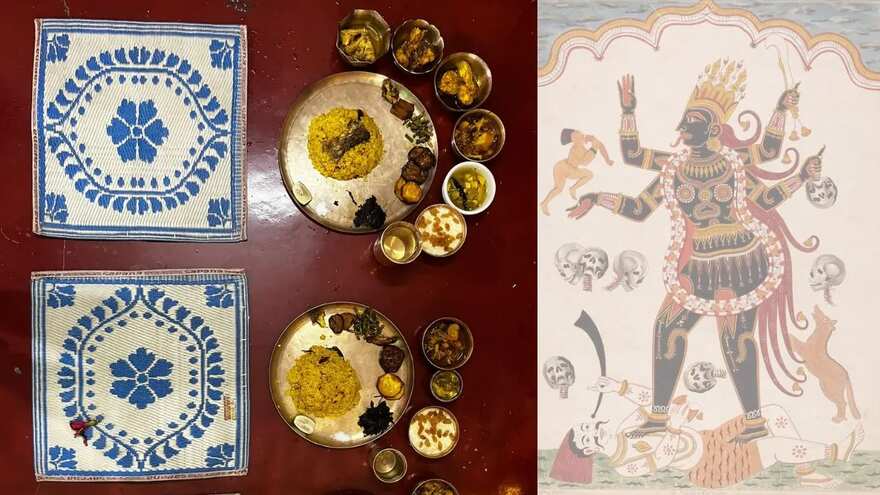
Photographs via Amar Mukherjee (@gastro_mancer)
The daily bhog, then, is a matter of choice. Through the centuries, because of the lush abundance of Bengal, the foods offered continued to multiply depending on communities, affluence, family traditions, resources, terrain and later caste, class and religious sects. The number of dishes offered can go up to an elaborate 108, an auspicious number.
In its simplest form, as gleaned from the ancient scriptures, it is Patram (leaves), Pushpam (flowers), Phalam (fruits) and Jalam (water). An example of leaves as bhog is a spiced paste of Tamal patra or the green Indian bay leaf. Bhang or cannabis leaf paste laddoos, or mixed with milk into a drink, are offered as well. Fruits cover the seasonal spectrum of the indigenous bichi kala or bananas with seeds, shakalu (Jicama), cucumber, jambura (grapefruit), tender and dry coconut and the jewel red pomegranate, among others. Plain water is a must along with the panchamrit (five nectars), namely a mix of dugdha (cow milk), ikṣuras(sugarcane juice), ghṛta (ghee), madhu (honey), and dadhi (yoghurt).
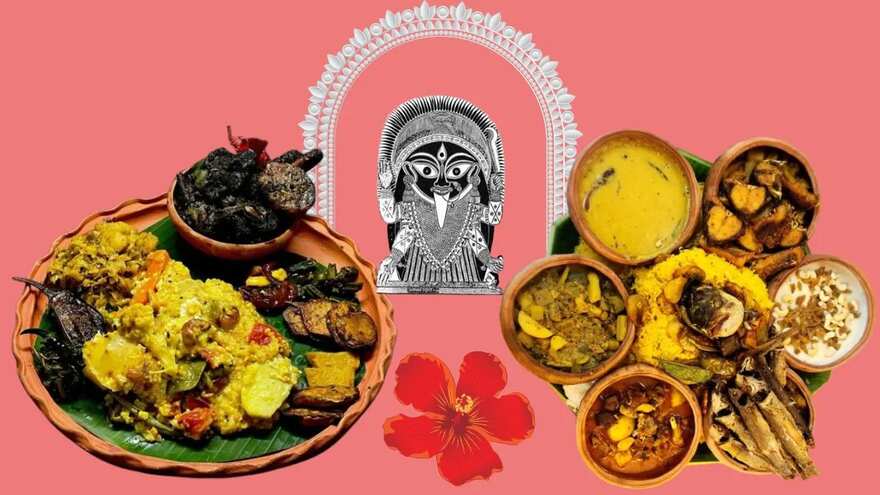
Rice is the staple that sustains the region. Hence, it stands atop the bhog food chain. Four kinds of rice dishes — Annabhog (plain rice), Pushpanna (fragrant rice), Paramanna (Rice cooked in milk) and Khechranna (rice cooked with lentils) — are offered as per choice.
Swarnalata Mondal in rural West Bengal offers a simple meal of khichuri, the highlight being, she tells me, “kochu, mulo, palong shaak”, a stir fry of taro, radish and spinach as an accompaniment. At the Kalkaji Temple in New Delhi, the hollow of a coconut is filled with a mixture of powdered sugar, ghee, dry fruits and spices and then roasted in fire. The 300-year-old Bura Kali temple in West Bengal’s Dinajpur district offers boal fish weighing up to 20 kg, while at the Kali temple in Kalighat, Calcutta, sacrificial meat is offered along with curried or fried fish, lentils, cooked or fried vegetables and Khichuri. Adivasi or tribal traditions sacrifice birds and pigs and the eggs of ducks, hens, and pigeons, marked with vermilion, as offerings. It is recorded that in the late 18th century, Raja Isvarcandra, of Nadia district, sacrificed 65,535 goats during the three-day Durga Puja festival, when Durga is also worshipped as Kali or Chamunda.
Kali then is the sarvabhuk or omnivorous goddess, her palate straddling the three 'gunas' — tamasik, rajasik, and sattvik. Her appetite is insatiable, and the vast bhog repertoire stands testimony to that. There are no complex recipes involved, yet the food takes on profound spiritual and philosophical interpretations. No food is deemed unfit for consumption. For it is a gift, as much from the devotee to the Devi as it is a blessing from the Devi to her devotees.
RECIPE
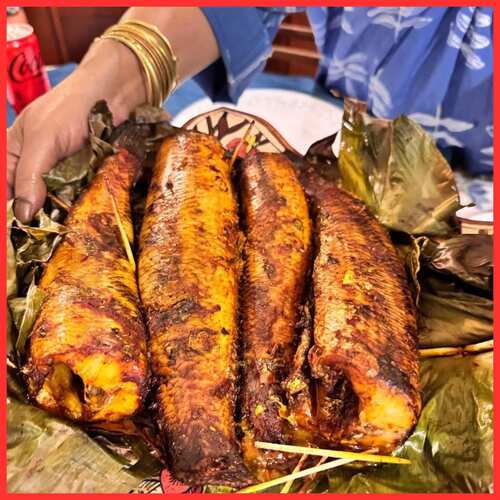
Shol Maach Pora (Roasted Snakehead Murrel)
Ingredients
1 whole fish cleaned
Turmeric 2 tsp
Mustard paste 2 tbsp
Green chilli paste to taste
Crumbled, roasted red chilli flakes
Juice of one lime
Mustard oil 4 tbsp
Rock salt, to taste
1 large banana leaf
Method
— Make a mix of the above spices, lime juice, salt and oil
— Rub the whole fish well with this mix, including the interiors of the stomach and let it marinate for about 15 minutes.
— Wrap tightly in a banana leaf and roast, pressing down gently from time to time on medium heat till the leaf starts smoking.
— Turn over and repeat the process.
— Test with a toothpick to see if done. If it comes out smoothly, the fish is ready to serve.
Recipe image courtesy: Pritha Sen
Pritha Sen is a food historian-revivalist and consultant in the hospitality sector.




