


 Share
Share

India has a vast coastline rich in marine life, yet seaweed remains a largely unexplored ingredient in the country's culinary landscape. Gabriella D'Cruz is working to change that. A marine conservationist with a Masters in Biodiversity Conservation and Management from the University of Oxford, she has spent the last eight years working exclusively on seaweed in India. In 2022, she founded Good Ocean, India's first seaweed food company that small-batch wild harvests seaweed from the Indian coast. Through her work, which includes educational tidepool walks, she aims to familiarise chefs and home cooks with the benefits, sustainable foraging practices, and incredible versatility of this marine plant.
The Journey Of Good Ocean
The origins of Good Ocean span nearly a decade of dedicated coastal work and a vision to elevate local marine life in the culinary world. "We have been harvesting seaweed along the Goan coastline for the last eight years. However, as Good Ocean, a seaweed food company, we began harvesting specifically for chefs and restaurants around four years ago. The reason we moved in that direction was because we recognised that seaweed is considered a high-value ingredient in many other parts of the world, yet hardly anyone in India was working with it as food when we started. We felt it deserved to be celebrated for its flavour, texture, and for the fact that Indian seaweed has its own identity, distinct from seaweeds found elsewhere. We reached out to chefs, and that is essentially how the journey began." As the brand grows, D'Cruz is eager to showcase the variety available along the subcontinent. "There is also a huge diversity of seaweed in India. At the moment, we harvest one particular species during the season, which is sargassum. Over the next few years, we are also looking at sourcing other species from different farms in order to provide a wider variety to the food industry."

Image credit: Gabriella D'Cruz
Tropical Terroir: Understanding Warm-Water Species
This variety is largely shaped by the temperature of the ocean, which creates a distinct culinary profile. "Indian seaweed is very different from Japanese or Korean seaweed, primarily because ours grows in warm waters. Japanese and Korean seaweeds are temperate species that thrive in colder waters, and naturally they have very different flavour profiles. Wakame, kombu, hijiki, and nori are generally associated with colder climates. While nori does grow in warm waters as well, it only appears during the monsoon season here." Instead, the focus is on varieties that naturally flourish in India. "The main tropical species we have in India include ulvas or sea lettuces, sea grapes, sargassum, gadaina, gracilaria, kappaphycus, and ulva lactuca. These are species native to tropical waters and therefore create an entirely different flavour palette that is local to India. They are quite distinct from Japanese and Korean seaweeds in both texture and taste."
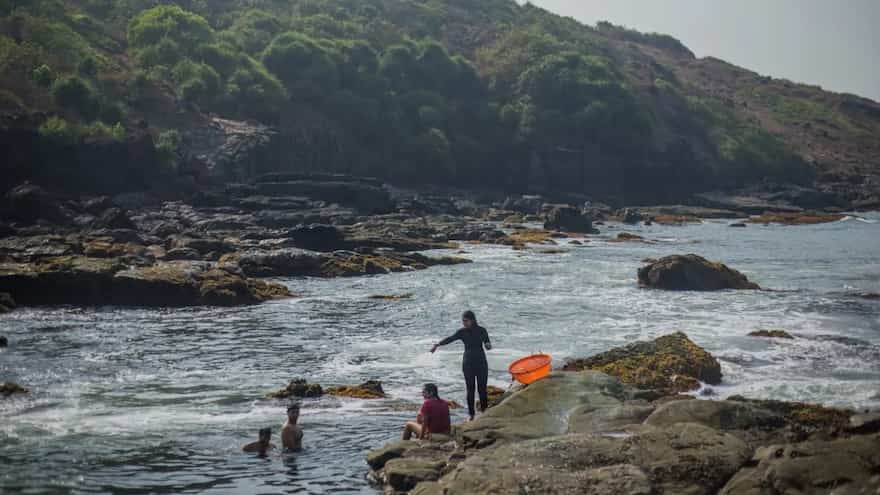
Image credit: Gabriella D'Cruz
Foraging Safely And Sustainably
For those interested in exploring the coastline themselves, D'Cruz encourages a closer, more deliberate look at the local ecosystem during low tide. "The diversity of seaweed is usually not something that we look at or pay attention to when we're at the tide pools. And so generally we're really curious about these different shapes, textures, and colours of seaweed that we find at low tide. As far as our research shows, all seaweed in India is edible, but it may not be palatable. So some may not be very nice tasting as compared to others." However, wild foraging comes with specific safety guidelines regarding contamination and personal health. "The thing to consider is that sometimes if you have a shellfish allergy, you should refrain from just eating the seaweed in the wild because there could be some shellfish fragments in them. Another thing to consider is you generally don't harvest seaweed at river mouths because there's a lot of pollution that comes down rivers. And so, it's advisable to harvest seaweed away from river mouths."
Timing and technique are equally vital for protecting the ecosystem from long-term damage. "And thirdly, I guess you should only harvest at low tide because that's when you can be very careful about how you harvest the seaweed. If you go into the water and you're getting tangled in the seaweed, you might pull the seaweed off from the rock and damage it. So it's better to go at low tide when the seaweed is emerged from the sea and you can see it on the rock very clearly and you can harvest it. And always take either a pair of scissors or a sickle so that you can cut the seaweed from a certain height and you don't pull it off the rock. That's really the most important thing."
This cautious approach extends to how Good Ocean manages its ongoing relationship with both the environment and the coastal communities who know it best. "Our harvesting practices are also very intentional and community-led. We only take as much as we need and never overharvest. A simple principle we follow is that if there are only a few clusters of seaweed in an area, we leave them untouched. If there are ten clusters growing, we may harvest one, but if there are fewer than that, we generally avoid harvesting altogether. We also always check with local fishing and coastal communities before harvesting in any area because they understand the coastline, tides, and ecology far better than anyone else." Understanding the natural growing cycles is also key for foragers hoping to spot these beds at their peak. "There are two main seasons for seaweed along the west coast. One is from November till March or April. That's when you will see a large diversity of seaweed in crop."
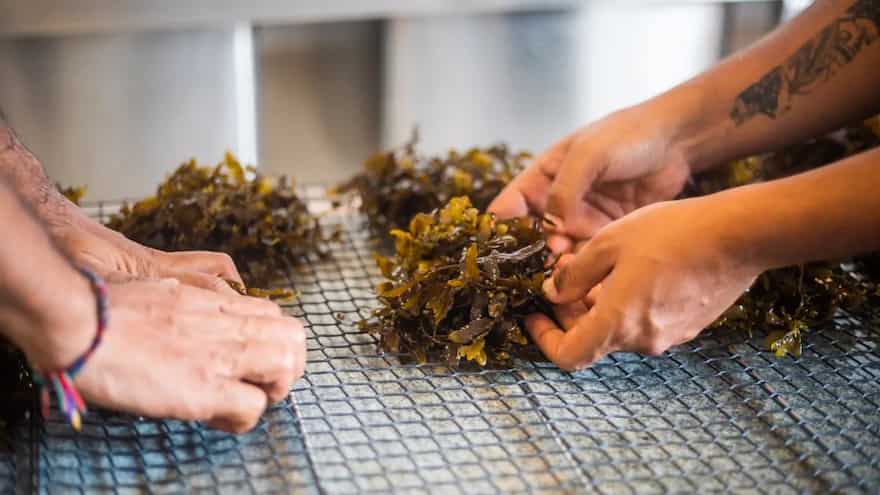
Image credit: Gabriella D'Cruz
Processing And Preserving For The Kitchen
Once harvested, proper cleaning and drying are essential for maintaining quality. "Traditionally, seaweed is not cleaned with fresh water. Instead, it is washed using salt water or a saline solution. After that, it can either be dehydrated naturally or dried in an oven at a very low temperature until all the moisture is removed. Once fully dried, it can be stored in an airtight container for long periods." The preservation process drastically transforms the ingredient and enhances its taste. "Seaweed has a very interesting texture because it is naturally gelatinous and highly responsive to hydration and dehydration. One of the most remarkable things about it is that it can remain dried and preserved for up to two years. In traditional Japanese and Korean methods, seaweed is intentionally dried because the process releases glutamates and salts that cling to the body of the seaweed, creating a deep umami flavour. MSG itself is another example of glutamates derived from seaweed. A lot of these flavour compounds develop during the drying process." This transformation unlocks numerous culinary possibilities. "That is what makes seaweed such a versatile ingredient. It can be dehydrated and stored for long periods, then rehydrated and used in salads, soups, or stocks. It adapts very well across different styles of cooking."
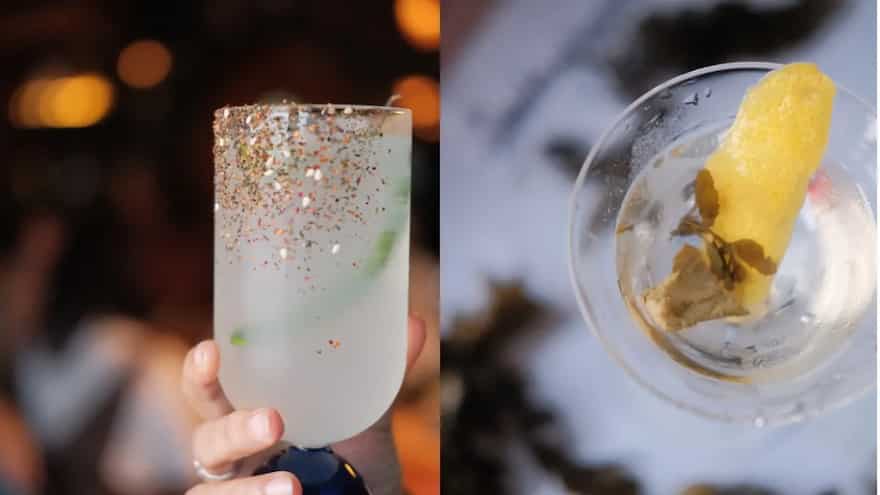
Image credit: Gabriella D'Cruz
Culinary Versatility For Home Chefs
Integrating this marine plant into daily meals is simpler than most people assume, presenting several accessible entry points for an average kitchen. "In terms of how home chefs can use seaweed, you can use it dried, so you can powder it and use it as a seasoning, sort of like a blend of sorts. You can also include it in other recipes. You can include it in curries or gravies if you want to add a nutritional element to it. You can also rehydrate it and use it in salads."
D'Cruz relies on this exact simplicity in her own daily routine, using it as a quick nutritional boost. "But usually, like as someone who is quite busy and on the go, I make a seaweed seasoning, so it's like a furikake-like seasoning, which is seaweed, sesame and chilli flakes. And then I just put that seasoning on like eggs on toast or in rice or on ramen or, you know, just anything that needs a little bit of seaweed flavour. And it's just about a teaspoon a day or so. And that's also like rich in iodine. And so that's something that I do personally, which is a nice way of including seaweed in your diet. But it's a really versatile ingredient in that sense. There are different things you could do with it, like you would with Japanese and Korean seaweed."
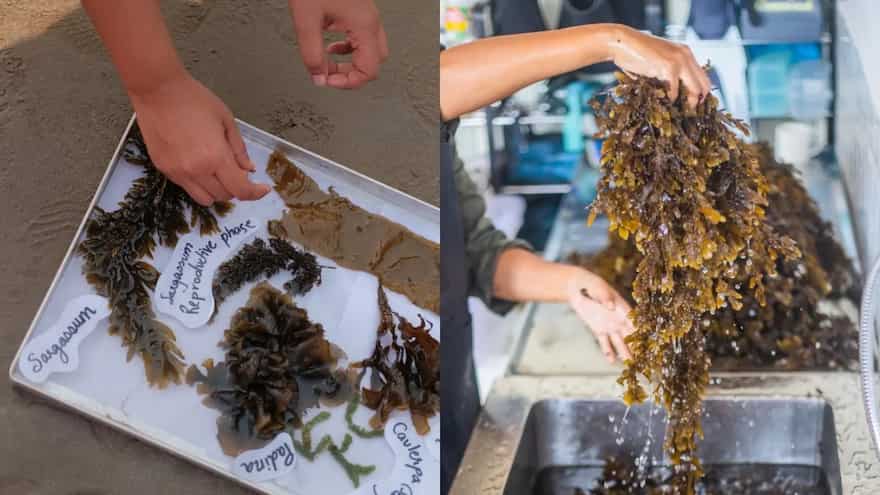
Image credit: Gabriella D'Cruz
The Future Of Indian Seaweed Cuisine
Despite the sheer abundance along the coast, the history of seaweed consumption within India remains largely unrecorded, creating a unique challenge for researchers. "In terms of the industry and traditions surrounding seaweed in India, there is currently not enough documented evidence of extensive traditional recipes within coastal communities. There are a handful of examples, perhaps one or two recipes found in parts of coastal Tamil Nadu and Kerala, but beyond that, there is very little recorded culinary documentation around seaweed." However, D’Cruz notes that a lack of written records should not be mistaken for a complete historic absence. "That said, it is important to recognise that the absence of documentation does not necessarily mean the absence of tradition. There are likely many recipes and practices that simply were never formally recorded, and that is an area that deserves much deeper research. The same applies to preservation techniques. Traditional methods of preserving seaweed in the Indian context are not well documented at the moment, and understanding those practices would be incredibly valuable."
This historical gap presents a blank canvas and a distinct creative opportunity for modern food practitioners. "Because of this gap, a lot of responsibility now lies with contemporary chefs, researchers, and food practitioners to experiment with new ways of preserving, cooking, and integrating seaweed into the Indian culinary landscape. It is still a relatively unexplored ingredient here, which also makes it exciting from a creative perspective." The most profound culinary shift, she believes, will happen when seaweed moves out of novelty contexts and into standard household meals. "Beyond that, there is also room to be inventive with Indian food itself. Seaweed can easily be incorporated into existing Indian dishes that could benefit from a little more umami, salinity, and nutritional depth. That is perhaps where the future of Indian seaweed cuisine becomes the most interesting, when it begins integrating naturally into foods people already cook and eat every day."
Ultimately, D'Cruz hopes that bringing seaweed into the kitchen will foster a deeper environmental awareness, linking consumer habits directly back to marine conservation. "I think one of the best ways to truly understand seaweed as an ingredient is to first understand the environment it comes from. If you are by the coastline and happen to notice seaweed growing around tide pools or rocks, it is worth paying attention to it. It is a fascinating organism, and observing these ecosystems closely is often the first step towards appreciating the ingredient itself. Engaging more directly with the ocean and coastal ecology helps create a much deeper connection with seaweed beyond simply seeing it as food. Otherwise, it can remain a fairly isolated concept for most people. At the same time, people can also experiment with seaweed quite easily at home. You can order Good Ocean seaweed online by reaching out to us on Instagram, and we can send across a sample pack to try in different ways."




