


 Share
Share

Every morning millions across the Indian subcontinent awaken to the rhythmic simmering of water, milk, and crushed leaves. This daily ritual transcends simple refreshment and provides the fuel for a bustling nation. Yet the beverage we consume carries an ancient linguistic map hidden within its very name. Whether you ask for chai at a vibrant street stall in Mumbai or order a cup of tea in a quaint London café, the word you choose serves as a historical compass. It reveals precisely how this beloved botanical infusion travelled from its ancestral home in East Asia to your cup. The phonetic divide between these two words is one of the most fascinating examples of how human language mirrors global trade, mapping out a saga of desert caravans, imperial conquests, and wooden ships navigating treacherous oceans.
The Ancient Chinese Origins Of A Divided Word
The story begins in the misty mountainous regions of ancient China. The leaf belongs to the Camellia sinensis plant, a species cultivated for millennia for its restorative properties. During the Tang dynasty the brewing and consumption of the leaf became a sophisticated cultural practice. In the classical Chinese script this botanical treasure is represented by a single elegant character. However the vast geography of the Chinese empire has always been a complex mosaic of diverse dialects and regional languages. The phonetic pronunciation of this single written character depended entirely on who was speaking and where they lived.
In Mandarin and Cantonese, spoken heavily in the imperial centres and the southern trading hubs respectively, the character was pronounced as cha. But along the rugged coastal province of Fujian the local Min Nan dialects pronounced the exact same character as te. This subtle linguistic fracture in ancient China would eventually divide the modern globe into two distinct phonetic camps.
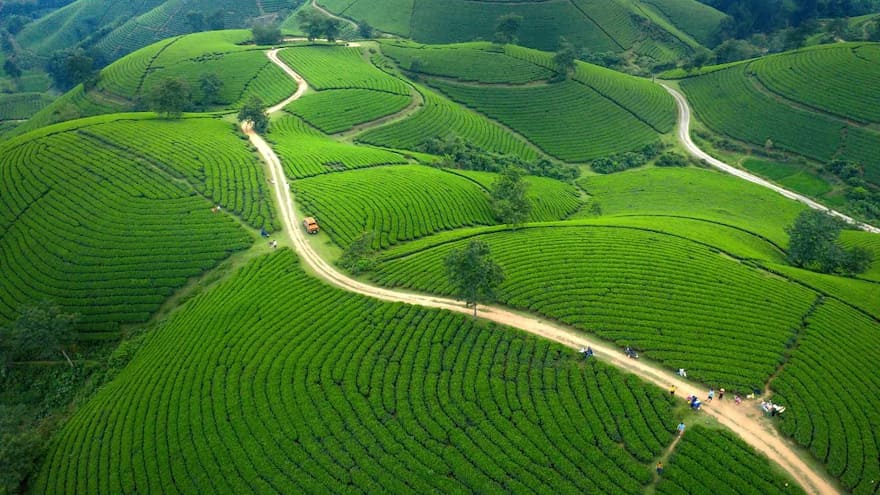
Image credit: Pexels
Desert Caravans And The Journey Of Chai
The word cha embarked on a grueling overland journey. Long before the era of mass maritime navigation goods flowed slowly along the ancient network of trading paths known collectively as the Silk Route. Caravans laden with compressed bricks of the prized leaf trudged through high mountain passes, across arid steppes, and into the vibrant bazaars of Central Asia. As the physical leaves moved westward through the hands of countless merchants, so did the Mandarin pronunciation.
The Persians were among the first major powers to eagerly adopt the beverage and its accompanying name. In the Persian language a grammatical suffix was naturally appended to the root word, transforming the crisp cha into the melodic chai. This Persian modification became the linguistic seed for a vast swath of the world. Because the Persian empire held immense cultural and commercial influence over Central Asia and the Middle East, their specific articulation of the word spread rapidly.
As the Mughal empire and deep Persian cultural currents swept across the Indian subcontinent the word chai took firm root in the local vernacular. Today the Indian style of brewing the leaf with rich spices, sugar, and milk is celebrated globally, yet its name remains a lasting testament to those ancient overland caravans. The same phonetic root echoed through the markets of Eurasia. The Russians adopted it as chay, the Arabs as shay, and the Turks as çay. The rule here is remarkably consistent. If a nation traditionally refers to the drink using a variation of cha or chai, history dictates that their ancestors first received the leaf via dusty continental roads and galloping horses.

Image credit: Pexels
Wooden Ships And The European Discovery Of Tea
While the overland caravans distributed cha across the vast Asian interior, a completely different narrative unfolded on the oceans. During the seventeenth century ambitious European powers began establishing vast maritime empires. The Dutch East India Company, a formidable commercial and military enterprise, became the dominant force in global shipping. When Dutch merchants arrived on the coast of China seeking lucrative exotic goods they did not establish their primary trading posts in the Mandarin or Cantonese speaking regions. Instead they anchored in the harbours of Fujian, specifically around the vital trading centre of Amoy, where the local Min Nan dialect reigned supreme.
The Dutch traders heard the local merchants refer to the valuable export as te. Consequently when their heavily laden galleons returned to the busy ports of Amsterdam they introduced both the exotic leaf and its coastal phonetic name to Europe. From the Netherlands the term spread rapidly across Western Europe, adapting slightly to fit local tongues and spelling conventions. The Dutch thee became the French thé, the Spanish té, the German Tee, and ultimately the English tea.

Image credit: Pexels
The Portuguese Anomaly In Global Trade
As with all great historical theories there is a brilliant exception that proves the rule. The Portuguese were among the earliest European explorers to reach the Far East, predating the Dutch maritime dominance by several decades. Because they were a seafaring nation one might expect their word for the beverage to be a variation of tea. However the Portuguese word is chá. This beautiful anomaly exists because Portuguese navigators did not conduct their primary trade in the coastal province of Fujian. Instead they established their legendary mercantile enclave in Macao, a southern port where Cantonese was the dominant dialect. Hence they adopted the cha pronunciation directly from the Cantonese merchants and shipped it back to Lisbon by sea, completely bypassing the Min Nan word.
Image credit: Pexels
British Colonisation And The Spread Of Tea Across New Worlds
The linguistic divide did not stop at the borders of Europe and Asia. As European powers launched an era of aggressive global colonisation they carried their respective words for the beverage across the Atlantic and Pacific oceans. The British East India Company systematised the global commercialisation of the plant, forever altering the cultural landscapes of the Americas and Australasia.
In North America the word tea arrived with British and Dutch settlers. The English terminology was forcefully imprinted upon the continent, superseding the various herbal infusions consumed by indigenous populations. The beverage became so deeply intertwined with British colonial control that it sparked the famous rebellion in Boston harbour. Similarly in Australia and New Zealand the British penal colonies and free settlers imported the word tea. The rugged Australian pioneers brewed what they called billy tea over open campfires in the outback, cementing the Min Nan coastal pronunciation firmly into the dialect of the Southern Hemisphere.
Interestingly the British colonisation of India created a fascinating historical overlap. The British cultivated tea in massive plantations across Assam and Darjeeling purely for global maritime export, while the local Indian population continued to drink chai rooted in centuries of overland Silk Road heritage.

Image credit: Pexels
The African Continent And A Complex Tapestry Of Trade
Perhaps nowhere is the linguistic map of this beverage more complex than on the African continent, where the terminology serves as a direct record of diverse colonial and commercial influences. In North Africa the overland and coastal Arab trade routes had long established the word shay, tying countries like Egypt and Morocco to the ancient Silk Route network.
However East Africa tells a different story deeply connected to the Indian Ocean trade. Swahili speaking populations in coastal nations like Kenya and Tanzania use the word chai. This is a direct result of centuries of maritime trade with the Arabian Peninsula and the Indian subcontinent, aided by the seasonal monsoon winds. This linguistic tie was later reinforced during the British colonial era when thousands of Indian labourers were brought to East Africa to construct the regional railway systems, bringing their beloved spiced chai culture with them.
Conversely in Southern Africa the influence of European colonisers dictated the vocabulary. The arrival of the Dutch in the Cape Colony introduced the Afrikaans word tee, while the subsequent British administration reinforced the English tea. Therefore moving from the north of Africa to the south takes you on a phonetic journey from ancient Arab trade routes to modern European imperialism.
South American Linguistic Divides From Imperial Conquests
The continent of South America offers a stunningly clear example of how European colonisation carved up global linguistics. Following the Treaty of Tordesillas the continent was largely divided between Spanish and Portuguese rule. This geopolitical split is perfectly preserved in the local words for the Chinese leaf.
In Brazil the sole Portuguese speaking nation in South America the word remains chá, reflecting the unique maritime route established by Portuguese merchants trading out of Cantonese speaking Macao. Meanwhile the surrounding Spanish speaking nations from Argentina to Colombia use the word té, inheriting the linguistic legacy of the Dutch traders who supplied the Spanish empire. While many South American nations maintain rich indigenous traditions of brewing local plants like yerba mate, whenever the Asian Camellia sinensis leaf is discussed it forces the speaker to invoke the ghost of either a Spanish or Portuguese colonial past.

Image credit: Pexels
A Lasting Legacy In Every Steeped Cup
Language is rarely accidental. The vocabulary we use daily is shaped by centuries of human movement, economic ambition, and cultural exchange. The dichotomy of the tea leaf provides a perfect historical lens through which we can view the development of the modern interconnected world and the heavy impact of colonial expansion. The next time you sit down to enjoy a steaming cup of chai or a delicate porcelain serving of tea, take a moment to consider the profound history resting in your hands. That single syllable carries the heavy footsteps of ancient merchants traversing the Hindu Kush, just as surely as the alternative carries the salt spray of the Atlantic ocean and the enduring legacy of global empires.




