


 Share
Share

IF YOU WERE ASKED to name the most whimsical food in your pantry, chances are you’d land on the marshmallow — a confection so airy and insubstantial that it feels like it should float away if you exhale too hard. It’s the stuff of campfires and childhood, of Technicolor cereal mascots and Peeps dioramas, of hot chocolate toppers and the purest forms of culinary nostalgia. But beneath its pastel, powdered exterior lies a story far older and stranger than most realise: one that begins not in a candy factory but in the ancient marshes of the Mediterranean.
WHEN MARSHMALLOWS WERE MEDICINE
Long before they were roasted on sticks and squished between graham crackers, marshmallows were… medicinal. The original marshmallow was made from the mucilaginous sap of the marsh mallow plant (Althaea officinalis), a wild herb used by the ancient Egyptians as early as 2000 BCE. They whipped the sap with honey to create a sweet, soothing elixir reserved for royalty and gods. The Greeks and Romans later prescribed the plant for sore throats and digestive issues.
So yes, your campfire treat has pharmaceutical roots.
By the 19th century, French confectioners adapted the plant into a lozenge-like sweet that was part dessert, part remedy. Early versions were still plant-based, made by beating marsh-mallow root paste with sugar and egg whites into fluffy, meringue-like pillows called pâte de guimauve. Apothecaries and candy-makers were, for a brief moment in history, the same people.
It didn’t stay that way for long.
THE INDUSTRIAL PUFF-UP
As demand grew, extracting sap from the finicky marsh-mallow root became impractical. Enter gelatin — bouncy, stable, efficient — and the marshmallow as we know it was born. By the early 1900s, American manufacturers had shifted to gelatin-based recipes and invented starch moulding techniques that allowed marshmallows to be shaped en masse.

Then, in 1948, a candy maker named Alex Doumak revolutionised the industry with an extrusion process that forced marshmallow batter through long tubes, cutting it into the tidy cylinders we know today. This is the moment when marshmallows went from a slightly medicinal artisanal candy to a mass-market cultural phenomenon.
No other food has embraced industrialisation with such marshmallowy enthusiasm. What used to be a rare herbal confection had officially become the star of supermarket shelves, holiday aisles, and childhood sugar highs.
MARSHMALLOWS INVENT AMERICAN CHILDHOOD
Marshmallows didn’t just infiltrate American culture — they helped shape it.
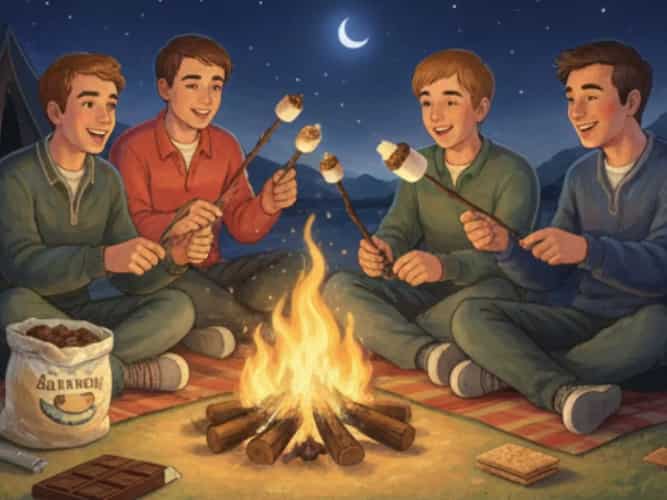
Consider the campfire marshmallow: the charred, gooey badge of honour for any kid who attended a scout camp, slumber party, or national park cookout. Roasting a marshmallow is a deeply democratic art form: everyone has their own technique (barely kissed by the flame or fully incinerated), and each approach reveals something about the roaster’s soul.
Then came the s’more, arguably the most iconic American dessert assembled outdoors. First appearing in a 1927 Girl Scouts guidebook, the s’more is as messy as it is brilliant: sticky marshmallow, melting chocolate, and crisp graham cracker in a harmony that only ever lasts three seconds before collapsing. Yet it endures, because marshmallows make even chaos delicious.
And then there’s Rice Krispies Treats, the 1939 stroke of genius by Kellogg employees Mildred Day and Malitta Jensen, who combined butter, cereal, and melted marshmallows into a pan of pure architectural joy. It remains one of the few desserts practically everyone has made at least once, often using a wooden spoon nearly as tall as they were.
THE MARSHMALLOW GOES POP-CULTURE
Marshmallows didn’t slip quietly into pop culture; they bounced in with the self-awareness of a food that knows it is inherently funny. Something about their composition — the wobble, the puff, the way they surrender so willingly to heat — invites mischief. Few confections are as visually expressive, which may explain why directors, advertisers, and internet hobbyists keep returning to them as props of delight.
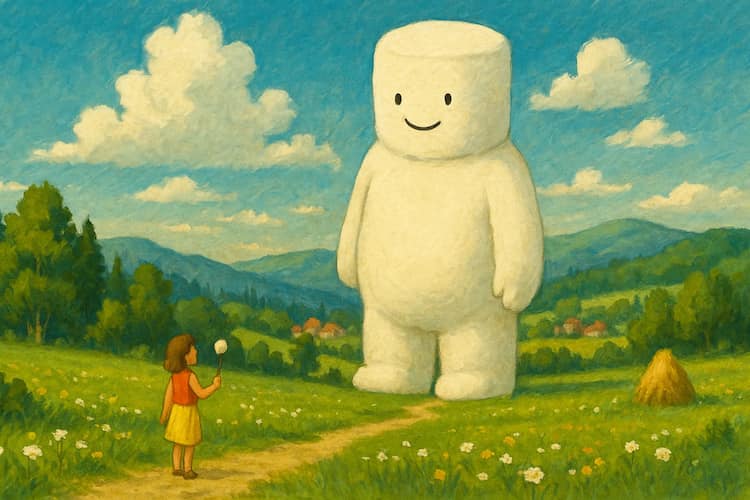
The most indelible pop-culture marshmallow remains the Stay Puft Marshmallow Man from Ghostbusters (1984), a grinning mascot-turned-monster designed precisely because marshmallows radiate harmlessness. To inflate something so benign into a kaiju-sized threat is to acknowledge the deep cultural truth: marshmallows look like they belong in a hug, not a city-wide rampage. That tension — between softness and spectacle — is what made Stay Puft instantly iconic.
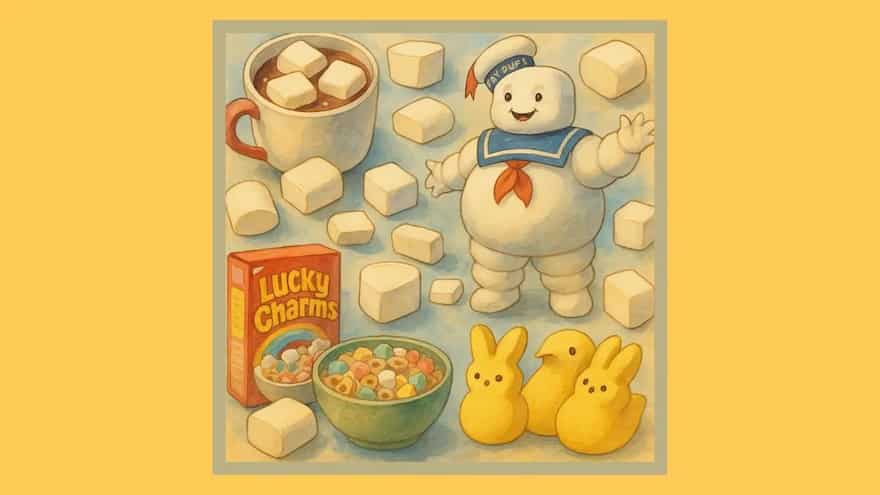
Then there are Peeps, the neon Easter chicks that long ago outgrew their seasonal brief. In the United States, they’ve inspired everything from university engineering experiments to elaborate dioramas, some lovingly crafted, others hilariously unhinged. For years, the Washington Post’s annual Peeps contest functioned as a national showcase of marshmallow-based creativity — a reminder that even the most unserious foods can become artistic raw material.
The internet, naturally, has only heightened the marshmallow’s capacity for spectacle. The early-YouTube “chubby bunny” challenge turned them into instruments of slapstick chaos. TikTok has since adopted them for slow-motion melting videos, gourmet roasting rituals, microwave experiments, and the eternal quest to build the platonic ideal of a s’more. Marshmallows behave dramatically on camera, which is half the reason people keep filming them.
Marshmallows also permeated television and film in quieter ways. They show up in Christmas specials as shorthand for emotional warmth; in sitcoms like Gilmore Girls, Friends and New Girl as comfort food for heartbreak; and in animated films like Frozen and Hotel Transylvania as characters who are literally soft-hearted. Even breakfast cereals — Lucky Charms most famously — turned marshmallows into edible iconography, their “marbits” so beloved that General Mills eventually sold bags of just the marshmallows.
Across all of this, marshmallows carry a strangely consistent symbolism: innocence, whimsy, and the pleasure of being a little bit ridiculous. They’re a food that invites play, and pop culture has obliged at every opportunity. Perhaps that’s the marshmallow’s greatest trick. It’s a confection that never stopped being fun, no matter how many forms it took or how grown-up its audience became.
CULTURAL SYMBOLISM: SWEETNESS MEETS SOFTNESS
Across cultures, marshmallows carry surprisingly rich symbolism.
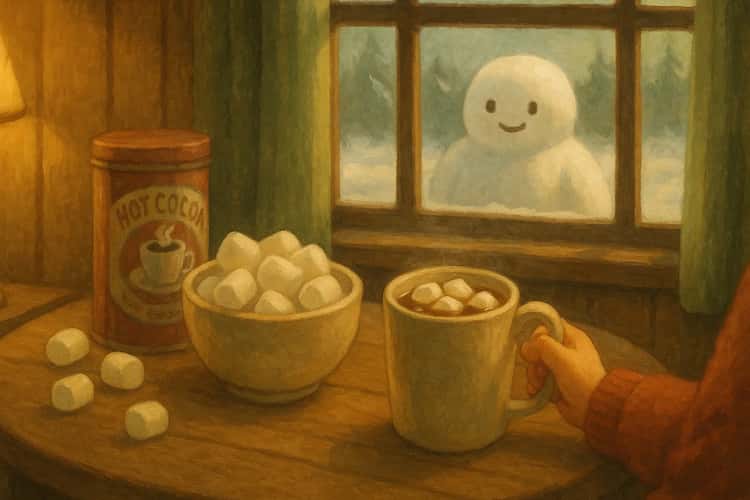
They are tied to childhood nostalgia, associated with purity, softness, comfort, and whimsy. They often act as a culinary shorthand for emotional warmth. Think hot chocolate ringed with tiny marshmallows in wintertime movies or the marshmallow snowmen decorating a holiday mug.
Yet they also represent excess and spectacle. What other ingredient gets flambéed, toasted, stretched, squished, piped, dipped, exploded in microwaves, and turned into pink rocky landscapes in children’s books? Marshmallows are the culinary embodiment of “extra”.
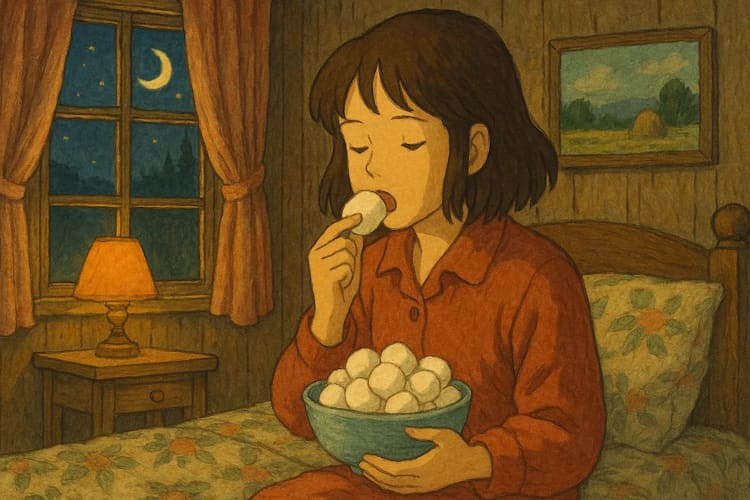
And in some circles, they even carry a whiff of scientific intrigue: your marshmallow’s ability to puff, melt, and caramelise follows the same physics that explain volcanic magma. (Perhaps that’s why kids love poking them with sticks.)
THE MARSHMALLOW TEST: A PSYCHOLOGICAL CELEBRITY
No discussion is complete without the marshmallow test, the infamous 1972 Stanford experiment in which children were given a marshmallow and told they could either eat it now or wait 15 minutes to earn a second one. The test became a global cultural myth about willpower and future success.
Though the study’s original conclusions have since been questioned, the marshmallow’s place in the collective imagination was cemented. It became the symbol of temptation, delayed gratification, and the scientific curiosity surrounding human behaviour.
Few foods can boast such a strange résumé: medicinal herb, industrial candy, campfire staple, psychological metaphor.

AND YET... THE MARSHMALLOW REMAINS SOFT AT HEART
Despite its long, tangled history, the marshmallow remains what it has always been: a little cloud of comfort. It melts, it burns, it stretches, it dissolves — but mostly, it softens the edges of the world.
A cup of hot chocolate with marshmallows can repair a bad day. A s’more can anchor a memory. A puff of candy can turn an ordinary evening into a moment of shared sweetness.
In a world obsessed with seriousness, marshmallows remind us to be a little unserious — to indulge, to roast something at sunset, to turn sticky for no reason, to let softness have its say.
Because perhaps the greatest cultural function of the marshmallow is its permission slip: it allows us — even just for a moment — to be tender.




