


 Share
Share

OBSERVED across China, Vietnam, Korea, Malaysia, Singapore and beyond, the Lunar New Year marks the start of a new lunar cycle. But culturally, it’s much bigger than that. It’s about recalibrating your fortune. Realigning your household. And, crucially, re-staging your destiny through dinner.
Because if there is one thing Lunar New Year makes clear, it’s this: the table is never random.
The dishes laid out for reunion meals are chosen with surgical intention. Their names are puns. Their shapes are metaphors. Their colours are coded messages to the universe. In Chinese culinary tradition, especially, homophones do heavy lifting: the word for fish (yú) sounds like surplus; lettuce sounds like “becoming wealthy”. The number eight (ba) sounds like prosperity (fa). Sound becomes symbolism. Symbolism becomes ritual.
Visual cues matter too. Golden foods — spring rolls, citrus, glazed meats — evoke bullion. Whole animals, served head and tail intact, promise completeness and a good beginning and end to the year. Long noodles stretch into the future. Round sweets echo reunion.
Even the etiquette is strategic. Communal dishes like basin feasts and hot pots reinforce togetherness. Fish is deliberately not finished — leftovers are a flex, proof that abundance spills into tomorrow. Meanwhile, certain foods are consciously avoided: white foods (associated with mourning), humble porridge (lest the year begin in scarcity), bitter melon (because no one wants to manifest bitterness).
In other words, the Lunar New Year spread is less a menu and more a manifestation board. Except you get to eat it.
Here’s your A–Z guide to the foods that make up this edible lexicon of luck.
A — Almond Cookies
Round. Golden. Sweet. These festive Chinese biscuits are intentionally designed to resemble coins. Flavoured with almond extract or almonds, they’re small but symbolically loud: the circular shape signals wholeness and wealth, the golden hue signals fortune, and the sweetness gestures toward a year that (hopefully) goes down easy.
B — Ba Bao Fan (Eight-Treasure Rice)
If abundance had a dessert form, this would be it. Originating in Jiangsu and Zhejiang cuisine, this sticky rice showpiece layers glutinous rice with red bean paste and eight “treasures” — lotus seeds, red dates, longan, nuts, preserved fruits, dried hibiscus flowers — often sealed with a glossy syrup lacquer.
The number eight (ba) sounds like prosperity (fa), and the dish itself reflects accumulated abundance: disparate elements assembled into a cohesive, prosperous whole.
B — Bak Kwa
Originally from Fujian but now widely popular in Malaysia and Singapore, bak kwa is sweet, smoky dried meat — typically minced pork or chicken marinated in soy sauce, honey, sugar and five-spice powder. It’s spread thin, baked until firm, then grilled for a scarlet, caramelised finish.
What began as preservation has evolved into a festive luxury. During Lunar New Year, shops in Malaysia see queues wrapping around the block for freshly grilled slabs. It’s edible goodwill — often gifted, always coveted.
B — Bánh Chưng
In North Vietnam, bánh chưng is essential to Tết celebrations. This square parcel of glutinous rice, fatty pork and mung beans is wrapped tightly in banana leaves and steamed for hours.
The shape matters. In the north, it’s square; in the south, cylindrical (bánh tét). Either way, it symbolises familial continuity — a ritual food that binds generations through labour, memory and shared time.
C — Chả Giò / Nem Rán
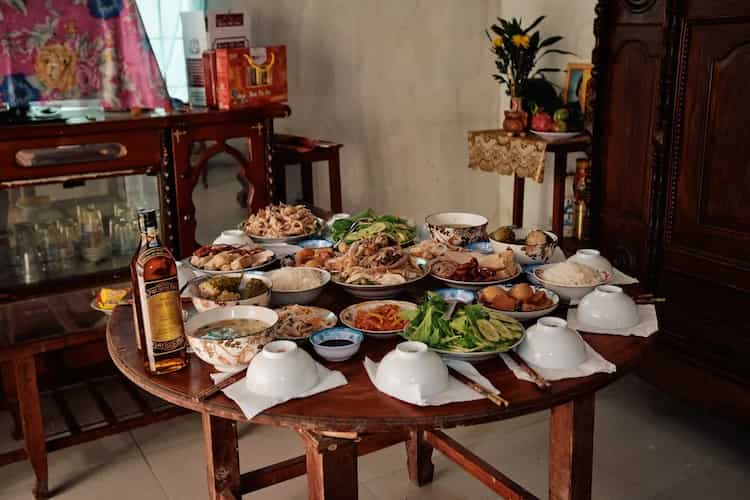
Vietnamese fried spring rolls are crisp, golden and deceptively technical. The rice paper wrapper is thinner than most — it needs only a quick dip to soften, or it becomes impossible to handle. (Pro tip embedded in tradition: a splash of sugary soda in the dipping water boosts browning.)
Filled with minced pork, glass noodles, wood ear mushrooms and aromatics, they’re prepared in large batches and shared. Their labour-intensive assembly makes them less everyday snack, more collective effort — prosperity built together.
C — Chicken (Whole)
Across Mainland China, Hong Kong, Macau and Malaysia, chicken appears on the table intact — head, feet, everything. Often poached, roasted or braised simply with soy sauce, ginger and scallions.
The wholeness symbolises unity and completeness. The word for chicken (ji) is a homophone for good luck or prosperity. There’s even a micro-ritual embedded within: the family breadwinner may eat the feet to “grab” wealth — the word for grab echoing talons.
D — Dumplings (Jiaozi)
If wealth had a shape, it would look like a dumpling. Originating in Northern China, these dough pockets are carefully folded to resemble ancient gold and silver ingots.
Fillings vary — minced pork, prawns, Chinese chives, cabbage, ginger — but the ritual is constant: families gather on New Year’s Eve to wrap them together. Sometimes a coin, sweet or nut is hidden inside one dumpling. The finder? Predicted to have exceptional luck in the year ahead.
The rule is simple: the more you eat, the richer you get.
F — Fa Gao (Prosperity Cake)
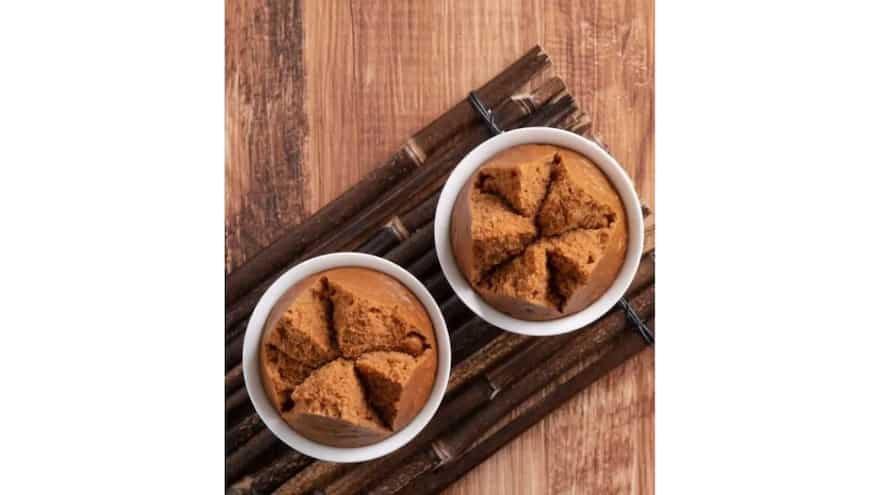
These steamed, fluffy rice-flour cupcakes are known for their split tops, which bloom open like flowers. Made with rice flour, sugar (often brown) and leavening agents, they’re lightly sweet and visually optimistic.
The name sounds like prosperity and growth. The blooming top? A literal metaphor for rising fortune.
F — Fat Choy (Black Moss)
This black, hair-like moss is often braised with shiitake mushrooms or dried oysters. Its Cantonese name sounds exactly like “striking it rich” (fat choy). Pair it with dried oysters (ho si) and it phonetically echoes “good market” — making it particularly popular with business owners.
It’s not without controversy, however: mass harvesting has raised environmental concerns.
F — Fish (Whole Steamed)
Perhaps the most iconic of all. Whole fish — sea bass, carp or snapper — steamed with ginger, spring onions, soy sauce and sometimes fermented black beans.
The head and tail must remain intact to symbolise a good beginning and end. And here’s the twist: you’re not meant to finish it. Leaving leftovers ensures surplus carries into the new year. Because the word for fish (yú) sounds like surplus.
J — Japchae
A staple of Korean Seollal celebrations, japchae is a stir-fry of sweet potato glass noodles tossed with carrots, spinach, mushrooms, egg and often beef, all dressed in soy sauce and sesame oil.
It’s prized for its colour, balance and texture — celebratory abundance rendered in strands.
L — Lion’s Head Meatballs
Popular in Shanghai, these oversized braised pork meatballs are served with vegetables (often bok choy or cabbage) that frame them like a mane.
The lion symbolises strength. The roundness signals unity. It’s theatrical, comforting and metaphorically muscular.
L — Lo Bak Go (Turnip/Radish Cake)
Despite the English name “turnip cake”, this Cantonese favourite is made from shredded daikon radish (lo bak), rice flour, cured meat, dried shrimp and shiitake mushrooms. It’s steamed, then often pan-fried until crisp outside and tender inside.
In Cantonese, lo bak sounds like “gathering good omens” or fortune — making it a prosperity magnet in cake form.
L — Longevity Noodles (Changshou Mian)
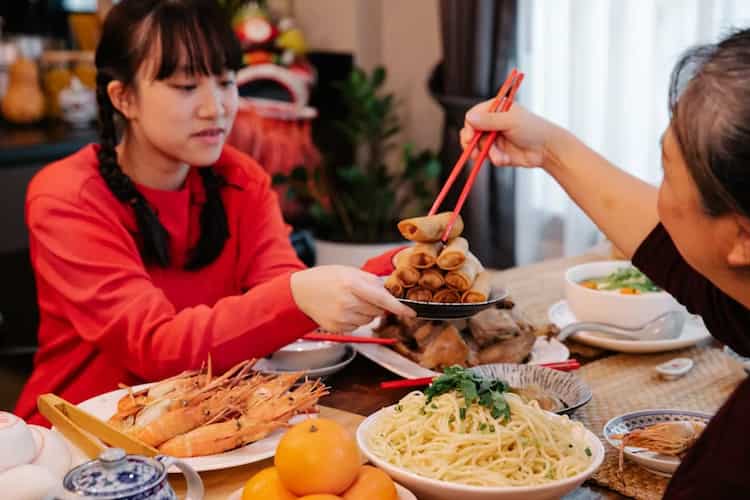
These noodles can stretch up to two feet long. They’re served stir-fried or in broth — but here’s the rule: do not bite them. Do not break them.
Breaking the strand symbolically “cuts short” your life or luck. Slurp with intention.
N — Nian Gao (Year Cake)
Dense, chewy and made from glutinous rice flour, nian gao can be sweet (often steamed with brown sugar) or savoury. It may include chestnuts, dates or lotus leaves.
Its name is a homophone for “higher year” (nian nian gao). Eat it to rise — professionally, financially, physically.
P — Pineapple Tarts
A Southeast Asian Lunar New Year staple, these buttery pastries are filled with spiced pineapple jam (sometimes scented with star anise or cinnamon).
In Hokkien, pineapple (ong lai) sounds like “fortune comes”. The golden filling only reinforces the message.
P — Poon Choi (Basin Feast)
Originating in Hong Kong’s New Territories and Macau, poon choi is a communal basin layered with premium ingredients — abalone, roast duck, prawns, dried scallops, sea cucumber, mushrooms, pork belly — stacked over absorbent tofu and radishes.
You eat it from top to bottom. Layer by layer. Symbolically uncovering treasure. Legend traces it back to villagers serving a fleeing Emperor in wooden washbasins.
S — Spring Rolls
Golden, cylindrical and filled with pork or vegetables, these East Chinese classics resemble bars of gold. Their colour and shape alone are a thesis on wealth. Associated with the phrase Hwang-jin wan-lyang — “a ton of gold”.
T — Tang Yuan
Round, chewy rice balls made from glutinous rice dough and filled with black sesame, peanut or red bean paste. Served in sweet syrup, often during the Lantern Festival (the 15th day marking the end of celebrations).
The name sounds like tuan yuan — reunion. The shape symbolises completeness.
T — Tray of Togetherness
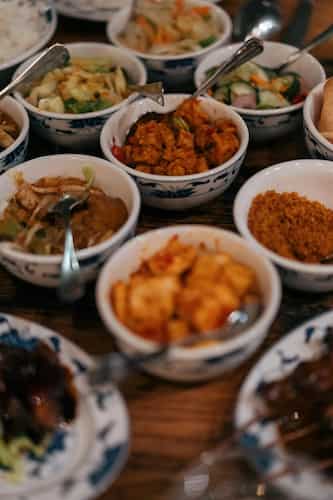
A circular or octagonal tray with six or eight compartments holding dried fruits, nuts, candies, melon seeds — sometimes with red envelopes placed in the centre.
The number eight is lucky. The round shape signals unity. Offering sweets from it is offering a sweet year.
T — Tteokguk
A clear Korean rice cake soup eaten during Seollal. Thin, coin-shaped rice cakes float in beef or anchovy broth, garnished with egg, seaweed and scallions.
Eating a bowl symbolises growing one year older. The white rice cakes represent purity and fresh beginnings; their coin shape suggests prosperity.
Y — Yu Sheng / Lo Hei
A Malaysian and Singaporean creation from the mid-20th century, this raw fish salad combines salmon, shredded carrots and radish, pomelo, crushed peanuts, deep-fried flour crisps (pok cui), plum sauce and sesame oil.
Then comes the ritual: everyone stands. Chopsticks in hand. The ingredients are tossed high into the air while shouting auspicious phrases.
The higher the toss, the greater the luck.
Lunar New Year food is phonetics turned into prophecy. It’s colour theory with financial aspirations. It’s culinary wordplay engineered to coax the universe. It’s not just dinner…it’s destiny, plated.




