


 Share
Share

Filed under: CULTURE | FOOD | INTERNATIONAL INCIDENTS
***
IT BEGAN, as all great international incidents do, with pastry.
A woman — American, as you have already guessed, because of course she is — visited Stohrer, one of Paris's oldest and most revered pâtisseries, founded in 1730 by Nicolas Stohrer, personal pastry chef to Queen Marie Leszczyńska, wife of King Louis XV. She bought three chocolate éclairs. She brought them home. And then, in an act that will be studied by future historians alongside the burning of the Library of Alexandria, she cut them in half. The short way.
The short way.
She posted a photo to Threads with the cheerful caption that she'd visited "a pastry shop started by a chef who used to cook for King Louis" — which, as several French commenters noted with the pained precision of people watching a loved one step on a rake in slow motion, is like saying Shakespeare was "some writer from England." There were, they explained, eighteen King Louises. There is rather a lot of difference between them. One of them lost his head, which at this point seemed poetically relevant.
The Threads post received 310,000 views. The French descended. It was, as one non-French observer put it, "perfectly French, and it hurts."
We, the food-loving people of the world, watched. We laughed. And then, quietly, we thought about our own national food crimes. The things that make our grandmothers clutch their chests. The transgressions that have ended friendships, delayed weddings, and caused grown men to push their plates away in dignified, silent fury.
Herewith, a compendium. Consider it a public service.
France: The Éclair Affair (And Other Structural Violations)
Let us start at the scene of the crime. The éclair, for those who have been living under a Cromwellian cloud of ignorance, is a choux pastry filled with cream and topped with a glaze. It is a complete architectural unit. It is not a sandwich. It is not a sub. It is not something you bisect with the casualness of someone halving a banana.
Cutting an éclair in half, so that the cream falls out like the contents of a defeated piñata, is considered a cry for help.
"Did they guillotine the éclairs for you?" asked one commenter, with 11,200 likes. The guillotine joke wrote itself. The French, to their credit, were not even surprised. They were just... tired.
Related French food sins: asking for a baguette sliced (the look you will receive), putting anything other than butter or jam on a croissant (possible deportation), and ordering a café au lait after 11am (they will serve it, but they will know).
India: There Are 1.4 Billion People Here, And Every Single One Of Them Has An Opinion On Biryani
India does not have a food culture. India has approximately nine thousand food cultures, each of which believes all the others are doing it wrong, and none of which is incorrect in this belief.
The biryani, for instance, is not one dish. It is a galaxy of dishes, each region's version protected by the kind of fierce local pride usually reserved for national borders. Putting ketchup on a Hyderabadi dum biryani is not merely a food sin — it is a statement of intent. You are announcing, calmly and to the room, that you would also like to put tomato sauce on the Taj Mahal.
Further Indian food sins that will end relationships:
• Calling all lentil dishes "dal" with the same energy you'd call all pasta "noodles." You have been warned.
• Eating a dosa with a fork. A fork. In front of people. The dosa is designed to be torn. It is practically begging to be torn. Using a fork on a dosa is like reading poetry with a highlighter.
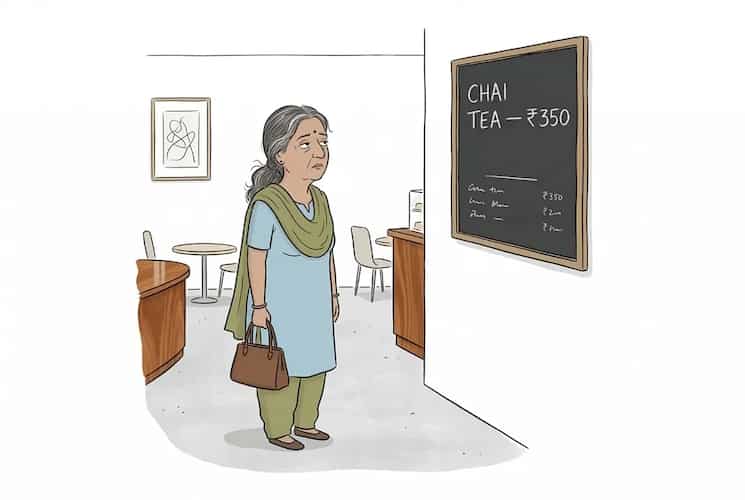
• Ordering "chai tea" anywhere within earshot of a desi person. Chai means tea. You have ordered tea tea. You are a tea tea ordering person and you should feel tea tea bad. (See also: "naan bread".)
• Putting curd rice anywhere near someone's Chettinad mutton. These two dishes are not friends. They have not agreed to be on the same plate. Respect their boundaries.
Italy: A Nation Held Together Entirely By Pasta Rules
Italy is a country where the rules of pasta are more constitutionally binding than the actual constitution. Carbonara without eggs and guanciale is not carbonara. It is a beige crime. Adding chicken to it should technically be a violation of the Geneva Convention. Italian nonnas across the peninsula sense it the moment it happens, like a disturbance in the Force, and they set down their wooden spoons very slowly.
The Italian commentary on the éclair post, it should be noted, was gleeful. "I'm just a simple Italian woman enjoying other nations' food raging," wrote one commenter. "Thank you, my French cousins, you did not disappoint." This is peak Italian energy: immense food pride, but always willing to enjoy someone else's catastrophe with an espresso.
Classic Italian food sins:
• Pineapple on pizza. This has been litigated. The verdict is in. It is not a close case.
• Ordering a cappuccino after noon. Italy will make it. Italy will not forgive you.
• Cutting spaghetti. Using a spoon to twirl pasta. Both are acceptable in their own country. In Italy, they are conversational topics that can ruin a dinner party.
• Putting the pasta in before the water boils. You know what you did.
Japan: The Quiet Fury
Japan does not shout about food sins. Japan does not post about them on Threads with 11,000 likes. Japan simply notes them, internally, and adjusts its opinion of you accordingly, and this is somehow more devastating.
Sticking chopsticks vertically into a bowl of rice is a funeral rite. Do not do this at a dinner table unless the dinner has gone very badly indeed and you are making a statement. Passing food chopstick to chopstick is also a funeral custom. If you do both in quick succession, a Japanese grandmother will not say anything. She will simply look at you. That is enough.
Pouring soy sauce directly onto plain rice at a nice restaurant is technically legal. So is arriving at the opera in a sleeping bag. Both will result in the same expression from the people around you.
Mexico: Salsa Is Not Negotiable
Mexico has a Tex-Mex problem, in the same way that France has an éclair problem, which is to say: Tex-Mex exists, people enjoy it, and Mexican grandmothers have simply agreed not to discuss it at family gatherings because life is short and mole takes three days to make.
But there are limits. Putting sour cream inside a taco (not on the side — inside, like structural support) is regarded as a form of architectural hubris. A hard-shell taco filled with the floppy spiritual ancestors of a real taco is not something that should exist. The fact that it does is viewed as a purely American achievement, like sending a car to space: technically impressive, but raising many questions about priorities.
Britain: The Scone Schism
Britain would like you to know two things. First: it is scone (rhymes with gone), not scone (rhymes with bone), depending entirely on where in Britain you are from, and this has been an active source of conflict since approximately the 14th century. Second: whether the cream or the jam goes on first is not a trivial question. It is a constitutional question. Cornwall says jam first. Devon says cream first. The rest of England watches and is grateful it does not have to take sides.
Calling a biscuit a cookie in a British kitchen will not start a war. It will simply cause a very specific silence, the kind that means I have noted this, and I will think less of you from now on, and I will be very polite about it, and that will be worse.
The lesson, if there is one: food is not just food. It is history and memory and identity, wrapped in dough or simmered in a pot or, in the case of the éclair, presented to a tourist who will subsequently cut it the wrong way and inadvertently unite the French internet for the first time since 1789.
The woman from Threads, for her part, seems to be taking it well. She posted the photo, got 310,000 views, and is presumably now in possession of a very good story for dinner parties.
Though we'd advise, for the future: don't cut the éclairs. Don't ask for your steak well-done. Don't put ketchup on the biryani.
Some lines, once crossed, cannot be uncrossed.
***
Have we missed the most egregious food sin in your books? Tell us about it. We have time. We are eating éclairs — correctly — while we wait.




