


 Share
Share

Of course, everyone enjoys desserts since they provide a delicious and gratifying ending to a meal and are typically created with recognisable ingredients such as fruits, nuts, milk, or grains. However, many people overlook the fact that desserts can use non-vegetarian ingredients in unexpected and innovative ways. Such desserts have long existed in various culinary cultures, from India to West Asia and even portions of the United States, quietly questioning what we believe sweets should be.
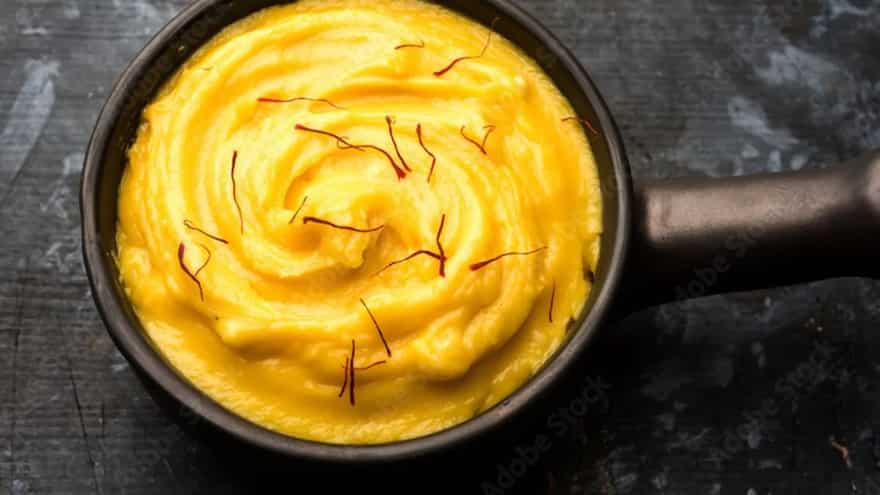
Image Credit: Adobe Stock
Non-vegetarian desserts do not merely contain eggs or gelatin, which are already prevalent in baking, but also include meat, fish, or seafood as a central component of the meal. While this may appear unusual at first, these components are frequently cooked in such a way that their savoury qualities are masked or changed, allowing them to merge effortlessly with sweet sensations. The result is a dessert that surprises the tongue, combining familiar sweetness with a novel twist, demonstrating that the boundaries of dessert-making are significantly more adaptable than you realise. If this has made you curious to try them in your kitchens when you don’t know what to make with your non-veg items, here are a few options to try:
Gosht Halwa, India
Mughlai cuisine is one of the most loved and enjoyed cuisines in India. Having ruled India for almost 350 years, the Mughals modified and mingled their culinary preferences with the Indian cuisine to make it suitable for their palate. And this amalgamation gave rise to some of the most loved dishes of India today. Goshta ka halwa- a rich, thick dessert that is made with thickened milk (don’t mix it with condensed milk) and sugar, is almost like an ancient lost and forgotten recipe. In this delectable melt-in-the-mouth sweet dish, the taste depends on the quality of the pounded tender lamb and how well it has been cooked for hours. This dish, which finds its roots in rich Halwa Rampur in UP, is actually a dessert made of meat.
Khoresh-E Mast, Iran
Khoresh-e mast is a unique regional Iranian non-vegetarian dessert from Esfahan. The dessert differs from most other sweets in that it includes lamb as one of its key ingredients. Khoresh-e mast literally means ‘yoghurt stew,’ although it is a sweet dish. This dessert is said to have originated during the Qajar monarchy from 1789 to 1925 and was traditionally a meal reserved for the royal court and the elite echelons of society; then, it gradually expanded throughout the general populace and became one of the emblems of Esfahani cuisine. The meat is slowly cooked until absolutely soft before being shredded into tiny fibres and combined with sweet, saffron-flavoured yoghurt. The dish is served cold and frequently topped with walnuts and barberries. The meat is coarsely shredded and softly blended into the overall flavour. However, the texture is slightly stretchy, like chewing gum.
Image Credit: Wikimedia Commons
Otak Otak Fish Custard, Indonesia, Malaysia & Singapore
Otak-otak is a delicious dish of steamed fish infused with a spicy coconut-based custard and flavoured with aromatic herbs. While it does require certain unusual ingredients as a non-vegetarian dessert, such as daun kaduk (wild betel leaves) and galangal, it is actually pretty simple to create. If you can get all of the ingredients, the rest is simple. While this Nyonya steamed variant can be served in banana leaf wrapping, the flavour is distinct from the southern peninsular variety found in Muar, Johor. That variation resembles grilled spicy fish cakes. The fish and spices are blended into a paste. A small bit of the fish paste is then wrapped in a piece of banana leaf to form a thin bundle. The packet is then cooked over a charcoal fire. Unlike the Nyonya steaming otak-otak, the Muar variant is typically eaten as a snack rather than a major dish with steamed rice.
Pastilla, Morocco
Moroccan pastilla is a delectable sweet and savoury meat or seafood pie that is a culinary speciality of Morocco. It consists of layers of thin phyllo pastry filled with a mixture of poultry or seafood, almonds, eggs, and aromatic spices. Moroccan Pastilla's origins can be traced to the Arab and Andalusian influences that have shaped Moroccan cuisine over time. Pastilla, also known as "bastilla" or "b'stilla," was traditionally enjoyed during special occasions and festive celebrations. Moroccan pastilla exhibits a diverse range of variations influenced by regional preferences and ingredients. In the coastal regions, seafood-based pastillas are popular, featuring an array of fresh fish, shrimp, or a combination of seafood delicacies. Inland regions often showcase poultry variations, with chicken being the most common choice.
Mutanjan, India & Pakistan
If you dive deeper into the accounts of historians, this dish was a staple part of the spread among Nawabs, even when the food was sent to them. Boasting sweet, savoury, and nutty flavours, it’s a treat for not just taste buds but all the senses, making relishing it a sensory experience for foodies. Being an integral part of the Awadhi cuisine (though its roots are not Awadhi) today, you can easily spot it in Lucknow, Uttar Pradesh, where restaurateurs sell it along with smoky kebabs, vibrant biryani, and creamy kormas. Mutanjan is a part of festivities and weddings today, but it does not have just one recipe. Everyone makes it in a slightly different way. For Muslims in this region, this dish is extra special as it encapsulates emotions and cultural memories.

Image Credit: Wikimedia Commons
Anchovy With Caramel & Peanuts, Sicily, Malta & Turkey
Dried anchovies and peanuts are fried until precisely crisp, resulting in a rich and nutty base that is both flavourful and addictive. After being cooked, they are tossed in a glossy, caramelised mixture of sugar, soy sauce, and a small amount of oil, which uniformly coats each piece. The result is a crispy snack that combines sweetness with strong tastes, making it extremely pleasant. This delightful treat, which is popular in regions of Sicily, Malta, and Turkey, is frequently enjoyed as a non-vegetarian dessert separately or as a topping, providing a robust blend of textures and tastes in each bite.




