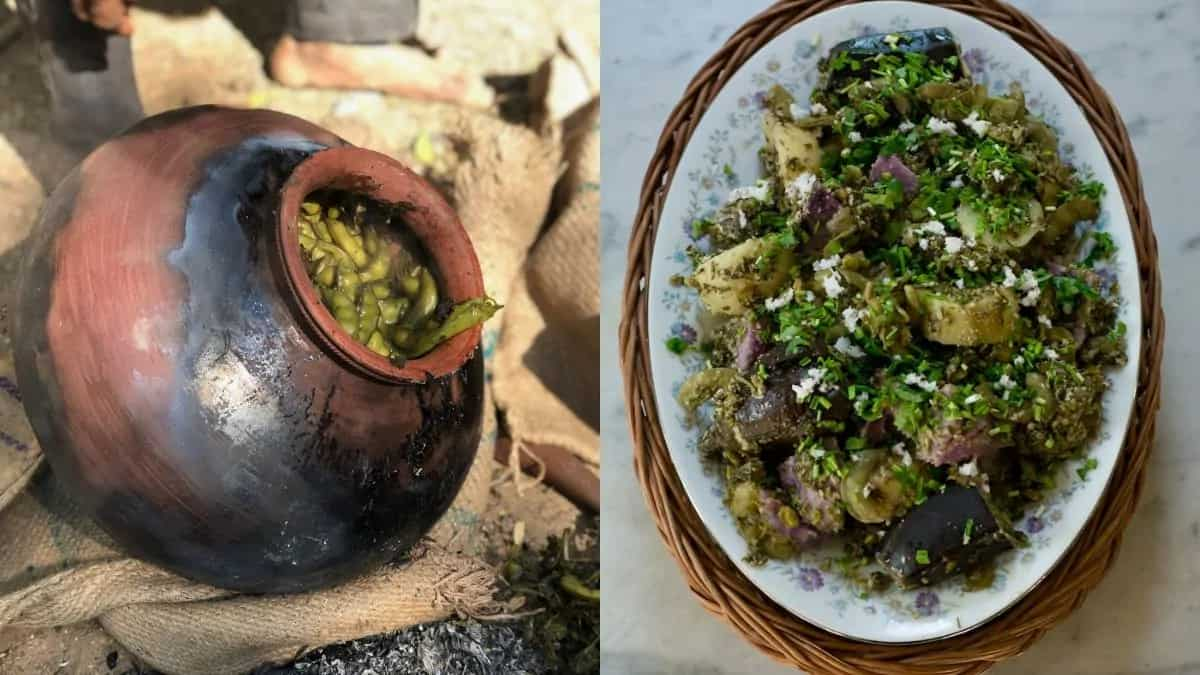
Every winter, somewhere in Surat, someone is stringing papdi beans with the patience of a person who knows no shortcut is coming. The flat, tender pods reach the markets as the weather turns, alongside deep purple ratalu, stubby sweet potatoes, baby aubergines no bigger than a fist, and bunches of green garlic that perfume an entire kitchen. Add a heap of fried fenugreek dumplings, and these become undhiyu: the one-pot medley that Gujaratis wait for all year and argue about every season. The name tells you how it was cooked. Undhu means upside down in Gujarati, a nod to the earthen pot, or matlu, that was traditionally turned over, buried in the ground and fired from above. What goes inside comes entirely from the soil: vegetables, beans, greens, groundnuts, coconut, sesame and oil. In its classic form, there is not a drop of dairy in the pot.
That makes undhiyu an easy poster child for plant-based Indian cooking this November, which is World Vegan Month. But as Sheetal Bhatt reminds us, its story is richer, and a little more complicated, than any label. Bhatt is an Ahmedabad-based culinary historian and author, the founder of the food blog The Route to Roots and widely regarded as one of the custodians of Gujarati culinary heritage. Her book, Silent Cuisines: The Unsung & Disappearing Foodways of Gujarat's Adivasis, documents the micro-cuisines of the state's north-eastern districts. We spoke to her about the undhiyu she ate as a child, the versions that have never left their villages, and why this dish, more than most, asks us to slow down.
A Dish That Never Used to Travel
Today, undhiyu is treated as shorthand for all of Gujarat. Bhatt grew up in Ahmedabad, though, and for her it was nothing of the sort. "Undhiyu was never such a big thing when we were growing up," she says. "Honestly, it was a lot of work. And the produce that travels now, like Surti papdi, would never travel to Ahmedabad. You wouldn't easily find ratalu, the purple yam, in Ahmedabad markets either. So it wasn't a pan-Gujarati thing in that way." The dish belongs, first, to the south. It is a regional speciality of Surat, built on vegetables that grow along the South Gujarat coastline in winter, around Surat, Navsari and Valsad. The produce is so particular that Mumbai's Gujaratis have long had it brought in by rail. Surti papdi famously makes the trip to Mumbai every winter on the Flying Ranee, and one storied Mumbai farsan house still has its undhiyu vegetables sent from Surat daily by train.
For the young Bhatt, undhiyu meant a journey too. "It was something I looked forward to, something I only got to taste when I travelled to Surat, to my masi's place," she recalls. "It was a huge thing in Surat. Everybody would talk about undhiyu. There would be undhiyu parties hosted by my aunt and her friends." Those parties had their own ritual, and it always ended the same way. "It was enjoyed a lot, and it called for an afternoon nap," she laughs. "It was usually a Sunday thing. You enjoyed it, and then you just went to sleep."
Ahmedabad had its own undhiyu moment, and it arrived with the kites. On Uttarayan, the city's rooftop festival every 14 January, undhiyu and jalebi become the meal of the day. Local reports put the city's appetite at around 5 lakh kg of undhiyu on that single day, sold from some 3,000 makeshift stalls. "Ahmedabadis would go wild on an undhiyu and jalebi feast on Uttarayan," Bhatt says. "It is huge in Ahmedabad. People would either buy it or make it." But the Ahmedabad pot was a different creature from the one in Surat. "Our Ahmedabad undhiyus are rich in oil," she says. "You want the vegetables immersed knuckle-deep in oil. And the colour is red, whereas Surti undhiyus are always green." As a child, she was not a fan. "Ours was very red, and a lot of us kids did not like it, because it would have brinjals, which we didn't like. It was very spicy, very oily. I think that was a deterrent." The undhiyu most of us picture today, she points out, is the southern one. "The ingredients you associate with undhiyu now, the ones you identify it with these days, are the southern Gujarati, or Surti, undhiyu ingredients."
Two Days For One Pot
In Bhatt's memory, undhiyu was a project rather than a recipe, and most of the work happened long before the stove was lit. Her masi was exacting about every ingredient. "I know the care she took in procuring the most tender coriander for the green masala, the most tender papdi beans," she says. "The aubergines also had to be of a certain kind and size, so that they cooked evenly. The ratalu had to be the best purple colour." Then came the preparation, which ran across two days. "Now everything comes prepped. You don't need to peel anything. Even the papdi beans come ready," Bhatt says. "Earlier, you had to string the papdi and shell the tuvar and papdi beans. That takes a lot of time."
It was work built for a joint family. "Everybody was given a task," she remembers. "There would be grandmothers shelling the tuvar beans, and they would start prepping. A whole bunch of coriander goes into it. On my masi's side, there would be coconut as well, so a lot of coconut had to be grated." And then, of course, the fenugreek dumplings. "How did I forget the muthias? The methi greens had to be prepped for those too." The irony is that the cooking itself was the easy part. "Basically, it's the procuring of the vegetables and prepping them," she explains. "When the ingredients are fresh, they don't need much time to cook."
All that effort meant undhiyu was never an everyday dish. Families made it perhaps two or three times a season. When they did, it came with its own equipment and its own exceptions. Her masi, a doctor, frowned on deep-fried food, but she made puris on undhiyu day all the same. Big pots of kadhi bubbled alongside. The undhiyu itself went into special kalai wala brass vessels, lined with tin, kept aside for the purpose. "The kalai worked as a natural non-stick," Bhatt says. "It wouldn't allow the undhiyu to stick to the bottom."
One Dish, Many Gujarats
There is no single undhiyu. There are at least half a dozen, and each one maps onto its own soil, weather and temperament. "Each is made in a unique way," Bhatt says. "Those versions are equally fascinating, very intriguing. But they never stepped out of their regions."
Surti Undhiyu: Green, Garlicky and Meticulous
This is the undhiyu of wedding banquets, served with puris, and the one Bhatt would put in front of a newcomer first. Its signature is a coarse green masala of green garlic, coriander, green chillies, ginger and fresh coconut. Baby aubergines, potatoes and raw bananas are slit and stuffed with it, then layered with purple yam, sweet potato, papdi, tuvar and muthias.
"For the southern Gujarati undhiyu, it's always the green masala," she says. "Everything has to be green in colour. Even the papdi beans that they roughly pound and add need to be the most tender and the greenest."
What she loves most is its restraint. "There are no loud flavours. It's the freshness of the ingredients that talks to you," she says. "It's the way the vegetables have been stuffed, the care that has gone into making these small, petite muthias. Each vegetable is stuffed with so much care." The ratalu, sweet potatoes and potatoes are sometimes given a light shallow fry, then layered one after the other. "Such different flavours, such different colours, and still they blend so beautifully into one whole dish."
Central Gujarat and Ahmedabad: The Red One
Travel north to Ahmedabad and the pot turns red. The colour comes from red chilli powder rather than green masala, Bhatt explains, and the oil is generous enough to cover the vegetables. It is louder, spicier and richer, and for many Ahmedabadis it remains the taste of Uttarayan.
Kathiyawadi and Kutchi: Fiery and Oil-Rich
In Saurashtra, Kathiyawadi undhiyu is deep red and far spicier, made with fried chunks of vegetables and often eaten with roti or bajra rotla. Bhatt notes that the Kutchi and Kathiyawadi versions, which have become more visible in recent years, are "very rich in oil".
Charotari Matla Undhiyu: No Masala at All
The most startling version comes from Charotar, the fertile central belt around Anand and Kheda. Here, the cook adds almost nothing. "In the Charotari undhiyu, there is no masala that goes into it," Bhatt says. "It's just the kalhar greens, a kind of wild weed that the matla, the earthen pot, is lined with. It gives a very subtle, ajwain-like flavour to the vegetables as they stew."
No water goes in either. "They cook on their own, with the moisture the vegetables have and the moisture those leaves provide," she says. "They just roast in the earthen pot." The pot is turned upside down and sealed with kalhar, then covered with dried cow dung cakes that are set alight as fuel.
The pot holds only the essentials: papdi, potatoes and sweet potatoes. "It wouldn't have brinjals, or ripe bananas, or even tuvar beans. No green garlic goes in it. Nothing," she says. The seasoning arrives only after cooking. The vegetables are mashed and dressed with green garlic chutney, coriander chutney and a sweet-sour wood apple chutney, which she likens to a khatti meethi tamarind chutney. Sev and a generous pour of sesame oil finish it off.
The meal comes with its own digestive. "It is had with a tamarind drink," Bhatt explains. "Tamarind helps digest the undhiyu well, because there are beans and potatoes, all of which can cause flatulence." Chaas and jalebi may join the table too.
Umbadiyu: The Highway Barbecue
Down south in Valsad district, the matla tradition lives on as umbadiyu, also called ubadiyu. Bhatt names it alongside the Charotari pot as one of the great matla undhiyus. It is cooked in rural Valsad and along National Highway 48, from Dungri to Umargam, where its smoky flavour has earned it the nickname Gujarati barbecue. Farming communities along the highway popularised it, burying upturned pots in pits fuelled by dung cakes and sugarcane waste. Food writers have suggested that the undhiyu we know today may have evolved from this older dish.
Stalls along the highway seal their pots with aromatic leaves: kalar (Indian nettle), kamboi (black honey shrub) and ajwain. Ajwain and crushed peanuts give umbadiyu a spice blend distinct from undhiyu. One well-known roadside maker keeps his pot to just papdi, potatoes, ratalu, kand and sweet potatoes. Once the pot is emptied, the smoked vegetables meet a drizzle of sesame oil, a green chutney and a pungent wood apple chutney.
What unites them is the season and the soil. What divides them is how much the cook chooses to add, and Bhatt worries that the subtlest versions are the hardest to find. "Even now, you'll only find them at food festivals, where people come with their own ingredients," she says. "Because those wild greens are not widely available any more."
So, Is Undhiyu Vegan?
World Vegan Month began as a single day. The Vegan Society, which coined the word vegan in November 1944, launched World Vegan Day on 1 November 1994 to mark its 50th anniversary. The day later stretched into a week, and then into the month-long celebration we have every November.
By the strictest reading, undhiyu passes the test with ease. The pot holds winter vegetables, fresh beans, gram flour and fenugreek dumplings, coconut, groundnuts, sesame and oil. There is no ghee, cream or paneer in sight. It is the kind of dish that shows how naturally plant-forward Indian regional cooking can be, with no substitutes and no apologies.
Ask Bhatt to call Gujarati food vegan, however, and she pushes back, gently but firmly. "Honestly, we can't do without our dahi and chaas," she says. "Undhiyu is always paired with shrikhand. Now, how do you do without shrikhand?" For her, the issue runs deeper than a dessert on the side. "I feel Gujarati vegetarian cuisine is so rich in its diversity," she says. "But going vegan without dahi and buttermilk is very difficult. All our ferments, the dhokla and the handvo, require chaas." Buttermilk, she adds with a laugh, is practically a regional institution. "In Saurashtra, chaas is like their beer. It's the Kathiyawadi beer."
Ghee is just as hard to give up, especially now. Winter is the season of vasanu, the body-warming foods Gujarati households prepare in the cold months. "They are all made in ghee, so that they balance the heat of the spices," she explains. "Those spices need to be cooked or roasted in ghee to bring out their flavours and their medicinal value. Even ruling out ghee is difficult. So I don't know how I would justify it as a completely plant-based cuisine."
That honesty is useful. Undhiyu is a vegan dish served inside a meal that often isn't. "Kadhi is there, chaas is there, shrikhand is there," Bhatt says of a typical undhiyu spread. "So then it is not vegan." For anyone cooking this November, the takeaway is simple. Undhiyu itself is a cornerstone of plant-based Gujarati cooking, and arguably its finest showcase. A fully vegan plate only needs a few easy checks:
- The muthias: some families bind the methi dumplings with a spoonful of curd, so ask, or leave it out.
- The puris: fry them in oil rather than ghee.
- The sides: swap shrikhand and kadhi for a tangy wood apple chutney, a green garlic chutney or the tamarind drink of the matla tradition. Jalebi batter is often fermented with curd, so check before counting it in.
- The meal: if you are buying undhiyu ready-made, check the frying medium and the dumplings.
Perhaps the better lesson from undhiyu has little to do with labels. It is plant-forward because winter makes it so, not because anyone set out to avoid dairy. In that sense, it is a reminder that some of the most sustainable eating in India was never branded at all.
Cooking With The Calendar
If undhiyu has a philosophy, it is this: you cook what the season gives you. "Imagine, we just don't get ratalu in summer. We don't get green garlic in summer," Bhatt says. "So undhiyu in summer is not at all possible. In the same way, eating bhindi in winter is not something we would do, because that is essentially a summer vegetable for us here in Gujarat." She has been making this case for a while. Her series on rojna shaak, the everyday vegetables of the Gujarati kitchen, set out to revive cooking "in sync with the season, with the produce we have on hand, and not go looking for carrots, French beans, cauliflower and cabbage through the year."
The reasons go well beyond flavour. "Remaining in sync with what the seasons offer, and planning our diets and meals around it, is the best we can do," she says. "Not just for the economy of every kitchen, but also for the planet. Otherwise you are encouraging vegetables that are not in season, and there is so much heavy input cost associated with growing, say, cauliflower or cabbage in summer." She has watched the shift happen within her own lifetime. As a young teenager in the 1980s, she taught herself to cook from Tarla Dalal's The Pleasures of Vegetarian Cooking. Every vegetable dish seemed to call for the same four ingredients: French beans, green peas, cauliflower and carrots. "I would go looking for them at my vegetable vendors and I would not find them, because they weren't in season," she recalls. "In the 90s, all of that was available. In ten years, that changed." Today, the gaps are filled by frozen aisles and quick commerce apps. "Blinkit has it. Amazon Now has it. So we are always reaching for the vegetables we like, or the ones that are convenient, and not the ones that are in season."
Convenience has reshaped the Gujarati plate in other ways too. Living in Delhi between 1995 and 1998, Bhatt was astonished to find vegetable vendors selling blocks of paneer, which was hard to come by in Ahmedabad then. Today, she observes, paneer and cheese have crept into Gujarati food everywhere. "That has made us move away from so many vegetables that come so naturally to us." She buys her own produce from a farmers' market in Ahmedabad, where growers arrive twice a week and sell directly to customers. Few young people shop there, she notes, and those who do often don't know what to do with gilki (sponge gourd), turai (ridge gourd) or tinda. That gap in kitchen knowledge has consequences in the field. "If vegetables that grow naturally are not consumed, the farmers are not going to grow them," she warns. "Then they will be spraying fertilisers to make cauliflowers grow, because that is what people are demanding through the year."
Her conclusion is plain: "For the sake of the health of this earth, we should choose to eat what is in season."
Seasonal eating is also, she argues, why undhiyu tastes the way it does. The classic Surti vegetables were grown within 10 to 20 kilometres of Surat, and they reached the kitchen within hours of harvest. "That soil gives you a very good quality of produce," she says. "And when a dish is made with fresh ingredients, it doesn't take time to cook. Even the papdi pods cook within ten minutes."
What We Stand To Lose
The quiet threat to undhiyu is not that people will stop loving it. It is that the ingredients that make it special are slipping away, often without anyone noticing. Take the wild greens that line a Charotari matla. "We've done away with the weeds, right?" Bhatt says. "Weedicides are killing all the weeds. So it's only some farms that have not sprayed weedicides that would still have these wild weeds growing." Without kalhar, the pot loses the very thing that seasons it.
The Surti papdi faces a different danger. The finest, most aromatic papdi, Bhatt says, is a native variety that grows in just one village near Surat. "Sadly, that village is now rapidly getting urbanised," she says. "So there is a loss of land. The soil and the water will change very soon. You might not even get the same kind of papdi beans, which added so much aroma and flavour to the Surti undhiyu."
This concern runs through all of Bhatt's work. While writing Silent Cuisines, she travelled with the team from the organisation Aranya across six districts of north-eastern Gujarat, from Banaskantha to Dahod. They timed their visits to agricultural and ecological calendars, sometimes racing to reach a village during a flower's ten-day bloom. In an interview about the book, she described cooking one's heritage food as a form of conservation: if we stop making it, the next generation won't know it existed.
The same logic applies to undhiyu. Ready-made versions and vacuum-packed undhiyu mixes now make the dish easy to buy and hard to understand. Bhatt has encountered them abroad. "When I stayed in Singapore, there would be a big bag of undhiyu mix," she recalls. "Would I cook with those ingredients? Maybe once, because I wouldn't have access to anything else otherwise. But would I love it? I don't think so. It's not the same."
Making It at Home: There Is No Chalega
So what would Bhatt tell someone making undhiyu for the first time, in an ordinary kitchen, with no clay pot or fire pit in sight? Her answer comes immediately. "Give it time and patience, and don't take shortcuts," she says. "This is a dish you make when you have time on hand." That begins at the market. "No shortcuts even in buying or procuring the ingredients. Don't make compromises on the quality," she insists. She has a checklist ready:
- Ratalu: Surti ratalu, deep purple, is far better than the paler purple yam sold around Ahmedabad.
- Aubergines: they have to be a certain kind and size, so they cook evenly.
- Bananas: a particular traditional variety, not "the hybrid ones that ripen so quickly".
- Methi: it has to be aromatic and bitter, "because the dish is a fine balance of sweet, bitter and salty".
- Papdi and coriander: the most tender and the greenest you can find.
Her cousin, her masi's daughter, takes this further. She still cooks undhiyu every season and has written about it for The Route to Roots. "She doesn't even buy from a vendor she doesn't know," Bhatt says. "She knows only this lady brings the best coriander, only this person has the best beans. Their vendors are fixed."
The knife work matters as much as the shopping. "You have to chop a certain way, a certain size. There can't be uneven cuts, because each layer has to cook," she explains. And the layering has its own order: the beans go in first, then the potatoes and kand, then the aubergines. "It is a layered dish, and you have to respect what it requires," she says. Then comes the line that sums up her whole approach: "There is no chalega in this." Chalega, Hindi for "it'll do", is the attitude she has no time for.
If that sounds demanding, she would say that is rather the point. "It is a dish that wants you to slow down. It wants you to enjoy the winter," she says. She remembers her grandmother cleaning the green garlic and coriander at leisure, sitting in the winter sun. "Enjoy the process. Enjoy the dish. Enjoy everything that it brings."
A Simple Home Method
For a first attempt on the stove, the broad sequence followed by most Surti households looks like this:
- Shop the day before. Buy papdi, tuvar, baby aubergines, small potatoes, purple yam, sweet potato, firm bananas, fresh methi, green garlic, coriander and a fresh coconut.
- Prep everything first. String the papdi, shell the tuvar, and cut the root vegetables into large, even chunks so they hold their shape.
- Make the green masala. Coarsely grind green garlic, coriander, green chillies and ginger, then mix in grated coconut, crushed groundnuts, sesame and a little sugar and salt.
- Stuff and shape. Slit the aubergines, potatoes and bananas and stuff them with masala. Make methi muthias with gram flour and fry them until golden.
- Layer, don't stir. In a heavy pot, layer the beans first, then potatoes and yam, then the stuffed aubergines and bananas, with masala between the layers.
- Cook low and covered. Steam gently over a low flame. Shake the pot instead of stirring, so the stuffed vegetables stay whole, and add the muthias towards the end.
- Finish fresh. Scatter fresh coconut, coriander and green garlic over the top and serve with puris.
Pressure cookers and instant pots offer faster routes, and they work. Bhatt's point is that the shortcut you take shows up on the plate.
Made To Be Shared
In the end, undhiyu resists being made for one. "You can't make a small pot of undhiyu," Bhatt says. "It is meant to be made in big batches. It is meant to be shared." Her advice is to revive the old undhiyu parties: gather family and friends, and set out puris, kadhi, chaas and shrikhand alongside, or whatever your own household insists on.
She is also clear about where the best undhiyu is found, and it isn't a shop. "The best versions are at somebody's home," she says. "And if you're lucky, it's some elder lady who's making it, because she'll be very insistent." Her cousin learnt the dish from her grandmother, not her mother, and Bhatt describes her undhiyu as "to die for". "I know I wouldn't get that flavour anywhere else."
That may be the truest measure of the dish. Undhiyu is plant-based by nature and seasonal by necessity. It is also deeply inconvenient, and in an age of ten-minute recipes, that is the most radical thing about it. "It requires a lot of patience and care and slowing down," Bhatt says. "Everything that we are so not used to these days."
This World Vegan Month, perhaps the best way to honour undhiyu is to cook it the slow way: in season, in a big pot, and for a table full of people.