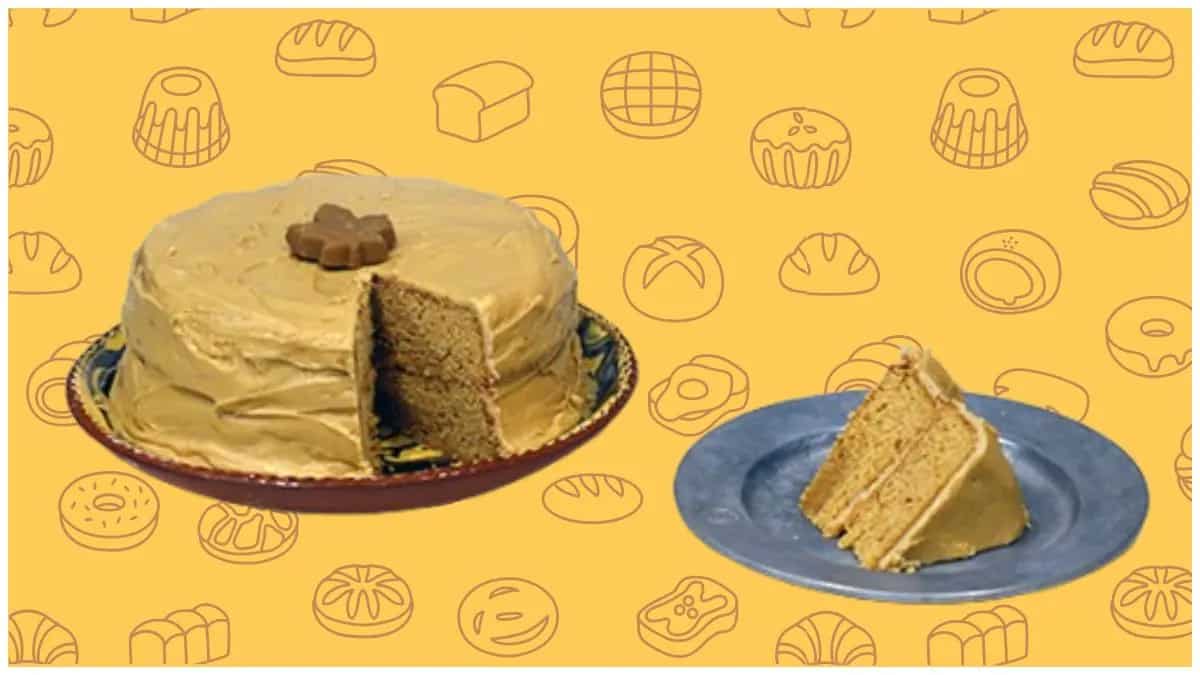
THERE ARE DESSERTS designed for repetition, and others designed for occasion. Burnt Sugar Cake has always belonged to the latter: a cake made slowly, deliberately, and rarely, reserved for moments that justified its risk and effort.
For much of the last half-century, it existed mostly as memory. A smell recalled rather than a recipe followed. A flavour people struggled to name, but never forgot. This year, it has re-entered public view through the work of Sonja Norwood, whose Black History Month video series revisits what she describes as “lost” Black American recipes. One of them is Burnt Sugar Cake — an heirloom dessert she insists must be understood on its own terms.
“If someone makes this cake for you, they love you,” Norwood says. The statement is not sentimental. It is practical.
Not caramel, and not convenient
Burnt Sugar Cake is frequently mistaken for caramel cake. The distinction matters. In most modern caramel cakes, sweetness is concentrated in the icing, while the sponge remains neutral. Burnt Sugar Cake does not separate flavour this way. Its defining ingredient — a burnt sugar syrup — is folded into both batter and frosting, infusing the cake entirely.
The result is darker, more complex, and less immediately sweet. The flavour is often described as smoky, slightly bitter, and balanced, with comparisons drawn to the torched surface of crème brûlée or the depth of dark toffee. Historically, it was understood as something older than caramel cake — its ancestor rather than its variant.
Its colour reinforced that difference. The sponge bakes to a deep amber or brown, earning the cake names like Burnt Leather Cake and Brownstone Front Cake. Bakers were explicit about the syrup’s appearance: it had to reach the colour of old leather. Anything lighter meant it had not gone far enough.
Sugar at the edge of burning
At the centre of the cake is a process that borders on the alchemical. White sugar is melted in a heavy pan until it smokes and darkens, taken to the edge of burning without tipping into bitterness. Boiling water is then added, causing the mixture to hiss and sputter violently before settling into a dark, liquid syrup.
The margin for error is narrow. Undercook it, and the syrup remains simply sweet. Overcook it, and it becomes acrid and unusable. Get it right, and sugar transforms into a flavouring agent that behaves almost like an extract — something historically valuable when vanilla and other flavourings were expensive or unavailable.
The danger is part of the point. Burnt Sugar Cake does not reward haste or approximation.
Born of necessity, kept by skill
The technique behind burnt sugar syrup emerged from resourcefulness. During periods of scarcity — pioneer expansion, economic hardship, the Great Depression — home bakers created flavour where none was readily available. Burning sugar became a way to produce depth without reliance on imported or costly ingredients. In parts of the American West and North, the syrup was even substituted for maple syrup when the real thing could not be sourced.
By the early 20th century, Burnt Sugar Cake was popular enough to appear regularly in print, with recipes circulating as early as the 1910s. Its decline came later, and swiftly. By the 1950s, boxed cake mixes and the standardisation of chocolate and vanilla flavours rendered complex, risky recipes increasingly impractical. The syrup’s volatility alone was enough to deter casual bakers in an age that prized speed and safety.
What disappeared was not just a cake, but a way of cooking that assumed time, confidence, and repetition.
A cake for Sundays and company
Within Black Southern foodways, Burnt Sugar Cake held particular significance. It was not an everyday dessert, but a Sunday cake, a church cake, a company’s-coming cake — made for gatherings that warranted its labour.
Post-emancipation, Black cooks who had long worked with sugar production brought exceptional skill to caramelisation and sugar work. Burnt Sugar Cake emerged from that lineage, carrying technical mastery alongside cultural memory. It was understood as something made for others, not oneself: a marker of care, patience, and occasion.
That context matters when the cake is remembered today. Many people describe it less as a recipe than as a sensation — a smell that filled a kitchen, a flavour associated with a grandparent, a taste difficult to recreate from memory alone. Younger generations often speak of it as “lost”, not because it vanished entirely, but because its exact balance proved hard to recover.
Remembering without simplifying
Norwood’s revival of Burnt Sugar Cake does not attempt to modernise or streamline it. She is explicit about what has been abandoned in the move towards convenience cooking: time, risk, and the knowledge that some foods are meaningful precisely because they are difficult.
In returning to the original method — burnt sugar syrup and all — she frames the cake not as nostalgia, but as inheritance. Burnt Sugar Cake asks something of the baker: attention, restraint, and a willingness to stand over a pan of smoking sugar without flinching.
It is not a cake designed for everyday life. It never was. What its return suggests, quietly, is a renewed interest in foods that carry history not just in their stories, but in their making.