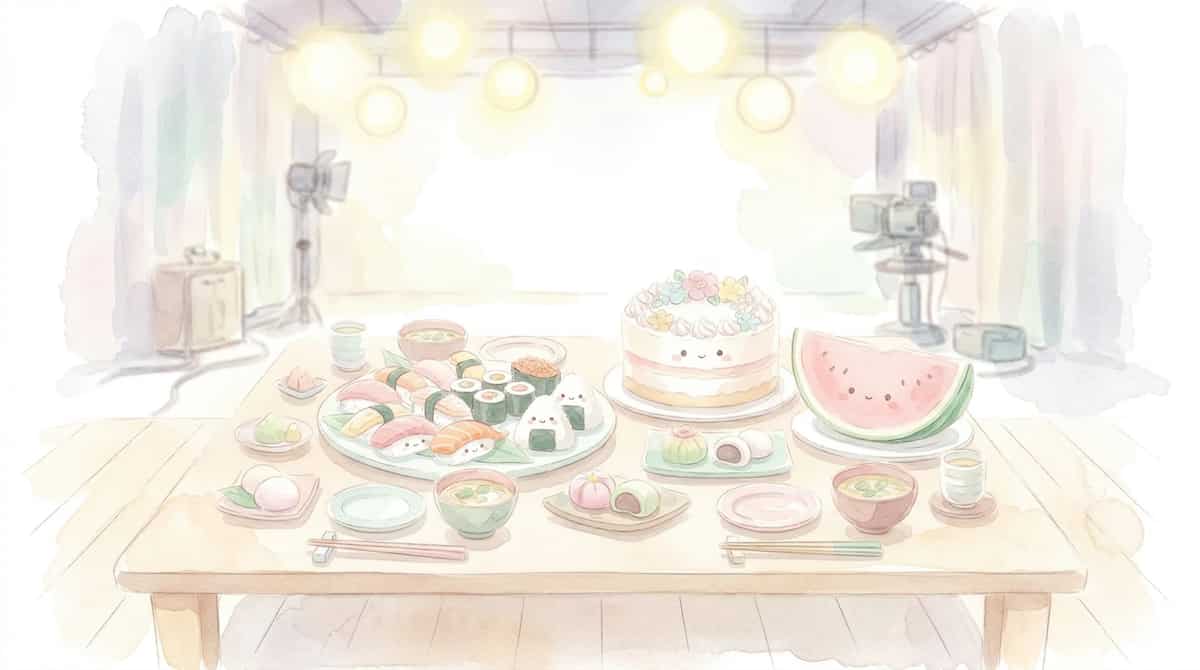
A CAKE is smashed.
A watermelon explodes.
A table of pristine sushi — arranged just so, gleaming under studio lights — is poked, prodded, turned into spectacle.
And then, almost as an afterthought, a caption appears on screen:
“The staff ate it later.”
It’s oddly reassuring. Almost tender. A small act of care after the chaos.
Also — possibly untrue.
In Japanese television, the phrase “この後、スタッフが美味しくいただきました” appears with surprising regularity. More fully translated, it reads: “After this, the staff ate and enjoyed it.” It’s a line that tends to surface in variety shows — those exuberant, often chaotic formats where food is as much prop as it is nourishment.
At first glance, it functions like a disclaimer. A quick, polite assurance that nothing has gone to waste. But over time, it has become something more: a cultural reflex, a ritual of reassurance, a quiet nod to an ethic that runs deep.
Because in Japan, wasting food isn’t merely inefficient — it is faintly tragic.
There is a word for this feeling: mottainai.
Often translated as “what a waste,” mottainai carries a deeper emotional charge — something closer to regret, even reverence. It speaks not just to the act of wasting, but to the loss embedded within it: the labour, the resources, the life that brought the food into being.
A grain of rice is not just a grain of rice. It is time, effort, land, weather, care.
To waste it is, in some small way, to disrespect all of that.
This cultural aversion to waste is not abstract. It is lived, inherited, reinforced across generations — shaped by histories of scarcity and resilience, much like post-war food cultures elsewhere in the world. And when television — a medium built on spectacle — began to treat food with casual disregard, audiences noticed.
They complained.
The caption, it is believed, emerged as a response to exactly this discomfort. According to one widely circulated account, a segment on a popular variety show involved the destruction of small watermelons — an act that triggered a wave of viewer outrage. The following year, the now-familiar line began appearing on screen, a preemptive gesture meant to soothe.
Nothing was wasted, it implied.
Everything was taken care of.
You can relax.
Except, of course, the question lingers: did the staff actually eat it later?
Here, the story becomes less a neat explanation and more a gently chaotic debate.
On one side are those who insist the caption is entirely truthful. Industry insiders have described crews finishing leftover food out of a sense of obligation — towards the restaurant, the chef, and the ingredients themselves. A food comic artist and a television reporter have both publicly affirmed the practice. A former athlete-turned-TV personality once shared photographs of staff members eating after a shoot, offering visual proof of this behind-the-scenes ritual.
On the other side are the sceptics — and they are not subtle.
“Who’s going to enjoy cake they splattered all over the floor?” one famously asked, with devastating simplicity. Others point out that they have never, in all their years in television, seen such a thing happen. There are also the practicalities: food sitting under hot studio lights for hours, stringent safety standards, the not-insignificant detail that some of what looks edible on camera… isn’t. Food stylists, after all, have long relied on non-edible materials to achieve perfection.
Between obligation and absurdity, the truth — like the caption itself — remains somewhat elusive.
But perhaps the more interesting question is not whether the staff ate it, but why we care so much that they might have.
Because what the caption offers is not just information. It offers moral closure.
It allows us to watch excess — food flung, smashed, wasted for entertainment — without carrying the full discomfort of it. It reassures us that, somewhere off-screen, order has been restored. That respect has been paid. That the food, in the end, fulfilled its purpose.
In this sense, the caption functions much like another familiar line from a very different media culture: “No animals were harmed in the making of this film.” Both serve as quiet negotiations between spectacle and ethics, between what we enjoy watching and what we believe is right.
They are less about fact than about feeling.
There is, of course, a certain inconsistency to all this. The same moral scrutiny rarely applies when footage of Spain’s Tomatina festival — where tonnes of tomatoes are gleefully thrown and trampled — is broadcast. Or when athletes spray champagne in victory. Or, closer home, when food becomes content in ways that are extravagant, excessive, engineered for virality.
We draw our lines selectively.
We always have.
Which brings us back to that small, polite sentence.
The staff ate it later.
Did they?
Maybe.
Maybe not.
But the persistence of the phrase suggests something more revealing than its literal truth. It speaks to a quiet, shared need — the desire to believe that food, even when it is treated as spectacle, is ultimately respected. That nothing truly goes to waste. That somewhere, somehow, someone finished what was left behind.
In a world where food is increasingly content, perhaps this is the last comforting fiction we allow ourselves.
And perhaps, in its own way, that matters just as much as the truth.