Indian Ocean And The French Islands
Colombo
Origin
Indentured Tamil and Telugu workers arrived after the French abolished slavery in 1848. About 44,000 came between 1853 and 1883. Finding none of their spices, they rebuilt the blend from what the islands offered: coriander, black pepper, turmeric, mustard, fenugreek and allspice, with raw rice toasted and ground in to thicken the sauce.
Where The Name Comes From
Two rival explanations. Most sources say it is the Tamil kulambu, a spiced gravy eaten with rice, and Guadeloupe’s own tourism board says the word is a distortion of kuzhambu, pronounced something like “koulambou”. The second says it is the port of Colombo in Ceylon, where ships carrying workers stopped.
History Of The Name
Writers on Caribbean food repeat both. One recipe site says the powder is named after Sri Lanka’s capital; another treats the word as a form of kalumbu, a spice blend. The Instagram slide that started this project put it best: the label came from outside the kitchen. Someone heard a Tamil word, bent it and fixed it to a pot they did not cook in.
Cari
Réunion
Origin
Tamil workers came to Réunion in large numbers after slavery ended on 20 December 1848, mostly from the French settlements of Pondicherry and Karaikal. By 1858 about 64,400 Indian labourers were on the island. Today the Malbars, as the Tamil-descended community is called, are about a quarter of the population. Their cari, a Creole curry, is the centre of the Réunion plate: rice, cari, rougail, and a pot of lentils or beans.
Where The Name Comes From
Cari is the Creole spelling of the same word that gave English “curry”: the Tamil kari, a sauce or relish eaten with rice.
History Of The Name
The spelling is French-Creole where the English one is British, and the two travelled by different routes from one Tamil root. In Réunion the word stretches to cover almost any stewed dish: chicken, sausage, goat, even tiny fish called bichiques. The Tamil language itself did not survive five generations on the island. The word did.
Image credit: Wikimedia Commons
Rougail
Réunion and Mauritius
Origin
A spiced relish of tomato, onion, chilli, ginger, garlic and thyme, sometimes with turmeric. It comes as a side sauce (the pilon) or as a main dish (rougail saucisse with sausage). The lineage is mixed: Indian, French and Creole, with Malagasy influence often claimed. It belongs to the same plate as cari and is eaten with it in Réunion and Mauritius.
Where The Name Comes From
Not settled. Dictionary.com records it as first appearing in French in 1955 to 1960 from the creoles of the Indian Ocean, with the further origin undetermined. Réunion’s tourist board traces it through the Creole rougay to a Tamil word for pickle, ū̄rukā̄y. A French reference work glosses rougay as a mixture or condiment.
History Of The Name
A popular folk explanation links the word to the French rougir, to redden, which suits the colour, but is not supported by the dictionaries. The honest summary is that the word is Creole, that it was coined in the kitchens of the sugar islands, and that Tamil may stand behind it.
Image credit: Wikimedia Commons
Dholl Puri
Mauritius
Origin
Brought by Bihari indentured labourers, who arrived from 1834. It is a thin wheat flatbread stuffed with roasted, ground yellow split peas and cooked on a tawa, not deep-fried, then wrapped around butter-bean curry and rougail. A popular story, undocumented, says that under rationing families kneaded dal water into the dough, then began putting crushed dal inside it. Dewa & Sons of Rose Hill began selling it from a bicycle in the 1960s.
Where The Name Comes From
Dholl is the Mauritian spelling of dal, the split peas. Puri is the Hindi word for a fried or griddled bread.
History Of The Name
The odd spelling is Mauritian: dhal, dal, daal and dholl all name the same pulse across the diaspora. The name is a little untrue, because a puri is normally fried and this one is not. In Trinidad and Guyana the same idea appears as dhalpuri roti, a wrap rather than a street snack.
Image credit: Wikimedia Commons
Gateaux Piment
Mauritius and Réunion
Origin
A fried fritter of ground yellow split peas with chilli, coriander and cumin, sold on almost every corner in Mauritius. It descends from the South Indian vadai, brought by indentured workers in the nineteenth century. Mauritians eat it tucked into buttered bread with chilli paste, a combination with its own name, dipain gato pima. Chefs who grew up on it compare it to falafel, with more of a South Indian flavour.
Where The Name Comes From
French and Creole. Gâteaux means cakes and piment means chilli, so it translates as chilli cakes. Creole speakers say gato pima.
History Of The Name
A South Indian fritter given a French name tells you who held the pen. In Réunion the same fritter is called bonbon piment, “chilli sweet”, which is a different French joke about the same thing. The Indian name vada has largely dropped out.
Image credit: Wikimedia Commons
The Caribbean
Doubles
Trinidad
Origin
In 1936 in Princes Town, Emamool Deen and his wife Raheman Rasulan began selling curried chickpeas on a single fried flatbread. Their son Badru says they sold the family’s only goat to buy oil and dried channa, the cheapest ingredients they could find. The bread, bara, spiced with turmeric and cumin, is a relative of the north Indian bhatura. Historians link the dish to chole bhature.
Where The Name Comes From
Customers began asking Deen to double the bara. “Doubles” is simply what he was asked for, one piece above and one below the channa.
History Of The Name
One account dates the word to 1937, a year after the dish. Before that it was channa and bara, at first as fried channa in cone-shaped paper. The Trinidadian spelling, channa with two n’s, is local. Badru Deen, the son, calls the dish “resistance food”.
Buss-Up-Shut
Trinidad
Origin
The Indian paratha, the layered flatbread, came to Trinidad with indentured workers after the 1840s. In Trinidad it is cooked on a tawa and then beaten with two flat wooden spoons until it breaks into soft, torn layers. It is a staple at weddings, poojas and every roti shop.
Where The Name Comes From
The name is the Caribbean pronunciation of “bust-up shirt”. The torn layers look like a ragged garment.
History Of The Name
The Oxford English Dictionary added buss up shut in September 2025, defining it as a flaky fried, unleavened bread similar to paratha or roti. Its entry says the name comes from the resemblance to rags of fabric. The Indian word paratha itself comes from Sanskrit parat, layers, and atta, flour.
Image credit: Wikimedia Commons
Pholourie
Trinidad, Guyana and Suriname
Origin
Golf-ball-sized fritters of wheat flour and ground split peas, spiced and fried, eaten with tamarind or mango chutney. Indian indentured workers brought the recipe and changed it to match local ingredients. It is tied to the Hindu festival of Phagwah, and its best-known tribute is the chutney singer Sundar Popo’s song “Pholourie Bina Chutney Kaise Bani”, which asks how you could make pholourie without chutney.
Where The Name Comes From
The Oxford English Dictionary says it is a borrowing from Indian languages: Hindi phulaurī̄ and Bengali phuluri. The root idea is puffing: the fritter swells as it fries.
History Of The Name
The dictionary’s earliest quotation is a 1936 calypso by Rafael de Leon, which makes it as old as doubles. The word entered the dictionary in September 2025. The spellings vary across the Caribbean: phulourie, phoulourie, pholourie.
Image credit: Wikimedia Commons
Roti: The Wrap
Trinidad, then Guyana, Suriname and Jamaica
Origin
Roti, the flatbread, came with the indentured workers of the 1840s as a side dish. The wrap came later. A San Fernando businessman, named in one account as Sackina Karamath, turned the roti into a wrapper for takeaway curry, in 1937 by one telling and the mid-1940s by another. The idea spread across the Caribbean and out with the diaspora, where the roti shop became an institution.
Where The Name Comes From
Roti is a Hindi word for bread and the Washington Post’s food desk traces it to Sanskrit for the same.
History Of The Name
Words travel with the dish. In East Africa roti and chapati are the same bread. In Trinidad roti means the bread, the wrap and the meal. In Queens, New York, it also names the shop: Singh’s Roti Shop, opened by a Trinidadian family in 1990, is often cited as the first roti shop in Richmond Hill.
Curry Goat
Jamaica, and across the Caribbean
Origin
Indian indentured workers brought curry to the island after emancipation. One account says they sought a substitute for lamb and settled on goat. Jamaica keeps the dish for celebrations. The Indian contribution is the technique of burning the curry, cooking the powder in hot oil until it darkens, followed by Jamaican seasoning: scotch bonnet, thyme, scallion, allspice berries.
Where The Name Comes From
Curry comes from Tamil kari. The word order is a Jamaican preference: Jamaica, Trinidad and Tobago say “curry goat”; Guyana says “goat curry”.
History Of The Name
The dish has a famous name story of its own. The first KFC in Jamaica, in the 1970s, served it. In 2011 a man in Portland, Jamaica walked into a KFC and ordered curry goat and a soda instead of chicken. He was mocked and earned the nickname Mr. Curry Goat. He was not wrong.
Image credit: Wikimedia Commons
Africa
Bunny Chow
Durban, South Africa
Origin
Indentured workers began arriving in Natal in 1860, and Gujarati merchants followed. A quarter loaf of white bread is hollowed out and filled with mutton, chicken or bean curry, topped with carrot, onion and chilli salad. Three origin stories compete: carrying curry out of restaurants that would not serve non-white customers; feeding Indian caddies at the Royal Durban Golf Course; and a café called Kapitan’s. One account names a restaurant owner, R. K. Vaid. None is documented.
Where The Name Comes From
“Bunny” is generally said to come from bania, the Gujarati merchant caste that ran Durban’s eateries. “Chow” is slang for food. A linguist at the University of Cape Town has noted that the word has nothing to do with rabbits.
History Of The Name
The size words follow the same trail: kota, the ordinary term for a quarter loaf, is a corruption of quarter. Bunny chow was recorded as a Durban staple by the 1940s. The same linguist has pointed out that Indian communities outside South Africa barely know the dish.
Image credit: Wikimedia Commons
Gatsby
Cape Town, South Africa
Origin
In 1976 Rashaad Pandy, who ran a fish-and-chips shop called Super Fisheries in Athlone, had day labourers to feed and had run out of fish. He took a long roll and filled it with polony, slap chips and achar, an Indian pickle, then cut it in four. Pandy is of Indian descent, and had been forced by apartheid’s group area removals to move from the town where he was born. The sandwich is a Cape Flats institution.
Where The Name Comes From
A labourer called Froggie, who had seen the film The Great Gatsby at the Athlone cinema, called it “a Gatsby smash”. Smash was local slang for a tasty dish.
History Of The Name
The name is the film, which was released in 1974, and not the novel. An early story says the first loaf was shaped like the newsboy cap Robert Redford wears in the movie. Pandy had no idea it would take off. Achar, from the Persian-Hindi word for pickle, is the one ingredient in the sandwich that carries an Indian word.
Chapati
Kenya and East Africa
Origin
About 32,000 Indian workers, mostly from Punjab and Gujarat, built the Uganda Railway from 1896. They brought the unleavened flatbread. Kenyans now roll theirs softer and more layered than the Indian original, with oil and a coil of dough, and serve it at Sunday lunches, holidays and when a guest arrives. Ugali is the everyday staple. Chapati is for celebration.
Where The Name Comes From
Hindi capā̄tī̄. One account of the word says it describes the way the dough is shaped, slapped back and forth between the hands.
History Of The Name
The word was borrowed into Swahili and into Mauritian Creole. In East Africa chapati and roti are the same thing. Kenyans consider the bread fully Kenyan, and the people who brought it paid for it: 2,498 died building the railway.
Malaya And Singapore
Nasi Kandar
Penang, Malaysia
Origin
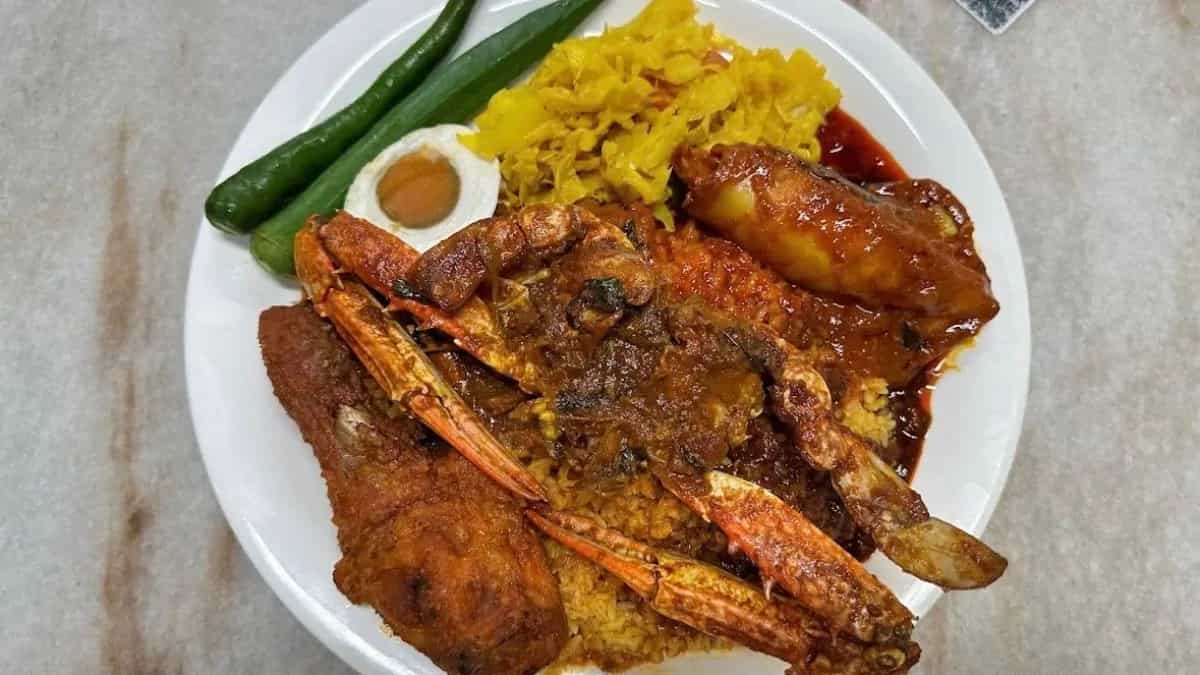
Tamil Muslim traders sold rice and curry to dock workers at Weld Quay in George Town, carrying the food in containers hung from a shoulder pole. They were free traders, not indentured, but they fed a workforce built by the same colonial economy. Hameediyah, Penang’s oldest nasi kandar restaurant, began in 1907 under a tree on Lebuh Campbell. The rice is flooded with several curries at once.
Where The Name Comes From
Nasi is Malay for rice. Kandar is the shoulder pole, from the Malay verb mengandar, to carry on the shoulders. A second theory points to the Urdu or Hindi kandha, shoulder.
History Of The Name
The name is probably a portmanteau of a Malay word and an Indian one that describe the same pole. Kandar was first the name of the pole. Today it names the dish, the restaurants and a whole style. Vendors moved indoors in the 1970s, and nobody carries the pole any more.
Image credit: Wikimedia Commons
Roti Canai
Malaysia, and roti prata in Singapore
Origin
Brought by Indian Muslims from Tamil Nadu, many of them with Malabar connections, who came to Malaya in the colonial period. By the 1920s roti canai with dal or curry was a meal sold at Indian Muslim stalls across the country. It is a layered, ghee-brushed flatbread, flipped and stretched to order.
Where The Name Comes From
Roti is the bread. Canai is contested. The more likely reading is a Malay word for rolling out dough. Less likely theories point to the Indian city of Chennai, formerly Madras, from which many workers came, or to the Hindi chana, chickpeas, since it is often eaten with chickpea or dal curry.
History Of The Name
In Singapore the dish is roti prata, from the paratha of north India, itself from Sanskrit parat (layers) and atta (flour). The Michelin Guide’s writer on the subject cites a researcher who says the veechu parotta style common in Malaysia and Singapore may originate in Jaffna, Sri Lanka. Malaysia nominated roti canai for UN intangible heritage recognition in 2024.
Image credit: Wikimedia Commons
Teh Tarik
Malaysia and Singapore
Origin
Indian Muslim immigrants ran drink stalls at the gates of rubber estates, serving masala tea to workers, by the 1870s according to the Singapore government. After the Second World War, the vendors turned to cheap, bitter tea dust and added condensed milk to mask it. The result, poured between two vessels at arm’s length to cool and froth it, became Malaysia’s national drink.
Where The Name Comes From
Malay: teh is tea and tarik is pulled. It is named for the pouring.
History Of The Name
Stalls like these are called mamak stalls. Mamak, or mama, comes from the Tamil word for uncle. Singapore and Malaysia, which separated in 1965, both claim the drink. Malaysia nominated it for UN heritage recognition in 2024 along with nasi lemak and roti canai.
Image credit: Wikimedia Commons
Fish Head Curry
Singapore
Origin
In 1949 M. J. Gomez, a Malayali from Kerala, opened a restaurant on Sophia Road. His Chinese customers prized fish heads, though Malayali cooking does not usually serve the head, so he stewed one in a Kerala-style curry of mustard seed, fenugreek, curry leaf and tamarind, with coconut, okra, tomato and aubergine. He was a free immigrant, not indentured.
Where The Name Comes From
Literal. A red snapper head cooked in curry.
History Of The Name
The name has been argued over. Malaysians dispute Singapore’s claim. Singapore’s heritage agency credits Gomez and documents Malayali, Goan, Chettinad and Chinese versions. After he retired to Kerala, his son says, he never knew how famous the dish had become.
Image credit: Wikimedia Commons
Two Words That Conquered The World
Curry
The word, from Tamil Nadu
Origin
Not a dish but a name, and the most successful Tamil export in history. The Tamil kari meant a sauce or relish eaten with rice. British traders and cooks took the word, and curry powder, a premixed European blend, became the shortcut for producing the flavour without mastering the spices.
Where The Name Comes From
From Tamil kari, a sauce.
History Of The Name
The word came into European languages through the Portuguese and then English. It then returned to the indentured. In British Guiana the ration scale for Indian labourers included rice, lentils, coconut oil, sugar, salt and curry powder, a premixed European blend that Indian cooks would not have used at home. A word taken from them came back as a ration.
Mulligatawny
Madras, India, and then Britain
Origin
Anglo-Indian. Indian cooks working in the houses of East India Company officials in Madras in the eighteenth century adapted pepper water, a thin peppery broth like rasam, to British tastes with rice, chicken, lentils and sometimes apple. Retired Company merchants made it fashionable in England in the early nineteenth century.
Where The Name Comes From
From the Tamil milagu (pepper) and tannir (water): pepper water. A second account derives it from an Ayurvedic preparation called mollo tunny.
Image credit: Wikimedia Commons
History Of The Name
Madras civil servants were nicknamed “Mull” after the soup, according to the nineteenth-century glossary Hobson-Jobson. The Anglo-Indian cookery writer who published as Wyvern complained that a really well-made mulligatawny was a thing of the past. The original pepper water was a poor person’s digestive eaten with boiled rice. The Tamil word became the name of a soup that few Tamils recognise.